
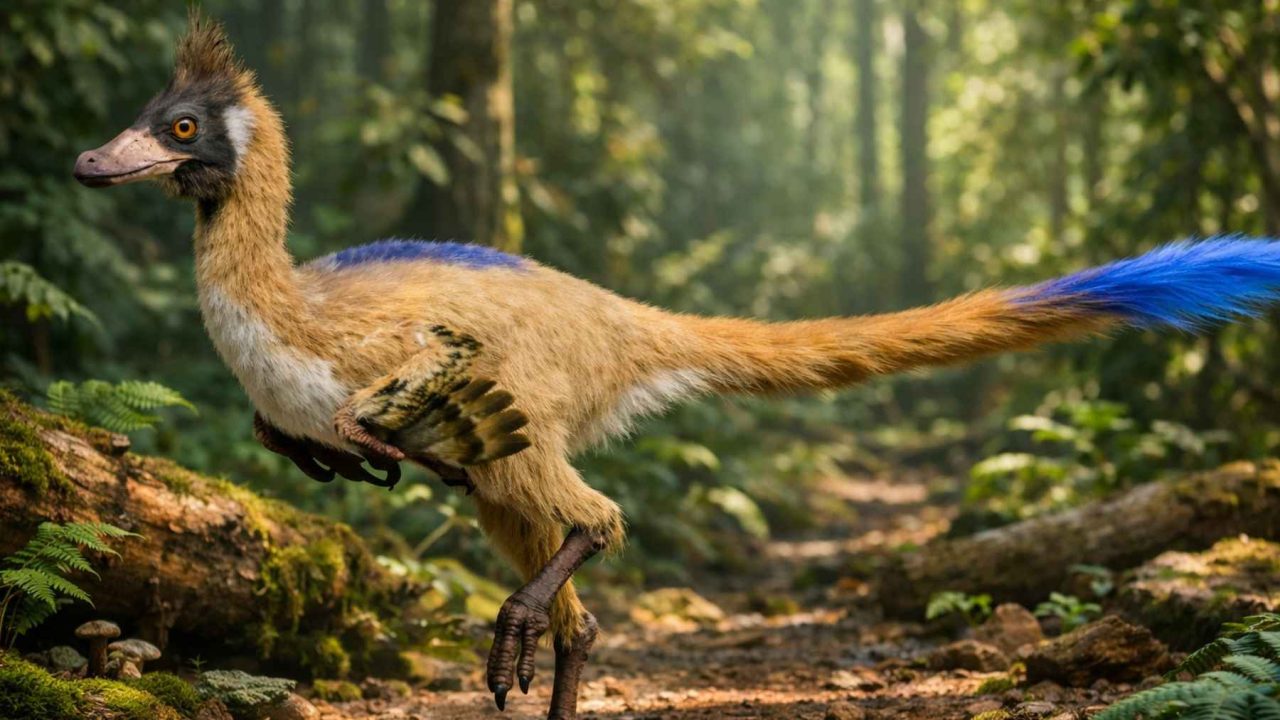
A dinosaur the size of a crow, weighing less than two pounds, lived and died in what is now Argentina roughly 90 million years ago — and the nearly complete skeleton it left behind may finally settle one of paleontology’s longest-running arguments.
The fossil belongs to Alnashetri cerropoliciensis, a small theropod dinosaur from a mysterious group called alvarezsaurs. For decades, scientists have debated where these animals fit on the dinosaur family tree and how they managed to spread across the globe. This specimen, researchers say, offers the clearest picture yet of both questions.
It is also, notably, one of the smallest dinosaurs ever recovered from South America — a fact that makes its near-perfect preservation all the more remarkable.
What Makes Alvarezsaurs So Puzzling
Alvarezsaurs were strange creatures by any measure. They belonged to the theropod lineage — the same broad group that includes Tyrannosaurus rex and modern birds — but their bodies took a distinctly unusual path. Small, lightly built, and equipped with odd limb proportions, they have long frustrated researchers trying to pin down their evolutionary relationships.
Part of the problem is the fossil record itself. Small dinosaurs are notoriously difficult to find in good condition. Delicate bones don’t preserve well, and when fragments do survive, they rarely give scientists enough information to draw firm conclusions. Most of what was previously known about alvarezsaurs came from incomplete or scattered remains, leaving major gaps in the understanding of how they evolved and where they originated.
That is precisely why the Alnashetri skeleton is generating so much attention. A near-complete skeleton from this group — especially one this old — is genuinely rare.
The Fossil That Researchers Are Calling a “Paleontological Rosetta Stone”
The skeleton was first uncovered in 2014 at La Buitrera, a fossil-rich site in northern Patagonia, Argentina. It was later studied by an international research team co-led by the University of Minnesota Twin Cities.
Bone analysis revealed that the animal was an adult approximately four years old at the time of its death. It weighed less than 2.2 pounds — lighter than most house cats — and was roughly comparable in size to a modern crow.
Lead author Peter Makovicky described the leap from scattered fragments to a near-complete skeleton as finding a “paleontological Rosetta Stone.” That comparison carries real weight in this context. Just as the original Rosetta Stone unlocked an entire language that had been unreadable, this skeleton is providing researchers with anatomical detail that previous alvarezsaur fossils simply could not offer.
The team also confirmed that more fossils from the same La Buitrera site are already being prepared for study, suggesting this may be the beginning of a larger wave of discoveries from the region.
Key Facts About Alnashetri cerropoliciensis
| Feature | Detail |
|---|---|
| Species name | Alnashetri cerropoliciensis |
| Age of fossil | Approximately 90 million years old |
| Discovery site | La Buitrera, northern Patagonia, Argentina |
| Year of discovery | 2014 |
| Estimated body weight | Less than 2.2 pounds |
| Approximate size | Comparable to a modern crow |
| Age at death (estimated) | Approximately 4 years old (adult) |
| Dinosaur group | Alvarezsaurs (theropod family) |
| Research institution | University of Minnesota Twin Cities (co-led) |
| Lead author | Peter Makovicky |
- Alnashetri is described as a “missing link” in alvarezsaur evolution
- It is one of the smallest dinosaurs ever found in South America
- The skeleton is described as near-complete, which is exceptionally rare for animals this small
- Additional fossils from the same site are currently being prepared for analysis
Why This Discovery Matters Beyond the Fossil Itself
The significance here goes well beyond one small skeleton from Patagonia. Alvarezsaurs have been found on multiple continents, and the question of how a group of small, specialized dinosaurs managed to spread so widely — and when — has been a source of genuine scientific disagreement for years.
Researchers describe Alnashetri as a “missing link” that helps explain both how these animals evolved their distinctive body shapes and how they came to be distributed across such a vast geographic range. A fossil this complete, from a time period this early, gives scientists something they rarely get: a firm anchor point in the evolutionary timeline.
It also reinforces the importance of South America as a key region for understanding dinosaur evolution more broadly. Patagonia in particular has produced some of the most significant dinosaur discoveries of the past several decades, and La Buitrera appears to be emerging as one of its most productive sites.
What Comes Next for This Research
The team studying Alnashetri has indicated that additional fossils from La Buitrera are already in the preparation phase. That means further analysis and potentially new species or specimens that could add more detail to the picture this skeleton has begun to reveal.
Whether those fossils will confirm the current interpretation of Alnashetri as a pivotal evolutionary link — or complicate it — remains to be seen. That is, of course, how science works. But for now, researchers have something they have been missing for a long time: a nearly complete window into a chapter of dinosaur history that was previously blurry at best.
For a creature that weighed less than a bag of sugar, Alnashetri cerropoliciensis is carrying a remarkable amount of scientific weight.
Frequently Asked Questions
What is Alnashetri cerropoliciensis?
It is a small alvarezsaur dinosaur that lived approximately 90 million years ago in what is now northern Patagonia, Argentina. It weighed less than 2.2 pounds and was roughly the size of a modern crow.
Why is this fossil considered so significant?
The skeleton is described as near-complete, which is extremely rare for small dinosaurs. Researchers say it acts as a “missing link” that helps explain how alvarezsaurs evolved and spread across the globe.
Where was the fossil found?
It was discovered in 2014 at La Buitrera, a fossil-rich site in northern Patagonia, Argentina.
Who led the research on this fossil?
The study was co-led by the University of Minnesota Twin Cities, with Peter Makovicky named as lead author.
How old was the dinosaur when it died?
Bone analysis suggests the animal was an adult approximately four years old at the time of its death.
Will there be more discoveries from the same site?
Yes. The research team has confirmed that additional fossils from La Buitrera are already being prepared for study, suggesting further findings are expected.


Leave a Reply