
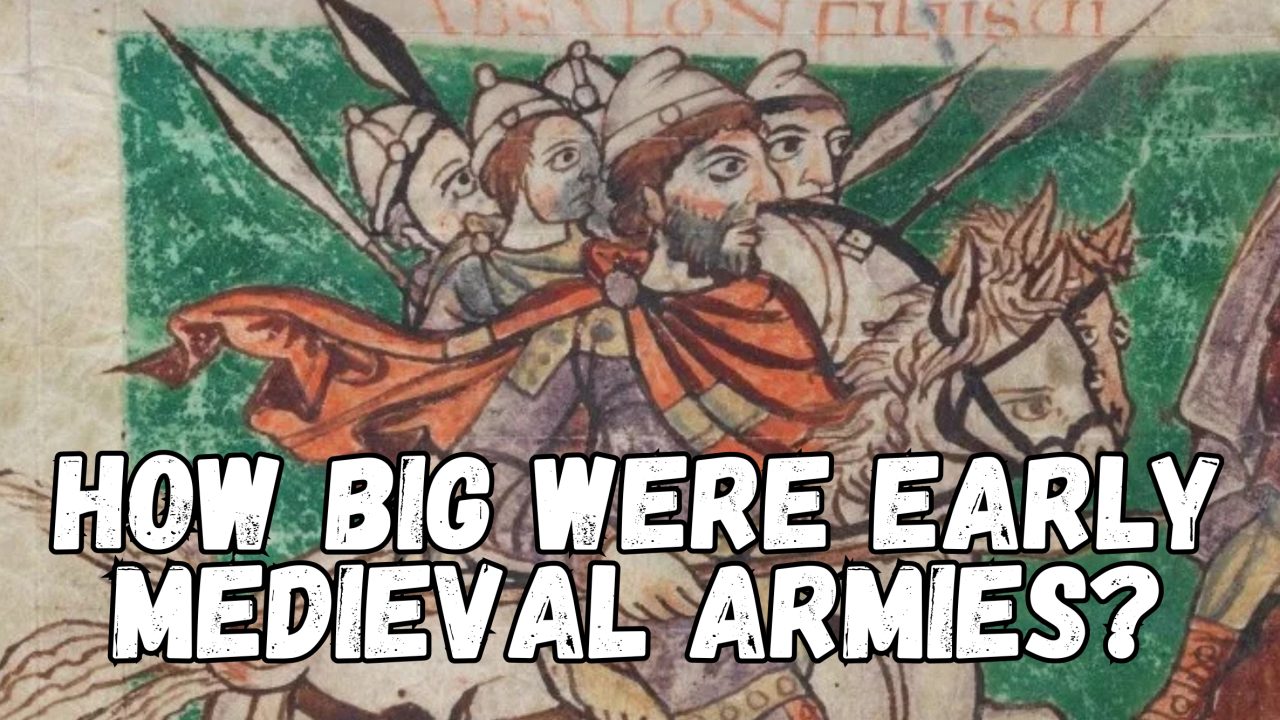
How large were the armies that fought across Europe after the fall of Rome? It sounds like a simple question — but for more than a century, it has divided historians into two fiercely opposed camps, sparked accusations of poor scholarship, and forced a fundamental rethinking of what the so-called “Dark Ages” actually looked like on the battlefield.
The debate over early medieval army size is not just an academic curiosity. It cuts to the heart of how we understand an entire era of history — whether the rulers who inherited Rome’s former provinces were capable administrators building real military institutions, or little more than warlords commanding small bands of armed followers.
According to historian David Bachrach, writing for Medievalists.net, this question may be the most contentious topic in all of early medieval military history — more polemic, more contested, and more consequential than almost any other debate in the field.
The “Dark Ages” Model and Why It Still Shapes the Debate
For well over a century, a significant school of thought has held that the so-called “barbarian” successor regimes — the kingdoms that replaced Roman imperial authority across Western Europe — were fundamentally incapable of maintaining late Roman institutions. That incapacity, the argument goes, extended directly to military organization.
If Rome had built professional armies, complex logistics networks, and sophisticated military science, then the kingdoms that followed simply could not replicate them. Under this model, early medieval armies were small, poorly organized, and strategically limited — warbands rather than armies in any meaningful sense.
This view has deep roots. Bachrach identifies the German military historian Hans Delbrück as one of its earliest and most influential advocates. In the third volume of his massive History of War, published in 1907, Delbrück argued that early medieval Europe was an era without military science — specifically, an era without effective foot soldiers or the logistical capacity to sustain large-scale campaigns.
Delbrück was not simply speculating. He was the originator of a method called Sachkritik — a German term meaning, roughly, the study of material constraints on warfare. The idea was that you could evaluate historical claims about army sizes by testing them against physical reality: How much food would that many soldiers need? How wide would the roads have to be? How many horses could actually be fed in a given region?
Using this approach, Delbrück systematically collected data on large army figures reported in early medieval sources — and concluded that most of them were wildly exaggerated, or simply impossible.
What the Small-Army Argument Actually Claims
The small-size school of thought rests on several interlocking claims. Stripped down, its core arguments look something like this:
- Early medieval rulers lacked the administrative infrastructure to raise and supply large armies
- The collapse of Roman institutions meant the loss of professional military organization
- Logistical constraints — food, transport, equipment — made large-scale campaigns physically impossible
- Contemporary sources that report large numbers are unreliable and prone to exaggeration
- Effective infantry forces, a hallmark of Roman military power, had effectively disappeared
For Delbrück and those who followed his lead, this was not a cultural judgment so much as a practical one. The material conditions simply did not exist to support large armies — and therefore, large armies did not exist.
The Scholars Who Pushed Back
Not everyone accepted this picture. A competing school of thought has argued that the “Dark Ages” framing fundamentally distorts our understanding of early medieval governance and warfare. These scholars contend that the successor kingdoms were not simply Rome in ruins — they were functional political entities capable of developing their own military institutions, even if those institutions looked different from what came before.
Under this view, dismissing all large-number claims in early medieval sources as exaggeration is itself a form of bias. The debate, as Bachrach frames it, is not simply about numbers — it is about whether we are willing to take early medieval rulers seriously as administrators and military organizers.
The argument has real stakes. How historians answer the army-size question shapes how they interpret everything from the nature of early medieval kingship to the causes of major conflicts, the organization of taxation, and the capacity of post-Roman states to project power across large territories.
Why This Question Is Harder to Answer Than It Looks
| Factor | Small-Army Argument | Large-Army Argument |
|---|---|---|
| Source reliability | Contemporary figures are exaggerated | Sources should not be dismissed wholesale |
| Logistics | Post-Roman collapse made large supply chains impossible | Successor kingdoms developed their own logistical capacity |
| Infantry | Effective foot soldiers had largely disappeared | Infantry remained a viable part of early medieval forces |
| Institutional continuity | Roman military institutions were not preserved | New institutions replaced or adapted Roman ones |
| Interpretive framework | “Dark Ages” model of decline and fragmentation | Post-Roman kingdoms as capable political entities |
The methodology Delbrück pioneered — Sachkritik — remains genuinely useful. Testing historical claims against material reality is sound practice. The problem, critics argue, is that it can become a tool for dismissal rather than analysis if the baseline assumptions about early medieval capacity are themselves flawed.
What This Debate Means for How We Think About the Middle Ages
At its core, the argument about early medieval army size is an argument about historical imagination. Were the centuries after Rome’s fall a period of collapse and simplification — or a period of transformation and adaptation, in which new political and military forms emerged from the wreckage of the old?
The answer shapes not just military history but our broader picture of early medieval society. Large armies require taxation, administration, supply networks, and political authority capable of compelling service. If early medieval rulers could field substantial forces, they were doing something far more sophisticated than the “Dark Ages” label implies.
Bachrach’s examination of this debate makes clear that the question remains genuinely unresolved — and that the intensity of the argument itself reflects how much is at stake in the answer.
Frequently Asked Questions
Who was Hans Delbrück and why does he matter to this debate?
Hans Delbrück was a German military historian who, in his 1907 work History of War, argued that early medieval Europe lacked military science — including effective infantry and logistics — making large armies impossible. He is considered one of the earliest and most influential advocates for the small-army interpretation.
What is Sachkritik?
Sachkritik is a method originated by Delbrück that tests historical claims about warfare against material constraints — such as food supply, road capacity, and equipment — to assess whether reported army sizes were physically plausible.
What is the main argument against the small-army theory?
Critics argue that dismissing large-number claims in early medieval sources reflects a biased “Dark Ages” framework, and that successor kingdoms were capable of developing their own military institutions even without direct continuity from Rome.
Does this debate have a settled answer?
According to Bachrach, the debate remains highly contested and unresolved, with scholars on both sides continuing to argue over sources, methodology, and interpretation.
Why does army size matter beyond military history?
The size of early medieval armies has direct implications for understanding taxation, administration, and political authority in post-Roman kingdoms — making it a question that touches the entire structure of early medieval society.
What time period does “early medieval” refer to in this context?

Leave a Reply