
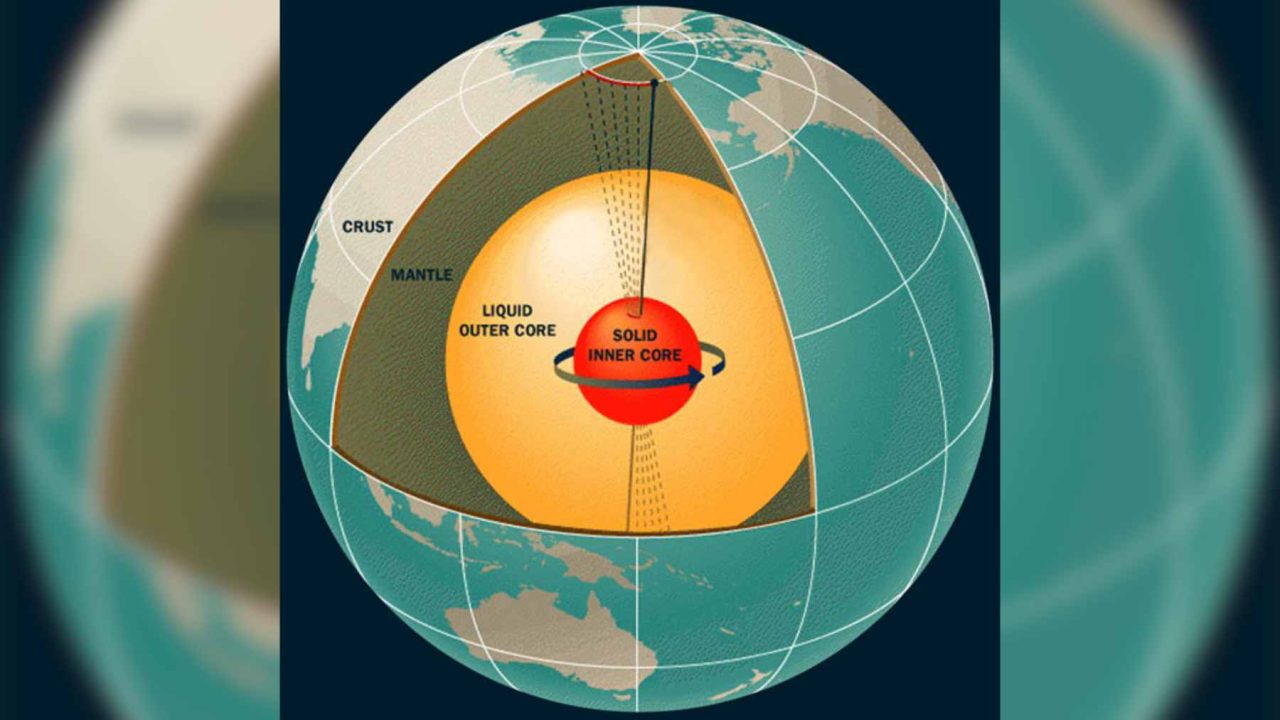
More than 99.999% of Earth’s gold, platinum, and other precious metals are thought to be locked inside the planet’s metallic core — roughly three thousand kilometers below our feet, far beyond any drill or mining operation ever conceived. For most of scientific history, that was considered a permanent arrangement. The core was a vault, and it was sealed.
New research suggests that picture is wrong. A study led by geochemist Nils Messling at the University of Göttingen has found chemical evidence that precious metals are slowly leaking out of Earth’s core and migrating upward into the rock above. The evidence came from an unlikely messenger: lava flowing out of Hawaiian volcanoes.
The findings don’t point to a sudden windfall or an accessible treasure. But they do force a fundamental rethink of how Earth’s deep interior works — and what that means for volcanoes, mineral deposits, and the planet’s long-term geology.
What Scientists Actually Found in Hawaiian Lava
The research focused on a specific class of volcanic rock known as ocean island basalts, the type produced by the volcanoes of Hawaii. These lavas are known to draw material from unusually deep within the Earth, making them a natural window into processes that happen far below the surface.
Using ultra-sensitive instruments, Messling and his team measured tiny variations in isotopes of two elements found within these lavas: ruthenium, a precious metal in the platinum group, and tungsten, a dense metallic element. Both are what geologists call “iron-loving” elements — meaning they have a strong chemical affinity for iron and, under the conditions of early Earth, would have sunk deep into the planet’s iron-rich core when the planet was still forming.
The isotopic fingerprints the team detected in the Hawaiian lava didn’t match what you’d expect from the rocky mantle alone. Instead, they carried a signature consistent with material originating from the core itself. The conclusion: precious metals from deep inside the Earth are leaking upward, carried by plumes of superheated rock rising through the mantle and eventually erupting at the surface.
Why the Earth’s Core Was Supposed to Stay Locked
The standard geological model held that the core and the mantle — the thick layer of rock sitting above it — were essentially separate systems. The boundary between them sits roughly 2,900 kilometers down, and for decades most scientists assumed very little material crossed it in either direction.
The logic made sense. Iron-loving elements like gold, platinum, and ruthenium bonded preferentially with iron during Earth’s formation about 4.5 billion years ago. As the planet differentiated into layers, these metals sank with the iron to form the core. The rocky mantle above was left relatively depleted of them.
That’s why the new findings carry weight. If isotopic signatures from the core are turning up in surface lavas, something is transporting core material upward — and has been doing so on a timescale long enough to leave a measurable chemical trace in modern volcanic rock.
Key Facts About the Discovery
| Detail | What the Research Shows |
|---|---|
| Lead researcher | Nils Messling, University of Göttingen |
| Sample source | Ocean island basalts from Hawaiian volcanoes |
| Key isotopes measured | Ruthenium and tungsten |
| Metals thought to be leaking | Gold, platinum, and other iron-loving elements |
| Estimated metals in Earth’s core | More than 99.999% of the planet’s total store |
| Core depth | Approximately 3,000 kilometers below the surface |
| Estimated gold leaking toward surface | Around 1,000 tons, on planetary timescales |
- The leak operates on planetary timescales — not years or centuries, but geological ages
- Hawaiian volcanoes were chosen because ocean island basalts are known to tap unusually deep mantle sources
- The isotopic method used is described as ultra-precise, detecting variations far too small for older instruments
- Gold and platinum are among the metals implicated, alongside ruthenium and other platinum-group elements
What This Means — and What It Doesn’t
The headline number — roughly 1,000 tons of ancient gold leaking from the core — sounds extraordinary. And in a scientific sense, it is. But it’s worth being clear about what that figure actually represents.
This is not gold pooling somewhere accessible. The process described operates across timescales that dwarf human civilization. Material rising from the core-mantle boundary travels through thousands of kilometers of rock before it ever approaches the surface, and most of it never makes it that far in any concentrated form.
What the discovery does change is the theoretical framework geologists use to understand where surface mineral deposits come from. If precious metals have been leaking upward from the core over billions of years, that process may have contributed — however gradually — to the distribution of gold and platinum found in the crust today. It also adds a new dimension to how scientists model the deep mantle plumes that feed hotspot volcanoes like those in Hawaii.
The finding also has implications for how we understand Earth as a dynamic system. The core was not simply a passive remnant of planetary formation. It appears to be an active participant in the slow chemical exchange that shapes the planet’s surface geology over billions of years.
What Researchers Will Be Looking at Next
The use of isotopic fingerprinting in volcanic rock opens a broader set of questions. If Hawaiian lavas carry core signatures, researchers will likely examine whether similar signals appear in other hotspot volcanic systems around the world — places like Iceland, the Galápagos, or the volcanic islands of the South Pacific, all of which are fed by deep mantle plumes.
Refining the estimates of how much material crosses the core-mantle boundary, and at what rate, will require more data. The ultra-sensitive instruments used in this study represent a relatively recent advance, and applying them to a wider range of samples could either strengthen or complicate the current picture.
For now, the study stands as a significant challenge to a long-held assumption — that what went into Earth’s core four and a half billion years ago stayed there. The vault, it turns out, has always had a slow leak.
Frequently Asked Questions
Who led the research into Earth’s core leaking precious metals?
The study was led by geochemist Nils Messling at the University of Göttingen, using isotopic analysis of volcanic rock samples from Hawaii.
How did scientists detect gold leaking from the core?
The team used ultra-sensitive instruments to measure tiny isotopic variations in ruthenium and tungsten found in Hawaiian lava, identifying chemical signatures consistent with core material.
Does this mean gold from the core is accessible to mine?
No. The process operates on planetary timescales and involves material traveling through thousands of kilometers of rock. There is no realistic path to accessing this gold through mining.
How much gold is estimated to be leaking from the core?
The research points to approximately 1,000 tons of ancient gold migrating upward from the core, though this occurs over vast geological timeframes rather than human-scale time.
Why were Hawaiian volcanoes used for this research?
Hawaiian volcanoes produce ocean island basalts, a type of lava known to draw material from unusually deep within the Earth, making them a reliable window into deep mantle and potentially core processes.
Does this change how scientists understand Earth’s mineral deposits?
Potentially, yes. If precious metals have been leaking upward from the core over billions of years, that process may have contributed to the distribution of gold and platinum found in Earth’s crust today.

Leave a Reply