
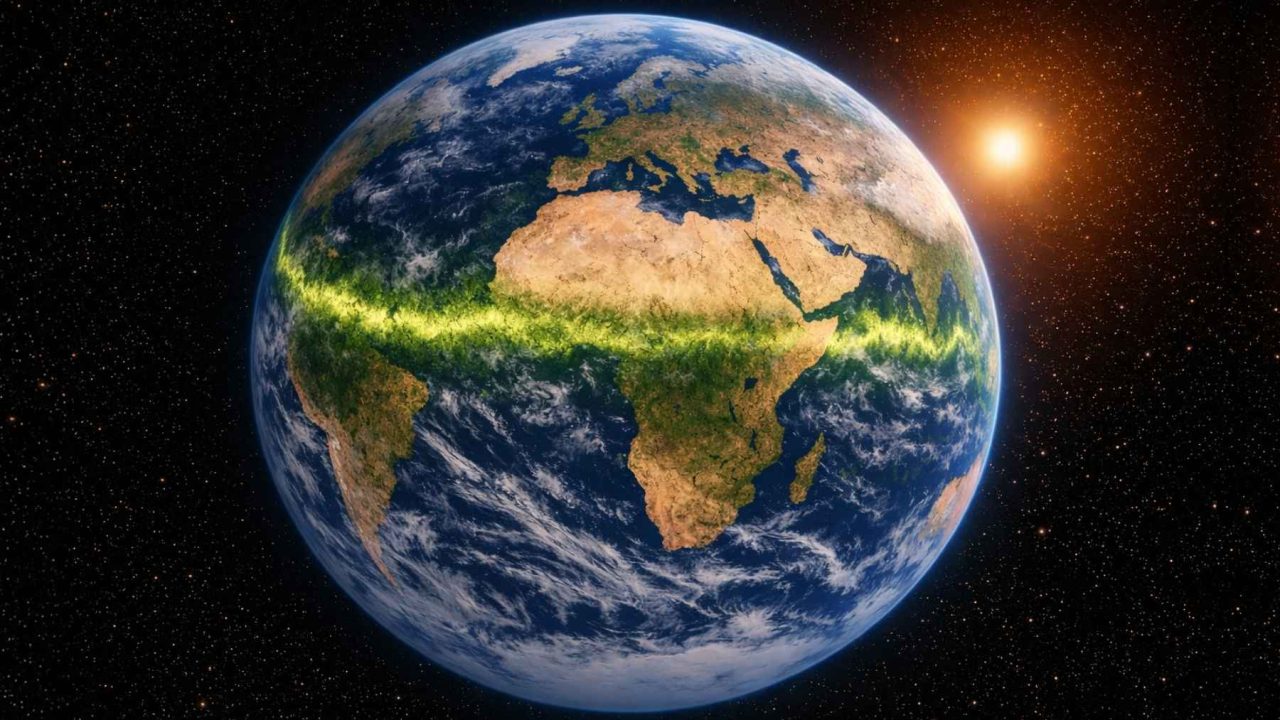
Earth’s green center of mass has been quietly drifting toward the northeast for decades — and since 2010, that drift has accelerated to a pace that has surprised the scientists tracking it. According to a new international study, the northward component of this shift reached roughly 8.7 miles per year (14.0 kilometers per year) during the 2010s, a rate far beyond what earlier decades recorded.
This isn’t a metaphor or a modeling exercise. Researchers measured it directly, reducing the entire complexity of global vegetation into a single moving point and then watching where it goes. What they found tells a story about how rising CO2 levels and a warming climate are quietly reshaping the living skin of this planet.
Most people have never heard of a vegetation center of mass. By the time this research filters into the broader conversation about climate change, it deserves far more attention than it’s likely to get.
What Earth’s “Green Pole” Actually Is
The concept behind this research is elegant in its simplicity. First author Miguel D. Mahecha describes it this way: imagine holding a perfectly round globe and attaching tiny weights around it that represent green leaves — every forest, every grassland, every crop field, every patch of tundra that turns green in summer.
The point where that weighted globe would perfectly balance is what the research team calls the vegetation center of mass. Think of it as Earth’s “green pole” — a single coordinate that summarizes where the planet’s plant life is concentrated at any given moment.
By tracking how that point moves over time, the researchers created what Mahecha describes as a kind of biosphere compass. And that compass has been pointing steadily toward the northeast.
The shift isn’t random. It reflects something real happening at the ecosystem level — forests thickening in northern latitudes, vegetation spreading into areas that were once too cold or too dry, and the seasonal rhythms of plant life changing in ways that tip the global balance in one direction.
How Fast the Green Pole Is Shifting — and Why 2010 Matters
The study draws a clear before-and-after line around 2010. Before that year, the drift existed but moved at a pace that, while notable, didn’t set off alarms. After 2010, something changed. The acceleration in the northward drift became pronounced enough that the researchers flagged it explicitly.
The data comes from long-running leaf area records — satellite measurements that track how much green leaf surface exists across the planet at different times of year. Those records show the shift most dramatically during what researchers call the austral peak, the point in the year when vegetation in the Southern Hemisphere reaches its seasonal maximum.
| Time Period | Northward Drift Rate | Notable Trend |
|---|---|---|
| Pre-2010 decades | Slower, baseline rate | Gradual, consistent drift |
| 2010s (post-acceleration) | ~8.7 miles/year (14.0 km/year) | Far faster than earlier decades |
The direction is also specific: northeastward, not simply north. That diagonal points toward regions where warming has been most pronounced and where vegetation has been expanding most aggressively — parts of the northern boreal zone and high-latitude areas of the Northern Hemisphere.
What This Tells Us About Ecosystems Under Pressure
The research team’s interpretation is that global ecosystems are reorganizing. This isn’t just about plants growing a little more in one place. It’s about the overall distribution of life on land shifting in a measurable, directional way in response to two major forces: rising atmospheric CO2 and a warming climate.
Higher CO2 concentrations can act as a fertilizer for some plants, encouraging more leaf growth in areas that were previously marginal. Warmer temperatures push the viable growing season further north and to higher elevations. Together, these forces tilt the balance of where green mass accumulates on the planet.
The fact that the shift accelerated around 2010 — rather than maintaining a steady pace — suggests the relationship between climate forcing and vegetation response isn’t linear. Something about the cumulative changes in the climate system may have crossed a threshold that pushed ecosystems into a faster mode of reorganization.
This matters beyond academic interest. How and where vegetation grows affects carbon storage, water cycles, regional weather patterns, and the habitats that countless species depend on. A shifting green pole is not just a data point — it’s a signal that the biosphere is responding dynamically to human-driven changes in ways that compound over time.
The Method Behind the Finding
One of the more interesting aspects of this study is the methodological choice the team made. Rather than trying to map every forest and grassland individually, they compressed the problem into a single moving coordinate.
This approach — reducing global vegetation to one balance point — allowed them to detect large-scale directional trends that might be invisible when looking at any one region in isolation. A forest growing denser in Siberia and a savanna greening in West Africa both contribute to the position of that balance point, even if neither change alone would look dramatic on a regional map.
The use of multiple long-running leaf area datasets gave the team confidence that the trend they observed was real and not an artifact of any single measurement system. The consistency of the northeastward drift across records strengthens the finding considerably.
What Researchers and the Scientific Community Are Watching Now
The acceleration observed after 2010 raises an obvious question: has the pace continued into the early 2020s, or has the rate leveled off?
What the study does establish is that the biosphere compass is moving, that it has been moving for decades, and that its speed increased significantly in a way that was not anticipated. For scientists trying to model how Earth’s ecosystems will respond to continued warming, this is a benchmark finding — evidence that the planet’s vegetation is not a passive backdrop to climate change, but an active and accelerating participant in it.
Whether policymakers, conservationists, and land managers will incorporate a shifting green pole into their long-term planning remains to be seen. But the signal is now on the record, and it’s pointing northeast.
Frequently Asked Questions
What is Earth’s “green pole”?
It refers to the vegetation center of mass — a single point that represents where the planet’s total green leaf area is balanced, as described by first author Miguel D. Mahecha using the analogy of a weighted globe.
How fast is the green pole moving?
During the 2010s, the northward component of the drift reached approximately 8.7 miles per year (14.0 kilometers per year), which is far faster than the rate recorded in earlier decades.
Why did the shift accelerate around 2010?
The study links the acceleration to rising CO2 levels and a warming climate, though
Which direction is the green pole moving?
The vegetation center of mass has been drifting northeastward, according to the international research team’s findings.
Does this mean more vegetation overall, or just a shift in location?
The study indicates that ecosystems are reorganizing as the climate warms, suggesting both a redistribution and an expansion of green cover in northern latitudes, though the precise balance between those two effects is not fully detailed in the available source material.
Who conducted this research?
The study was led by first author Miguel D. Mahecha as part of an international research team, though the full list of institutions involved has not been confirmed in the available source material.


Leave a Reply