
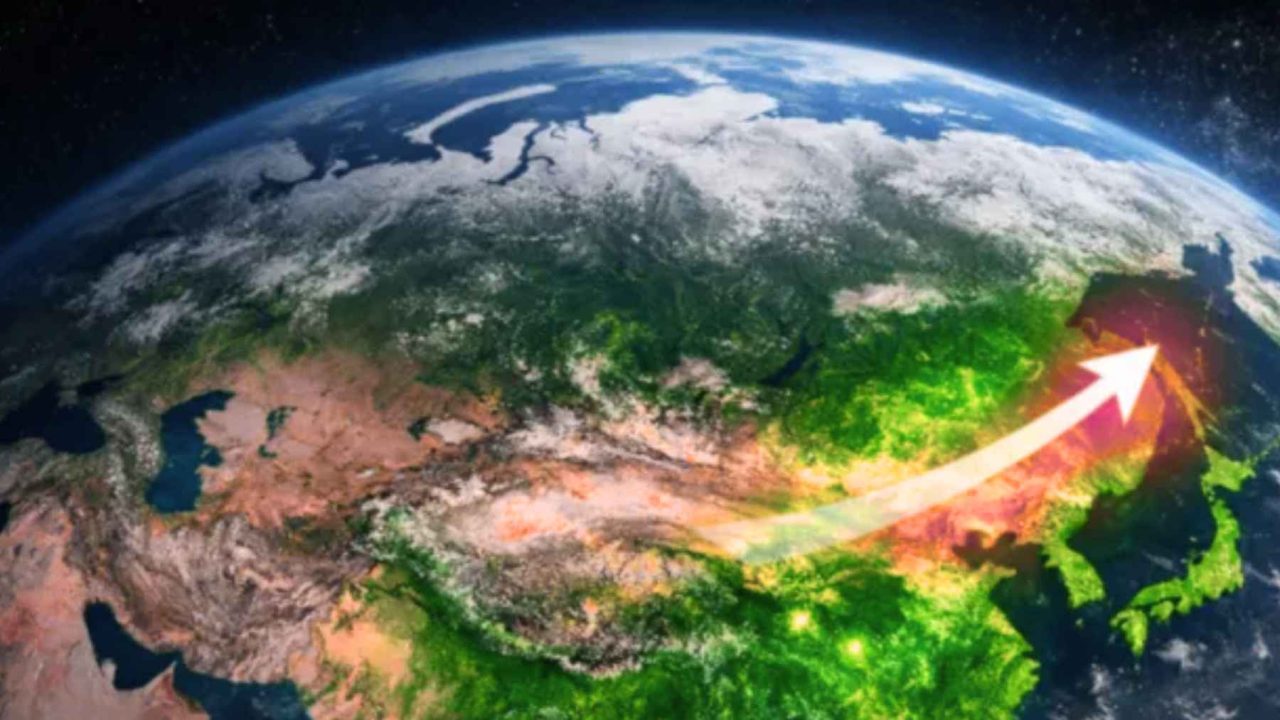
If you’ve ever noticed that spring seems to arrive a little earlier than it used to, science is starting to confirm that feeling — and then some. A new study published in early 2026 reveals that Earth’s seasonal “green wave,” the annual surge of plant growth and leaf coverage that sweeps across the planet each year, is not just shifting in timing. It’s shifting in direction.
Researchers have tracked a measurable drift in where the planet’s vegetation is most concentrated, and that center of greenness is moving toward the northeast. Scientists warn the shift could accelerate significantly over the course of this century, with consequences that reach far beyond the changing color of a hillside in spring.
The study, published in late February 2026, was led by researchers at the German Centre for Integrative Biodiversity Research Halle-Jena-Leipzig (iDiv), the Helmholtz Centre for Environmental Research, and Leipzig University. It represents one of the most creative attempts yet to summarize how climate change is reshaping the living surface of our planet in a single, trackable number.
What the “Green Wave” Actually Is — and Why It’s Moving
Every year, as temperatures warm and daylight lengthens, a visible wave of green spreads across the Northern Hemisphere. Leaves emerge, grasses grow, forests fill in. This is what scientists informally call the “green wave” — the seasonal pulse of vegetation that signals life returning to the land.
For decades, researchers have known that climate change is affecting this wave. Springs are arriving earlier in many regions. Some areas are staying green longer into autumn. But tracking these changes across the entire planet, all at once, is extraordinarily complex. There are thousands of ecosystems, hundreds of climate zones, and enormous regional variation.
That’s where the new research takes a genuinely clever approach. Instead of analyzing thousands of individual maps and data points separately, the team developed a way to boil all of that complexity down into a single moving point: a planetary “green center.”
Lead author Miguel Mahecha described the concept this way:
“Imagine holding a perfectly round globe, then adding tiny weights wherever leaves are denser until the planet has a single balance point.”
That balance point — calculated using satellite greenness data and computer climate models — is the green center. And when scientists track it over time, they can see it moving. Right now, it’s drifting northeast.
How Scientists Built a Global Vegetation Tracker
The method behind this research is worth understanding, because it’s what makes the findings so compelling. The team treated vegetation across the planet’s land surface like weights distributed on a globe.
Wherever plant growth is denser — think lush tropical rainforests, productive temperate farmland, or newly greening Arctic tundra — the “weight” is heavier. Wherever vegetation is sparse, the weight is lighter. By calculating where all of those weights balance, scientists can identify a single point that represents the overall center of Earth’s greenness.
They used two primary tools to build and test this tracker:
- Satellite greenness data — real-world observations of vegetation density captured from orbit over decades
- Computer climate models — simulations that project how vegetation patterns may respond to future climate conditions
By combining observed data with forward-looking models, the team could both confirm what has already happened and estimate where the green center is likely to move as the century progresses.
What the Research Team Found
| Finding | Detail |
|---|---|
| Direction of shift | Earth’s green center is moving toward the northeast |
| Study publication date | Late February 2026 |
| Lead institution | German Centre for Integrative Biodiversity Research (iDiv), Helmholtz Centre for Environmental Research, Leipzig University |
| Lead author | Miguel Mahecha |
| Data sources used | Satellite greenness data and computer climate models |
| Projected trajectory | The shift could accelerate over the course of this century |
The headline finding is striking in its simplicity: the planet’s center of greenness is on the move. But the implications of that movement are anything but simple.
Why a Shifting Green Center Matters for the Real World
A northeastward drift in vegetation concentration reflects enormous underlying changes in how, where, and when plants grow across the planet. As temperatures rise, regions that were once too cold to support dense vegetation — particularly in northern latitudes like Siberia, northern Canada, and Scandinavia — are becoming more hospitable to plant life.
At the same time, some regions closer to the equator may be experiencing stress from heat and drought, potentially reducing vegetation density in areas that were once reliably lush.
The combined effect of more green in the north and potentially less in other regions is what pulls the overall balance point — the green center — in a northeastern direction.
This matters for several reasons that touch everyday life:
- Agriculture — Growing zones are shifting, which affects what crops can be grown where and when planting seasons begin
- Biodiversity — Species that depend on specific vegetation patterns may find their habitats changing faster than they can adapt
- Carbon storage — Vegetation is a major carbon sink; where plants grow and how densely affects how much carbon the land absorbs from the atmosphere
- Water cycles — Plant coverage influences rainfall patterns, soil moisture, and river systems across continents
The researchers’ approach of distilling these complex, interconnected changes into a single trackable point gives scientists — and policymakers — a clearer way to monitor the pace and direction of planetary change over time.
What Could Come Next as the Century Progresses
The research suggests the northeastward shift in Earth’s green center is not a temporary blip. Based on climate model projections, the drift could accelerate over the course of this century as global temperatures continue to rise.
That acceleration would mean faster changes to growing seasons, ecosystem boundaries, and vegetation patterns across the Northern Hemisphere in particular. For scientists, the green center tracker offers a powerful new tool — a kind of vital sign for the planet’s living surface that can be monitored continuously using satellite data.
Whether this single metric eventually becomes a standard part of how the world tracks climate change remains to be seen. But the fact that researchers can now point to a measurable, directional shift in where Earth’s greenness is concentrated represents a meaningful step forward in understanding how deeply the planet’s biology is already being reshaped.
Spring may feel different because it is different. And according to this research, the changes are only getting started.
Frequently Asked Questions
What is Earth’s “green wave”?
The green wave refers to the seasonal surge of plant growth and leaf coverage that spreads across the planet each year as temperatures warm in spring and summer.
Which direction is the green center shifting?
According to the study, Earth’s overall center of greenness is drifting toward the northeast, a trend scientists say could accelerate over this century.
Who conducted this research?
The study was led by researchers at the German Centre for Integrative Biodiversity Research (iDiv), the Helmholtz Centre for Environmental Research, and Leipzig University, with Miguel Mahecha as lead author.
How did scientists calculate a single “green center” for the planet?
The team treated vegetation density across land surfaces like weights on a globe, using satellite greenness data and computer climate models to find the single balance point where all that weight is centered.
When was this study published?
The research was published in late February 2026.
Will this shift affect agriculture and ecosystems?



Leave a Reply