
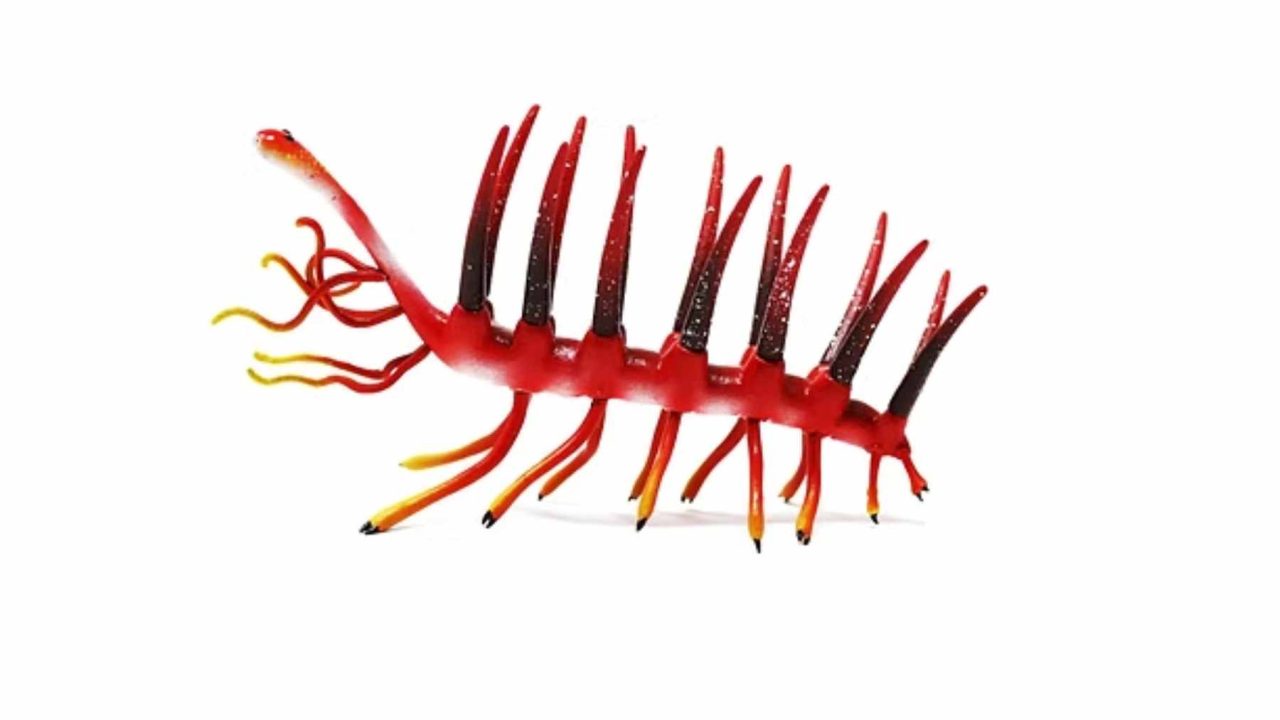
A fossil specimen first described in 1977 has been reexamined nearly 50 years later — and what researchers found inside it may finally answer one of paleontology’s most stubborn mysteries: what did Hallucigenia actually eat?
The answer, preserved in a roughly 500-million-year-old slab of rock from the Burgess Shale in western Canada, points to something surprisingly mundane for such a bizarre creature. Hallucigenia — long celebrated as one of the strangest animals to ever exist — appears to have been a scavenger, feeding on the decaying bodies of soft creatures that sank to the seafloor of the ancient Cambrian seas.
It’s a discovery that reframes how scientists think about early ocean ecosystems, and it comes from a fossil that had been sitting in the scientific record for decades, waiting for a closer look.
What Makes Hallucigenia So Strange in the First Place
Hallucigenia has fascinated and confused paleontologists since it was first formally studied. The creature — tiny, soft-bodied, and bristling with rigid spines — looked so alien that early researchers initially reconstructed it upside down and back to front. Its name is a nod to its hallucinatory weirdness.
It lived during the Cambrian period, roughly 500 million years ago, when life on Earth was exploding into an extraordinary variety of new body plans. The Burgess Shale in western Canada is one of the most important fossil sites in the world for understanding that explosion — a rare window into soft-bodied creatures that almost never fossilize.
Hallucigenia measured only about three and a half centimeters long. Despite its small size, it has generated enormous scientific debate, particularly around what it ate and how it fit into the broader ecology of Cambrian seas.
What the Reexamined Fossil Actually Shows
The new study was led by paleontologist Javier Ortega-Hernández at Harvard University. His team took a fresh look at the classic Burgess Shale specimen — the very one first described in 1977 — and found something that had apparently been overlooked.
The slab preserves the flattened body of a soft, jelly-like animal approximately three and a half centimeters long. Scattered across and around it are loose spines from at least seven individual Hallucigenia.
The interpretation the team offers is striking in its clarity. The jelly-like animal died and sank to the seafloor. Small Hallucigenia then gathered around the carcass to feed on it — likely using a suction-based feeding mechanism — and in the process shed or lost their spines, which became embedded in the decaying mass.
Paleontologist Allison Daley of the University of Lausanne described the fossil as
“a moment captured in the fossil record.”
That description captures what makes this find so compelling. It is not just evidence of what Hallucigenia ate in the abstract — it is a snapshot of the actual moment of feeding, frozen in stone for half a billion years.
Key Facts From the Discovery at a Glance
| Detail | Information |
|---|---|
| Fossil age | Approximately 500 million years old |
| Fossil site | Burgess Shale, western Canada |
| Specimen first described | 1977 |
| Lead researcher | Javier Ortega-Hernández, Harvard University |
| External expert quoted | Allison Daley, University of Lausanne |
| Number of Hallucigenia represented | At least seven individuals (via shed spines) |
| Estimated body length of Hallucigenia | Approximately 3.5 centimeters |
| Feeding behavior identified | Scavenging on soft-bodied carcasses, likely by suction |
- The prey animal was soft and jelly-like, with a flattened body preserved in the same slab
- The spines scattered across the carcass suggest multiple Hallucigenia fed together
- The feeding method is believed to have involved suction rather than biting or tearing
- The specimen had been in the scientific record since 1977 but had not previously yielded this interpretation
Why This Changes How We See Cambrian Oceans
The significance here goes beyond one peculiar creature’s diet. If Hallucigenia was a scavenger — gathering around dead and decaying animals on the seafloor — it played a specific ecological role in the Cambrian world. It was, in effect, part of the ocean’s cleanup crew.
Scavengers are essential to healthy ecosystems. They break down organic matter, recycle nutrients, and prevent the buildup of decaying material. Finding evidence that this role existed in complex form 500 million years ago suggests that early ocean ecosystems were more structured and functionally layered than previously appreciated.
It also raises new questions. Were there other Cambrian creatures playing similar roles? How common was scavenging behavior in those ancient seas? The Burgess Shale, extraordinary as it is, preserves only a fraction of the life that existed then — and each new interpretation of a known specimen can shift the picture considerably.
The fact that this insight came from a specimen described nearly five decades ago is itself a reminder of how much can be hiding in plain sight. Museum collections and archived fossil slabs hold descriptions made with the tools and knowledge of their time. Revisiting them with modern analytical methods and fresh eyes continues to yield surprises.
What Researchers Are Looking at Next
The reanalysis of this Burgess Shale specimen opens several avenues worth watching. Other researchers, including Jean-Bernard Caron at the Royal Ontario Museum, are noted in connection with the broader scientific conversation around this find — though
What is clear is that the study has renewed interest in both Hallucigenia specifically and in the ecological dynamics of Cambrian seafloors more broadly. With improved imaging technologies and a growing willingness to revisit classic specimens, paleontologists are increasingly finding that the answers to long-standing questions were sometimes already sitting in a drawer somewhere — just waiting for the right question to be asked.
Frequently Asked Questions
What is Hallucigenia?
Hallucigenia is a tiny, spine-covered soft-bodied animal that lived approximately 500 million years ago during the Cambrian period. It is considered one of the strangest creatures ever discovered.
What did this fossil reveal about Hallucigenia’s diet?
The fossil suggests that Hallucigenia was a scavenger, feeding on the decaying bodies of soft-bodied animals that sank to the seafloor, likely using a suction-based feeding method.
Where was the fossil found and how old is it?
The fossil comes from the Burgess Shale in western Canada and is approximately 500 million years old. The specimen was first formally described in 1977.
Who led the new study?
The study was led by paleontologist Javier Ortega-Hernández at Harvard University.
How many Hallucigenia were involved in the feeding event?
Based on the spines preserved in the fossil slab, at least seven individual Hallucigenia appear to have been present at the feeding site.
Why does it matter that a 1977 specimen produced this discovery?
It demonstrates that revisiting archived fossil specimens with modern methods and fresh scientific questions can yield major new insights, even from material that has been known to science for decades.



Leave a Reply