
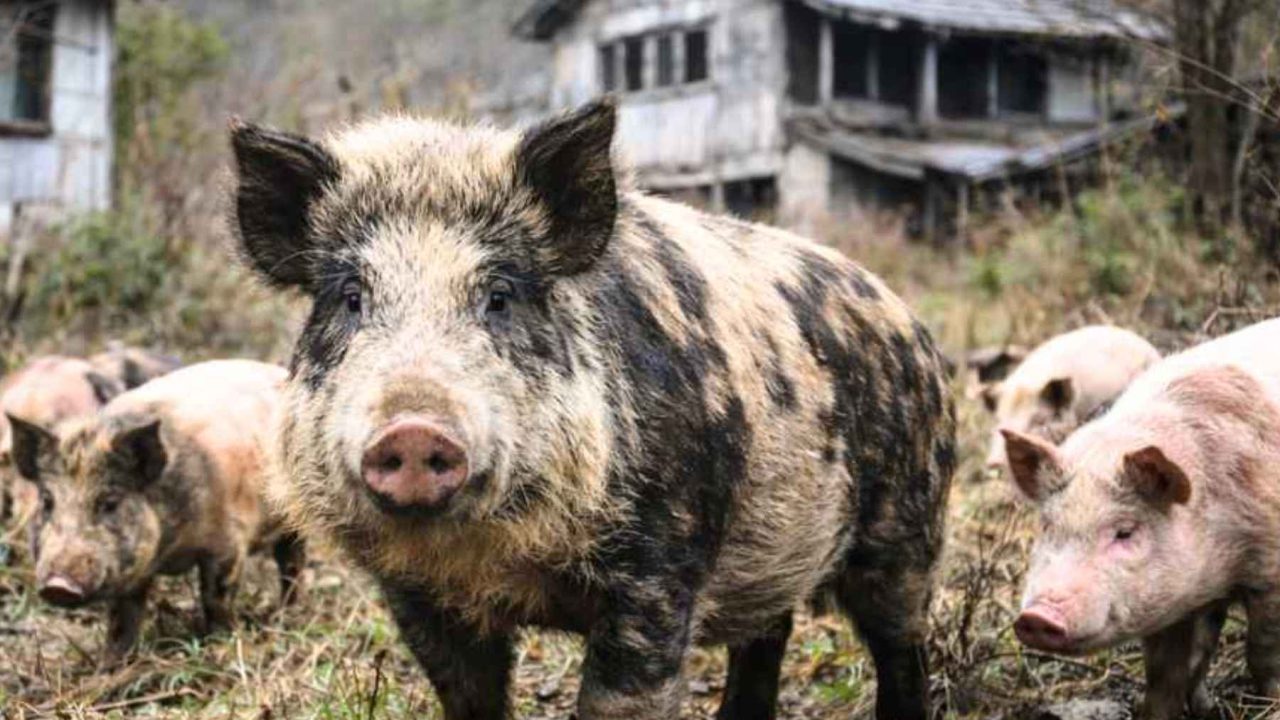
Fifteen years after one of the worst nuclear disasters in history, the abandoned exclusion zone around Fukushima Daiichi is producing something nobody predicted: a population of hybrid animals born from escaped domestic pigs and wild boar, quietly spreading through a landscape that humans left behind.
This is not science fiction, and it is not a mutation story driven by radiation. What researchers documented is something far more grounded — and in its own way, just as surprising. When people evacuated and farms emptied overnight, the animals they left behind did what animals do. They survived. They adapted. And they bred with whatever was out there waiting for them.
A new study, building on earlier findings from 2021, has now traced the genetic legacy of that mixing — and the results reveal how quickly a domestic animal’s traits can ripple through a wild population when the usual boundaries between human settlement and wilderness simply disappear.
What Happened After the Evacuation
When the Fukushima Daiichi nuclear disaster struck on March 11, 2011, the evacuation was fast and the exclusion zone was strict. Residents left. Farms were abandoned. And the animals on those farms — including domestic pigs — had nowhere to go and no one to contain them.
With human activity dropping sharply across abandoned farms and forest edges, escaped pigs found themselves in territory that wild boar already called home. The two species are closely related, and interbreeding followed. The area effectively became a rare, unplanned natural experiment in what happens when domestic and wild animals are suddenly thrown together with no fences, no farmers, and no interference.
A 2021 study had already confirmed that pig genes were entering the local wild boar population after the disaster. The new research goes further, examining how deeply those genes spread — and what behavioral or biological traits may have traveled with them.
How the Fukushima Hybrid Wild Boar Study Was Conducted
The new paper was produced by Shingo Kaneko of Fukushima University and Donovan Anderson of Hirosaki University. Their team analyzed genetic material collected from 191 wild boar and 10 domestic pigs, with samples gathered between 2015 and 2018. The researchers compared mitochondrial genetic data to trace the maternal lineage of the animals and determine how pig ancestry was moving through the broader population.
One of the more striking findings involved breeding patterns. The researchers found evidence suggesting that pig mothers appear to have passed on a faster breeding pattern — meaning the hybrid animals were moving from one generation to the next more quickly than typical wild boar populations. That kind of accelerated reproduction, if sustained, could have real consequences for how the hybrid population grows and spreads over time.
It is worth being clear about what this study does and does not show. The researchers did not document a new species. What they found is a hybrid population — animals carrying a genetic mix of domestic pig and wild boar ancestry — spreading within the exclusion zone.
Key Facts From the Research
| Detail | Information |
|---|---|
| Disaster date | March 11, 2011 |
| Study researchers | Shingo Kaneko (Fukushima University), Donovan Anderson (Hirosaki University) |
| Samples analyzed | 191 wild boar, 10 domestic pigs |
| Sample collection period | 2015 to 2018 |
| Earlier related study | 2021 study confirming pig genes entering wild boar population |
| Key finding | Hybrid population with faster breeding pattern traced to pig maternal ancestry |
- The hybrid animals are not a formally classified new species
- Domestic pig genes entered the wild boar population after the 2011 evacuation
- Faster generational turnover appears linked to the domestic pig maternal line
- The exclusion zone functioned as an unintentional wildlife experiment
- Genetic analysis tracked maternal lineage through mitochondrial DNA comparison
Why This Matters Beyond Fukushima
Stories from the Fukushima exclusion zone tend to focus on radiation levels, cleanup timelines, or the slow return of residents to some areas. This finding sits in a different category entirely. It is a story about what nature does when humans step back — and how fast genetic change can move through a wild population once the barriers between domesticated and wild animals come down.
The faster breeding pattern traced to pig ancestry is particularly worth watching. Wild boar already reproduce at rates that can challenge wildlife managers in many parts of the world. A hybrid population with an even shorter generational cycle could, over time, grow and spread more aggressively than a purely wild population would.
For researchers studying the long-term ecological effects of the Fukushima disaster, this finding adds a dimension that goes well beyond radiation biology. The disaster did not just affect the land and the people — it reshuffled the animal populations in ways that are still being mapped more than a decade later.
There is also a broader lesson here for how we think about nuclear exclusion zones and other areas where human withdrawal has been sudden and total. When people leave, other dynamics take over quickly. In Fukushima’s case, that included an unplanned hybridization event that has now left a measurable genetic mark on the local wildlife.
What Researchers Are Still Working to Understand
The study covers samples collected between 2015 and 2018, which means there is still a significant gap between what the data shows and what may be happening in the exclusion zone today. The hybrid population has had additional years to spread, reproduce, and potentially push its genetic signature further into surrounding wild boar communities.
Whether the faster breeding pattern documented in the research has continued to amplify the hybrid population — or whether natural selection has pushed back against certain domestic traits in a wild environment — remains an open question. Ongoing monitoring of the exclusion zone’s wildlife will be essential to understanding the full trajectory of this unusual population.
What the research has already made clear is that the Fukushima disaster’s ecological story is far from finished. The land may be quiet, but the biology is still moving.
Frequently Asked Questions
Are the Fukushima hybrid animals a new species?
No. Researchers documented a hybrid population, not a formally classified new species. The animals carry a genetic mix of domestic pig and wild boar ancestry.
Who conducted this research?
The study was led by Shingo Kaneko of Fukushima University and Donovan Anderson of Hirosaki University.
How many animals were included in the genetic analysis?
The researchers analyzed genetic material from 191 wild boar and 10 domestic pigs, collected between 2015 and 2018.
What is the most significant finding from the study?
Pig mothers appear to have passed on a faster breeding pattern to the hybrid population, meaning the animals move through generations more quickly than typical wild boar.
Was a similar study done before this one?
Yes. A 2021 study had already confirmed that pig genes were entering the local wild boar population following the 2011 disaster. The new research builds on those earlier findings.</p


Leave a Reply