
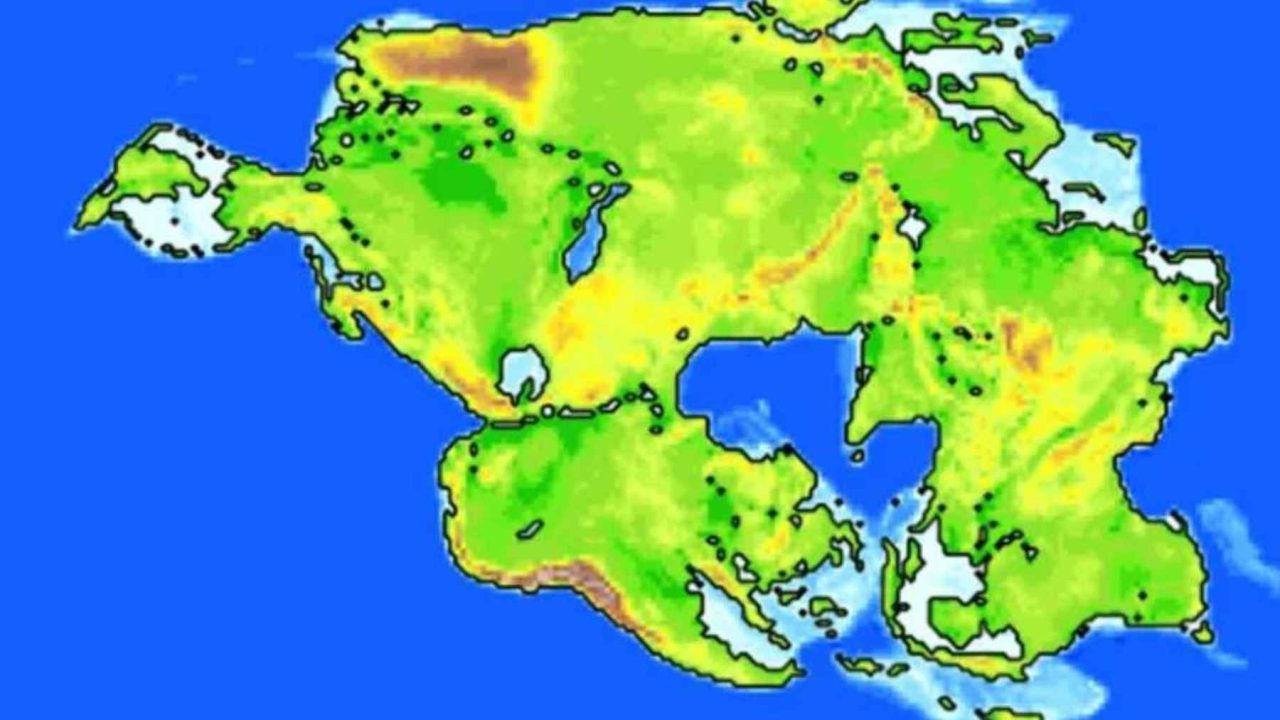
In roughly 200 to 250 million years, every continent on Earth could merge into a single landmass — and scientists say the climate consequences could be severe on a planetary scale. It sounds like science fiction, but it is grounded in plate tectonics, geological history, and increasingly sophisticated climate modeling.
The continents have done this before. About 335 million years ago, nearly all of Earth’s landmasses were joined together in a supercontinent called Pangaea. It eventually broke apart, and the pieces have been drifting ever since. Now researchers are warning that the drift may eventually reverse — and the world that emerges could be almost unrecognizable.
This is not a crisis for any living generation. But the science behind it reveals something important about how fragile the conditions for life on Earth really are — and how profoundly geography shapes climate.
Why the Continents Are Always Moving
Earth’s crust is not one solid shell. It is broken into massive tectonic plates that are constantly shifting, moving at roughly the speed fingernails grow. That motion is imperceptibly slow on a human timescale, but over hundreds of millions of years, it can open entire oceans, trigger earthquakes, and push up mountain ranges.
The same process that once assembled Pangaea and then tore it apart is still happening right now, beneath our feet. The Atlantic Ocean is slowly widening. The Pacific is slowly shrinking. The Indian subcontinent continues to press into Asia. Everything is in motion, and over deep time, that motion adds up to something enormous.
Scientists have been working to model where all of this leads — and the results point toward another supercontinent collision somewhere between 200 and 250 million years from now.
Four Possible Futures for Earth’s Continents
A 2018 study by researchers Hannah Sophia Davies, Mattias Green of Bangor University, and João C. Duarte of the University of Lisbon mapped out four distinct scenarios for how the continents could eventually come back together. Each one produces a different supercontinent with a different location, shape, and set of climate consequences.
| Supercontinent Name | Key Characteristics |
|---|---|
| Novopangea | One of four plausible future supercontinents identified in the 2018 study |
| Pangaea Ultima | One of four plausible future supercontinents; suggests a reformation near the current equatorial region |
| Aurica | One of four plausible future supercontinents identified in the 2018 study |
| Amasia | One of four plausible future supercontinents; suggests a merger centered around the Arctic region |
Each of these scenarios carries different implications for how heat would be distributed across the planet, how ocean circulation would function, and whether large portions of the landmass would become uninhabitable.
Where the Supercontinent Forms Could Change Everything
The location of this future landmass matters enormously. NASA climate simulations led by Michael J. Way at NASA’s Goddard Institute for Space Studies found that where the supercontinent forms could strongly reshape the planet’s entire climate system.
A supercontinent sitting near the equator, for example, would absorb far more solar radiation than one positioned closer to the poles. Interior regions — far from any ocean — would have no moderating maritime influence, potentially producing extreme heat and cold in ways that current Earth does not experience at scale.
Researchers have noted that the formation of a supercontinent could also disrupt ocean circulation patterns that currently distribute heat around the globe. The consequences would not be limited to temperature. Rainfall patterns, sea levels, and even atmospheric chemistry could shift dramatically over geological timescales.
What This Means for Life on Earth — Hundreds of Millions of Years From Now
No human alive today — or any human who will ever live in any foreseeable future — would experience this event. The timescales involved are so vast that they are difficult to truly comprehend. Two hundred million years ago, dinosaurs had not yet appeared. The world that existed then was as alien to us as the supercontinent world would be to whatever life exists in the distant future.
Still, the research carries real relevance. It demonstrates that Earth’s climate is not a stable background condition. It is the product of specific geological arrangements that have changed before and will change again. The planet has experienced climate transformations far more extreme than anything in recorded human history — and the engine driving those transformations never shuts off.
Scientists studying these deep-time scenarios also use them to better understand how climate systems work in general. Modeling a future supercontinent requires modeling how oceans, atmosphere, and land interact — and that knowledge feeds directly back into understanding climate dynamics happening right now.
What Scientists Are Still Working to Understand
The four supercontinent scenarios identified in the 2018 Davies, Green, and Duarte study represent plausible outcomes, not certainties. The actual path the continents take will depend on complex interactions between tectonic forces that scientists are still working to fully map.
NASA’s climate modeling work adds another layer to that picture by simulating what conditions on the surface might look like under each scenario. But the further out the projections reach, the wider the range of possible outcomes becomes.
What researchers agree on is the basic framework: the supercontinent cycle is real, it has happened before, and there is no reason to believe it has stopped. Earth’s geology operates on timescales that dwarf human civilization — and within those timescales, the world we know is just one brief arrangement of an endlessly shifting puzzle.
Frequently Asked Questions
When could the next supercontinent form?
Scientists estimate the next supercontinent could emerge in approximately 200 to 250 million years, based on current tectonic plate movement trends.
What are the names of the four possible future supercontinents?
The four scenarios identified in the 2018 study are Novopangea, Pangaea Ultima, Aurica, and Amasia.
Who conducted the key research on future supercontinents?
A 2018 study was authored by Hannah Sophia Davies, Mattias Green of Bangor University, and João C. Duarte of the University of Lisbon. NASA climate simulations related to this topic were led by Michael J. Way at NASA’s Goddard Institute for Space Studies.
Why would a supercontinent cause climate change?
The location and shape of a supercontinent would dramatically alter how solar heat is absorbed, how ocean circulation functions, and how rainfall is distributed across the planet.
Is this something people alive today need to worry about?
No. The timescales involved — hundreds of millions of years — are far beyond any human concern, though the science helps researchers better understand how Earth’s climate systems function.
Has Earth had a supercontinent before?
Yes. Pangaea existed approximately 335 million years ago before breaking apart into the continents we recognize today.



Leave a Reply