
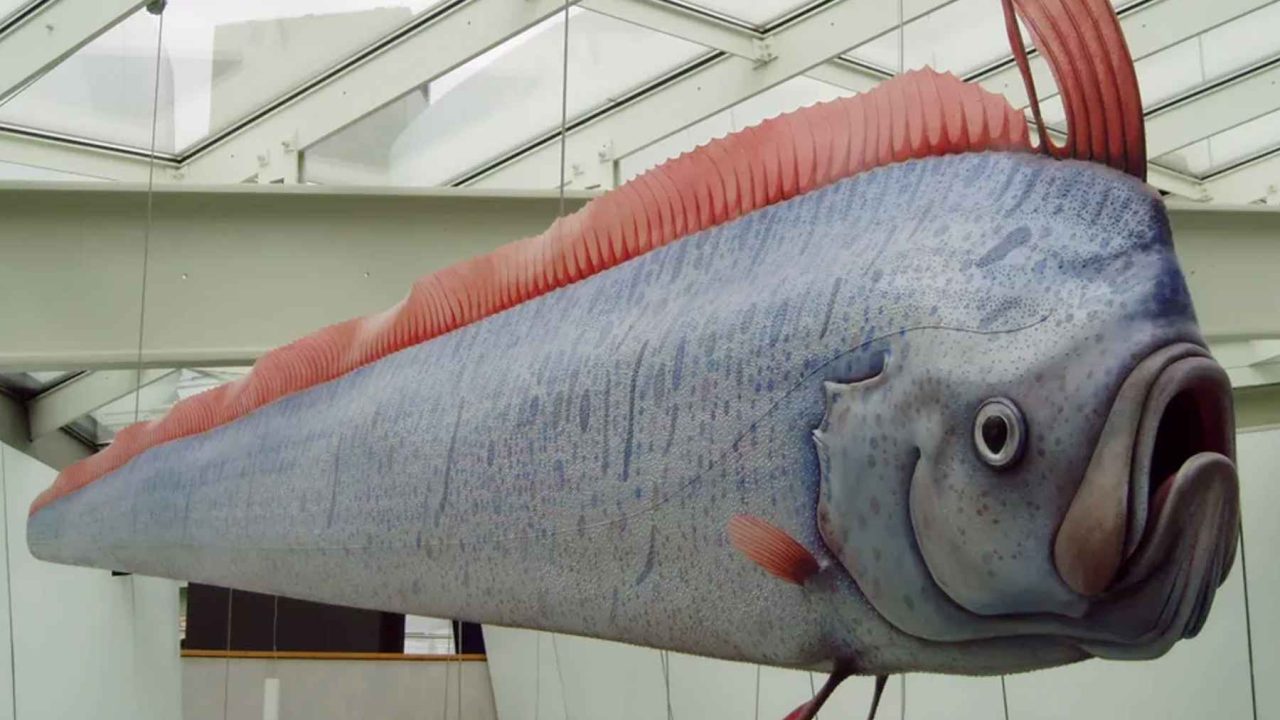
On February 9, 2025, beachgoers at Playa El Quemado in Baja California Sur witnessed something most marine biologists never see in a lifetime of research: a living oarfish, wriggling in shallow water, repeatedly lifting its head above the surface and swimming directly toward the people trying to help it. Visitor Robert Hayes filmed the encounter and shared the footage with Storyful, and within hours the internet had a new obsession — and a very old fear.
The oarfish, sometimes called the “king of herring,” is one of the longest bony fish on Earth. It lives in deep ocean waters and almost never surfaces alive. When it does, a wave of ancient mythology tends to follow close behind. The footage from Baja California spread fast, and with it came the familiar whisper: doomsday fish.
But what actually happened that day, and what does science say about why these creatures occasionally wash ashore? The answers are more grounded — and in some ways more unsettling — than any earthquake prophecy.
What the “King of Herring” Actually Is
The oarfish earns its regal nickname through sheer scale. It is a deep-sea species that spends its life far below the surface, rarely interacting with the human world. Its silver, ribbon-like body and dramatic appearance have fueled legends across multiple cultures for centuries, particularly in Japan, where it is known as ryugu no tsukai — the messenger from the sea god’s palace.
Because oarfish live so deep and die so rarely in ways that bring them to shore intact, almost everything scientists know about them comes from dead or dying specimens. A living oarfish in shallow water is not just unusual — it is genuinely extraordinary. That rarity is part of what makes each sighting feel charged with meaning, even when the science points in a far more mundane direction.
Marine scientists are clear on one point: an oarfish near shore is almost certainly there because something has gone wrong. The leading explanations center on illness, injury, disorientation, or the final stages of dying — not on seismic prophecy.
What Happened at Playa El Quemado
According to Hayes, the fish did not simply drift toward the beach. It swam directly at the group of onlookers, and when people tried to guide it back into deeper water, it kept returning. This happened three times. That persistence — the fish actively resisting redirection — is what gave the scene its eerie quality and helped the video travel so widely online.
The behavior is consistent with what researchers describe in distressed deep-sea animals that have lost the ability to orient themselves properly. An oarfish in that condition may have no reliable sense of which direction leads to safety. What looks like intention from the shore may simply be the absence of normal navigation.
Hayes later spoke to media about the encounter, and the footage was verified and distributed through Storyful. The event quickly reignited public discussion about whether oarfish sightings signal coming earthquakes — a belief with deep roots in Japanese folklore and one that resurfaces every time one of these fish appears near a coastline.
The Earthquake Myth — What the Research Actually Says
The idea that oarfish predict earthquakes is old and widespread, particularly in Japan, where historical records link deep-sea fish strandings to seismic events. But the best available scientific research does not support a reliable connection.
Studies examining the relationship between oarfish sightings and subsequent earthquakes have found no statistically meaningful pattern. Scientists note that Japan is one of the most seismically active places on Earth, meaning earthquakes follow almost any notable event simply by coincidence and frequency.
| Claim | What the Evidence Shows |
|---|---|
| Oarfish predict earthquakes | Not supported by current scientific research |
| Oarfish near shore signal disaster | More likely indicates the fish is sick, injured, or dying |
| Living oarfish sightings are common | Extremely rare — most encounters involve dead specimens |
| Oarfish behavior at Playa El Quemado | Fish swam toward shore repeatedly, resisted redirection three times |
That said, the myth persists for a reason. Oarfish do live near the seafloor, where seismic activity occurs. Some researchers have speculated — without firm evidence — that changes in deep-water conditions before an earthquake might disturb bottom-dwelling species. But speculation is not confirmation, and marine scientists continue to urge caution about drawing that line.
Why These Sightings Keep Capturing the Public’s Imagination
Part of what makes oarfish encounters so compelling is the sheer alienness of the animal. Most people will never see one, even in a zoo or aquarium. They are difficult to keep alive in captivity, and their deep-sea habitat makes direct study almost impossible. Every verified sighting carries the weight of genuine rarity.
There is also something viscerally striking about the animal’s appearance. Long, silver, and serpentine, it looks like the creature mythology would design if mythology were trying to make a point. When one surfaces alive and behaves strangely — swimming toward people, lifting its head, refusing to leave — it is genuinely difficult not to feel that something significant is happening.
Scientists understand that reaction. But they also consistently redirect it. The more pressing question raised by a beaching like this one is not what the fish was warning us about — it is what conditions in the deep ocean may have contributed to its distress in the first place.
The Uncomfortable Question Scientists Are Actually Asking
While the earthquake narrative dominates public discussion, marine researchers tend to focus on a different set of concerns. Deep-sea ecosystems are under increasing pressure from climate change, noise pollution, shifting ocean temperatures, and other human-driven disruptions. Whether any of those factors contributed to this particular oarfish’s distress is unknown — but the question is worth asking seriously.
A healthy oarfish has no reason to be in shallow coastal water. When one appears, it represents a breakdown of something in that animal’s biology or environment. Understanding what caused that breakdown matters more, scientifically, than counting the days until the next earthquake.
The footage from Baja California is striking and genuinely rare. But the story it tells is less about omens and more about how little we still understand of what lives — and what is struggling — far below the surface.
Frequently Asked Questions
Where did the February 2025 oarfish sighting take place?
It occurred on February 9, 2025, at Playa El Quemado in Baja California Sur, Mexico, and was filmed by visitor Robert Hayes.
Why is the oarfish called the “king of herring”?
The oarfish carries this nickname due to its enormous size and its status as one of the longest bony fish in the ocean, though the exact origin of the name reflects longstanding folklore around the species.
Do oarfish really predict earthquakes?
Current scientific research does not support a reliable connection between oarfish sightings and earthquakes, despite widespread folklore — particularly in Japan — claiming otherwise.
Why did the oarfish keep returning to shore?
According to the source, the fish swam toward the group and returned to shore three times despite people attempting to redirect it, behavior consistent with disorientation or illness rather than intentional warning.
Is it common to see a living oarfish?
No — it is extremely rare. Almost all known oarfish encounters involve dead or dying specimens, making a live sighting like this one genuinely unusual for marine scientists.
What do scientists think actually causes oarfish to beach themselves?
Marine scientists say a beaching is far more likely caused by illness, injury, or disorientation than any seismic signal, though the precise cause in any individual case is often difficult to confirm.




Leave a Reply