
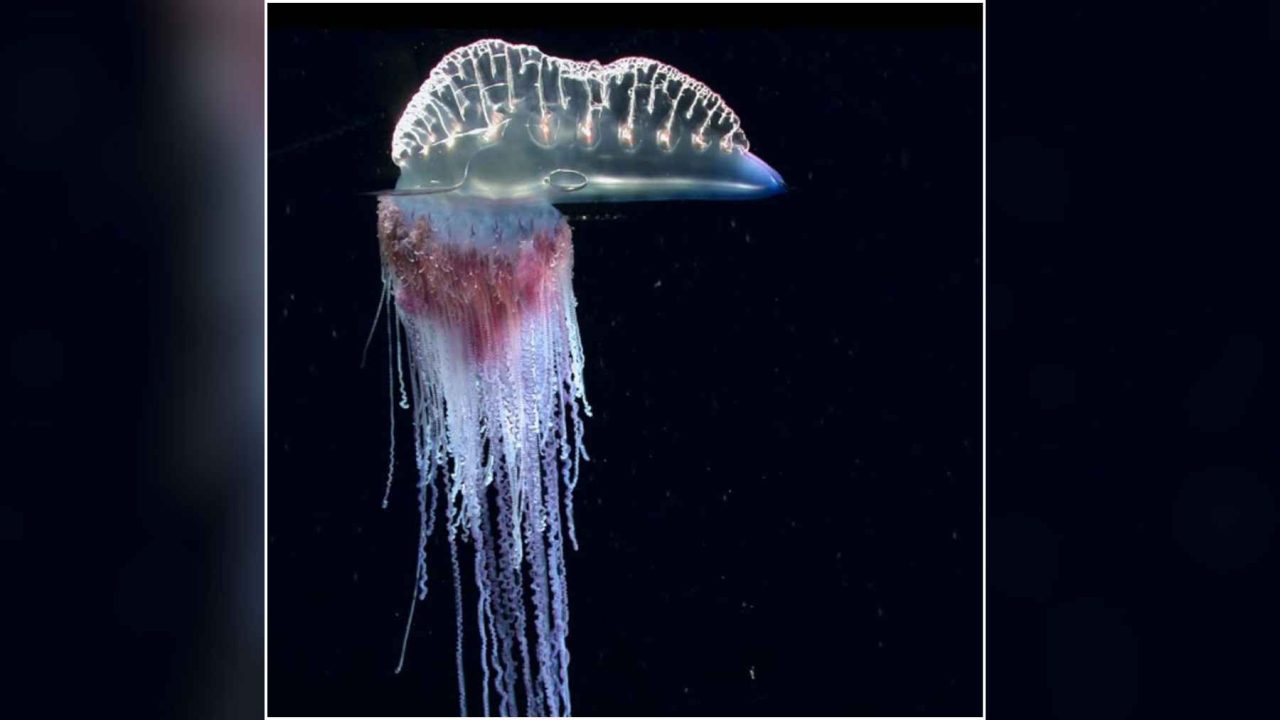
Six thousand meters beneath the surface of the ocean, where no sunlight reaches and the pressure would crush most life forms instantly, a remotely operated underwater robot captured something that stopped marine biologists in their tracks: a ghostly, translucent ribbon roughly 15 meters long, drifting silently through total darkness off the coast of Australia.
The footage has since circulated widely, drawing attention from researchers and science outlets across multiple continents. What the camera recorded was not a single animal in the traditional sense — it was a siphonophore, a colonial organism made up of thousands of tiny individual creatures working together as one body. And scientists reviewing the images have admitted they have rarely seen anything quite like it.
For a planet that considers itself well-explored, moments like this are a humbling reminder of just how little we actually know about what lives in the deep ocean.
What Exactly Is a Siphonophore — and Why Does It Matter?
A siphonophore is not a single creature in the way a whale or a shark is. It is a colonial animal — a living superorganism composed of thousands of genetically identical units called zooids, each one specialized to perform a different function. Some zooids handle movement, others digestion, others reproduction. Together, they form something that behaves like one organism but is technically a colony.
What makes siphonophores so scientifically striking is their size. Colonial animals are not constrained by the physical limits that cap the growth of a single-bodied creature, which means they can reach lengths that seem almost impossible. The 15-meter specimen filmed off Australia is extraordinary — but it is not even close to the largest on record.
In 2020, researchers with the Schmidt Ocean Institute reported a spiral siphonophore estimated at approximately 45 meters in length, also discovered in waters off Western Australia. That single find rewrote assumptions about how large soft-bodied colonies could grow in the deep sea.
The new footage adds to a growing pattern. Taken together, these sightings suggest that enormous siphonophore colonies may be far more common in the abyss than scientists previously expected.
Where the Discovery Was Made — and How
The footage comes from international deep-sea expeditions using remotely operated vehicles (ROVs) — underwater robots equipped with cameras and sensors capable of descending to depths that no human diver could survive. The target areas have been the steep submarine canyons off Western Australia, a region that has increasingly become a focal point for deep-ocean research.
Marine biologists reviewing the video described the organism as translucent, ribbon-shaped, and suspended in the water column like a loose thread, slowly curling as it moved through the dark. The depth recorded was greater than 6,000 meters — nearly four miles below the ocean’s surface.
Reports highlighting the video have emerged from science outlets in Spain, Portugal, and Brazil, reflecting the international interest the footage has generated among the research community.
Key Facts About the Discovery at a Glance
| Detail | Confirmed Information |
|---|---|
| Organism type | Siphonophore (colonial animal) |
| Estimated length | Approximately 15 meters |
| Depth of discovery | Greater than 6,000 meters |
| Location | Waters off Western Australia |
| Discovery method | Remotely operated vehicle (ROV) |
| Appearance | Translucent, ribbon-shaped, gelatinous |
| Related record | 45-meter spiral siphonophore (Schmidt Ocean Institute, 2020) |
- Siphonophores are colonial organisms, not single animals
- The colony drifts in total darkness at extreme depth
- The 2020 Schmidt Ocean Institute sighting in the same region remains the largest recorded
- Multiple international science outlets have flagged the footage as scientifically significant
- The discovery adds to evidence that giant soft-bodied colonies may be common in the abyss
Why This Changes How Scientists Think About the Deep Ocean
The deep ocean — anything below roughly 200 meters — covers the vast majority of Earth’s livable space, yet it remains one of the least explored environments on the planet. Scientists estimate that we have mapped more of the surface of Mars than we have of the ocean floor. Expeditions like the ones capturing this footage are genuinely charting unknown territory.
What these siphonophore sightings are doing, collectively, is forcing researchers to reconsider baseline assumptions about deep-sea life. Marine biologists reviewing the imagery have noted that organisms of this scale challenge existing frameworks for what counts as “large” in the deep ocean.
The fact that two extraordinary siphonophore sightings — one at 15 meters and one at 45 meters — have occurred in the same general region off Western Australia within a few years of each other is not likely coincidence. Researchers suggest it points to conditions in those submarine canyons that may be particularly hospitable to the growth of colonial soft-bodied animals.
The broader implication is significant: if creatures of this size have gone undetected until now, the deep ocean may be harboring biological communities far richer and stranger than current models predict.
What Comes Next for Deep-Sea Research in This Region
The submarine canyons off Western Australia have now produced multiple record-breaking discoveries in a short span of time, making the region a priority for continued deep-sea exploration. Remotely operated vehicle technology continues to improve, allowing researchers to reach greater depths, capture higher-quality footage, and collect physical samples from organisms that were previously impossible to study up close.
Scientists have not yet confirmed the species-level identity of the 15-meter organism from the most recent footage, and further analysis of the video and any collected data will be needed. What is already clear, however, is that every new expedition into these canyons has the potential to produce findings that rewrite what we thought we knew.
The ocean’s deepest zones are not empty. They are full of life we have not yet learned to see.
Frequently Asked Questions
What was discovered at 6,000 meters off Australia?
A remotely operated vehicle filmed a translucent, ribbon-shaped siphonophore estimated at approximately 15 meters long drifting in total darkness at a depth greater than 6,000 meters off Western Australia.
What is a siphonophore?
A siphonophore is a colonial animal made up of thousands of tiny individual units called zooids, each specialized for a different function. The colony acts as a single organism but is technically composed of many genetically identical creatures.
Is this the largest siphonophore ever found?
No. In 2020, researchers with the Schmidt Ocean Institute reported a spiral siphonophore estimated at around 45 meters in length, also discovered in waters off Western Australia.
How was this organism discovered?
The footage was captured by a remotely operated vehicle (ROV) during international deep-sea expeditions exploring steep submarine canyons off the coast of Western Australia.
Are giant siphonophores rare?
Scientists reviewing the footage suggest that giant soft-bodied colonies may actually be more common in the deep ocean than previously expected, based on the growing number of sightings in this region.
Has the species been officially identified?
The organism has been identified as a siphonophore, but a confirmed species-level identification has not yet been reported in the available source material.



Leave a Reply