
About 1,800 miles beneath your feet, two continent-sized blobs of unusually hot rock are quietly doing something that affects every living thing on this planet — and a new study suggests scientists may have been underestimating just how much influence these hidden structures have over Earth’s magnetic field.
A study led by geophysicists in the United Kingdom has drawn fresh attention to these massive formations sitting at the boundary between the Earth’s mantle and its liquid metal outer core. The research raises new questions about the long-term stability of the magnetic field that shields our atmosphere, our power grids, and frankly, life as we know it.
Most people encounter Earth’s magnetic field only when a compass needle swings north or when the aurora borealis blazes across a winter sky. But this invisible force does far more than that — and what’s driving it from deep below is more complex, and more uncertain, than previously understood.
What Scientists Found in the Deep Earth
Earth is layered like an onion. At the surface, there’s a thin crust. Beneath that sits the thick, rocky mantle. Deeper still is the liquid outer core, and at the very center, a solid inner core. The problem is that humans have only ever drilled about seven miles down — a tiny scratch compared to the nearly 4,000-mile journey to the planet’s center.
To understand what happens in those deeper layers, scientists rely on seismic waves — vibrations that travel through the planet after earthquakes — along with other geophysical measurements. It’s a bit like using an ultrasound to see inside a body you can’t open.
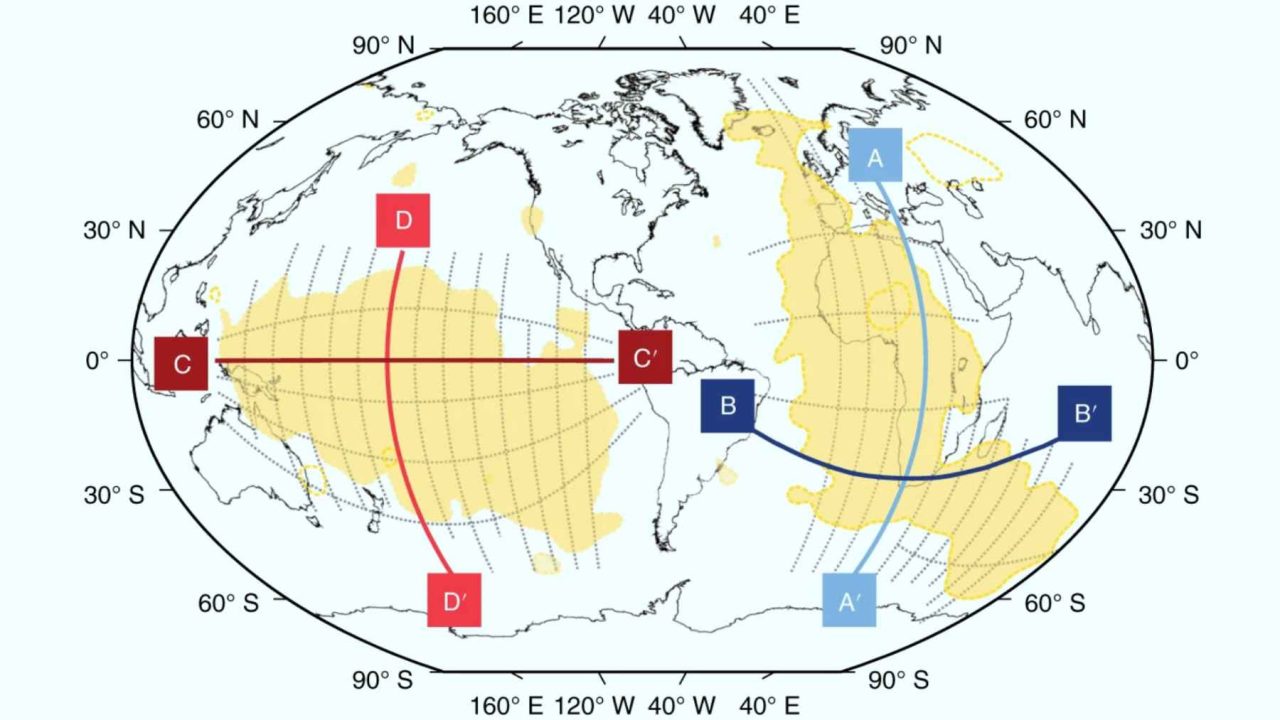
Using those methods, researchers have identified two enormous structures sitting at the base of the mantle, approximately 2,900 kilometers below the surface. One lies beneath Africa. The other sits under the Pacific Ocean. Both appear significantly hotter than the surrounding mantle rock, and both are roughly continental in scale.
These formations sit directly on top of the liquid outer core — the region where Earth’s magnetic field is generated. The new UK-led research suggests these hot rock piles have been influencing the behavior of that magnetic field for hundreds of millions of years.
Why the Magnetic Field Depends on What Happens Down There
Earth’s magnetic field isn’t generated by a permanent magnet at the planet’s center. It’s produced by the movement of electrically conductive liquid metal in the outer core — a process called the geodynamo. That movement is partly driven by differences in heat flow across the boundary between the mantle and the core.
This is where the two giant rock structures become critically important. Because they are hotter than the surrounding mantle, they alter the pattern of heat escaping from the core. Variations in that heat flow influence the circulation of the liquid metal, which in turn shapes the structure and behavior of the magnetic field above.
The researchers found evidence that these structures have been doing this — quietly steering the magnetic field — for an extraordinarily long stretch of geological time. That consistency is both reassuring and, in some respects, unsettling. It suggests the magnetic field’s behavior is tied to deep mantle features that evolve on timescales of hundreds of millions of years, making them difficult to model and harder to predict.
Key Facts at a Glance
| Feature | Detail |
|---|---|
| Depth of structures | Approximately 2,900 kilometers (about 1,800 miles) below the surface |
| Location of structures | One beneath Africa, one beneath the Pacific Ocean |
| Size | Continent-sized |
| Temperature | Hotter than the surrounding mantle rock |
| Boundary they sit on | The mantle-core boundary (base of the mantle) |
| Estimated influence duration | Hundreds of millions of years |
| Research origin | Led by geophysicists in the United Kingdom |
| Deepest human drilling | Just over 7 miles |
- The structures are sometimes informally referred to as “blobs” of hot rock
- They sit at the core-mantle boundary, one of the most geologically significant zones on Earth
- Heat flow variations from these structures help drive the circulation that generates the geodynamo
- Scientists use seismic wave data and other indirect measurements to study them, since direct access is impossible
What This Means for the Rest of Us
The magnetic field isn’t an abstract scientific concern. It deflects harmful solar radiation that would otherwise strip away the atmosphere and bombard the surface with charged particles. Without it, life on Earth would look very different — or might not exist at all.
Power grids, satellite communications, and GPS systems are all vulnerable when the magnetic field fluctuates. Major geomagnetic storms — caused by solar activity interacting with the field — have already knocked out power infrastructure in the past and remain a genuine risk today.
The field has also reversed its polarity many times throughout Earth’s history, with north and south magnetic poles flipping. During those transitions, the field weakens significantly. Understanding what controls the field’s long-term behavior — including the role of these deep mantle structures — is directly relevant to predicting how stable, or unstable, that field might be in the future.
The new research raises the possibility that these deep structures are a more fundamental driver of magnetic field behavior than previously appreciated, which adds a new layer of complexity to how scientists model and forecast geomagnetic change.
What Researchers Still Don’t Know — and What Comes Next
The study opens questions as much as it answers them. The mechanisms by which these hot rock piles interact with the core and influence the geodynamo over geological time are still being mapped out.
Scientists will continue using seismic imaging and geophysical modeling to refine their understanding of how heat moves across the core-mantle boundary and what that means for the magnetic field’s future. As computational tools improve, models of the deep Earth are becoming more detailed — but the core-mantle boundary remains one of the least accessible and least understood regions of the planet.
What this study makes clear is that the magnetic field protecting every living thing on Earth isn’t just the product of what’s happening in the liquid core. It’s shaped, in part, by two enormous masses of hot rock that have been sitting in silence nearly 2,900 kilometers below us for longer than dinosaurs have existed.
Frequently Asked Questions
What are the two structures found at the base of Earth’s mantle?
They are two continent-sized regions of unusually hot rock located approximately 2,900 kilometers below the surface — one beneath Africa and one beneath the Pacific Ocean — sitting at the boundary between the mantle and the liquid outer core.
How do these structures affect Earth’s magnetic field?
Because they are hotter than surrounding mantle rock, they alter patterns of heat flow at the core-mantle boundary, which influences the circulation of liquid metal in the outer core that generates Earth’s magnetic field.
How long have these structures been influencing the magnetic field?
According to the study, the structures appear to have been shaping the magnetic field for hundreds of millions of years.
Who conducted this research?
The study was led by geophysicists based in the United Kingdom, according to Specific institutional affiliations were not confirmed in the available
Could these structures cause the magnetic field to weaken or collapse?
The study raises new questions about the future stability of the magnetic field, but specific predictions about weakening or collapse have not been confirmed in the available source material.
How do scientists study regions so deep underground?
Since humans have only drilled about seven miles into the Earth, scientists rely on seismic waves — vibrations generated by earthquakes — and other geophysical measurements to infer conditions deep inside the planet.


Leave a Reply