
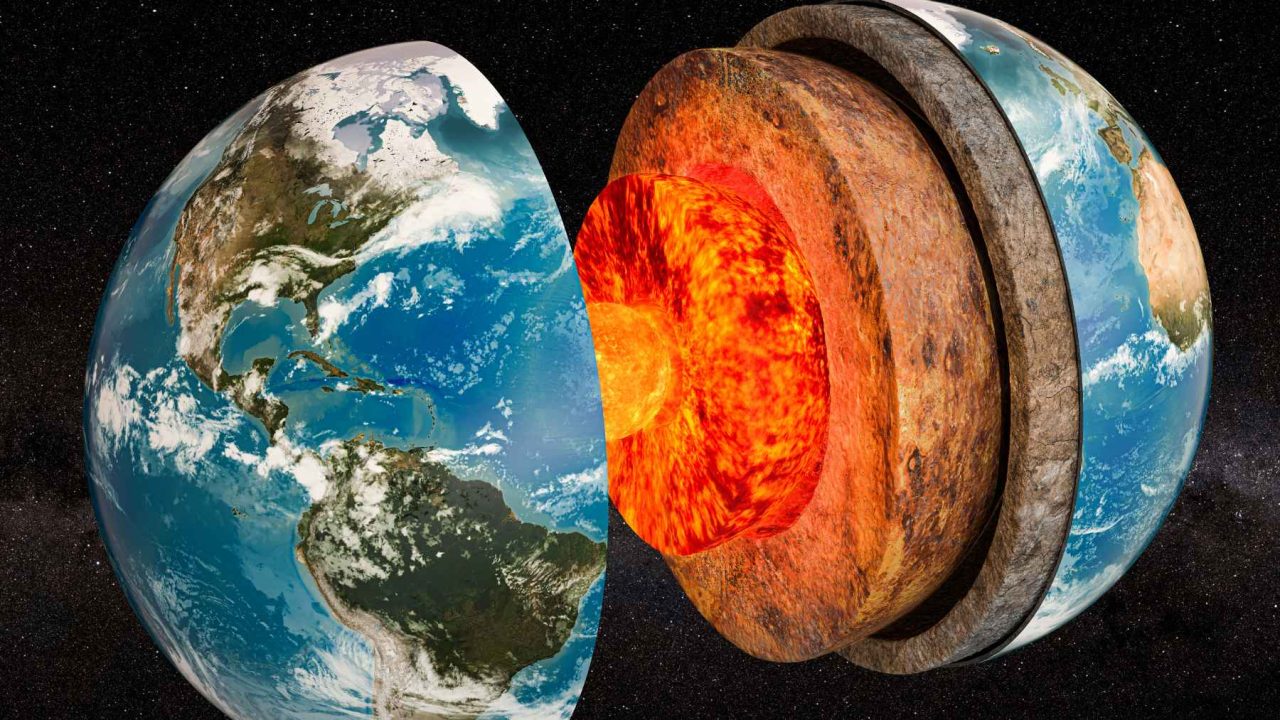
Earth’s core may be hiding enough hydrogen to fill between nine and forty-five times the volume of every ocean on the planet’s surface combined. That single finding, produced by researchers from Peking University and ETH Zurich, is quietly rewriting one of science’s oldest debates: where did Earth’s water actually come from?
For decades, the leading theory pointed outward — to comets and water-rich asteroids crashing into the early Earth and delivering their icy cargo. It was a tidy story. This new research suggests the real source of much of our water may have been inside the planet all along, locked in metallic iron thousands of kilometers beneath our feet.
Every glass of water you pour carries that unresolved question. And now, scientists have reason to believe the answer lies somewhere no drill will ever reach.
What Researchers Actually Found Deep Inside the Planet
The study centers on Earth’s core, which sits more than three thousand kilometers below the surface. At those depths, pressure and temperature become almost incomprehensible — and that’s exactly where this research focused.
Scientists from Peking University and ETH Zurich designed experiments to simulate those extreme conditions in a laboratory setting. They squeezed tiny samples of iron and hydrous silicate glass inside diamond anvil cells, devices capable of generating extraordinary pressure by pressing materials between two diamond tips.
The team reached pressures above one hundred gigapascals and temperatures above five thousand kelvin — conditions that closely mimic what exists at Earth’s core. What they found was that hydrogen can be stored inside metallic iron alongside silicon and oxygen under those conditions, effectively trapping it in a form that would never naturally rise to the surface on its own.
The implication is significant. If that stored hydrogen were ever to combine with oxygen to form water, the resulting volume would represent dozens of hidden oceans buried at the center of the planet.
Why This Challenges Everything We Thought We Knew About Earth’s Oceans
The prevailing model of Earth’s water origin has long leaned on external delivery. Comets and carbonaceous asteroids, rich in ice and hydrated minerals, were thought to have bombarded the early Earth during a period known as the Late Heavy Bombardment. That impact-driven delivery, the theory goes, seeded the planet with the water that eventually filled its oceans.
This new research doesn’t erase that theory entirely, but it forces a serious reassessment. If Earth’s core holds vastly more hydrogen than all surface water combined, then the planet may have had an enormous internal water reservoir from the very beginning — one formed during the planet’s original accretion, when iron and silicate materials were pulled together under intense heat and pressure.
That changes not just where Earth’s water came from, but potentially when it arrived and how the oceans themselves formed over geological time. Researchers now need to account for the possibility that water didn’t just fall from the sky — it may have leaked, slowly, from the inside out.
The Numbers Behind the Discovery
| Parameter | Value |
|---|---|
| Estimated hydrogen stored in Earth’s core | 9 to 45 times the volume of all surface oceans |
| Depth of Earth’s core | More than 3,000 kilometers below the surface |
| Pressure reached in lab simulations | Above 100 gigapascals |
| Temperature reached in lab simulations | Above 5,000 kelvin |
| Research institutions involved | Peking University and ETH Zurich |
The range between nine and forty-five times is wide, and scientists acknowledge that uncertainty. The core remains inaccessible to direct measurement, which means these estimates depend on modeling and experimental inference rather than direct sampling.
What This Means for Our Understanding of Planetary Formation
Beyond Earth, this research carries implications for how scientists think about water on other rocky planets. If hydrogen can be sequestered inside a planet’s iron core during formation — not just delivered later by asteroid impacts — then water-bearing planets may be far more common than current models suggest.
It also raises questions about planetary outgassing. As a planet cools and its interior evolves over billions of years, materials trapped in the core can migrate upward through volcanic activity and tectonic processes. Some researchers now argue that a meaningful portion of Earth’s surface water may have been released gradually from the interior, rather than arriving in a single dramatic bombardment phase.
- Earth’s core stores hydrogen bonded within metallic iron, silicon, and oxygen
- That hydrogen, if converted to water, would represent dozens of hidden oceans
- The findings challenge the long-held asteroid and comet delivery model
- Diamond anvil cell experiments simulated core conditions in a laboratory setting
- The research was conducted jointly by Peking University and ETH Zurich
The asteroid delivery model isn’t being abandoned — isotopic evidence still supports some external contribution to Earth’s water budget. But the balance of that contribution may need to be dramatically revised downward.
What Scientists Still Need to Figure Out
The core cannot be sampled directly, and that limitation shapes everything. Researchers must rely on seismic data, high-pressure experiments, and computational modeling to draw conclusions about what exists thousands of kilometers below the surface. Each method introduces its own uncertainties.
The next phase of this research will likely focus on how hydrogen might migrate from the core to the mantle and eventually toward the surface — and over what timescales that process could operate. Understanding the mechanism of release is just as important as confirming the reservoir exists in the first place.
For now, the finding stands as one of the more disorienting shifts in Earth science in recent years. The oceans didn’t just arrive from space. They may have, at least in part, come from within — from a deep, pressurized darkness that formed when the planet itself was born.
Frequently Asked Questions
Who conducted this research on Earth’s core and water?
The study was carried out by researchers from Peking University and ETH Zurich, who used high-pressure laboratory experiments to simulate conditions at Earth’s core.
How much water could Earth’s core potentially contain?
According to the research, Earth’s core may store between nine and forty-five times more hydrogen than all of the planet’s surface oceans combined — enough to represent dozens of hidden oceans if that hydrogen were converted to water.
How did scientists simulate Earth’s core in a lab?
The team used diamond anvil cells to compress tiny samples of iron and hydrous silicate glass, reaching pressures above one hundred gigapascals and temperatures above five thousand kelvin — conditions that closely mirror those found at Earth’s core.
Does this mean asteroids and comets didn’t bring water to Earth?
Not necessarily. The findings challenge the dominance of the external delivery model but do not eliminate it entirely — the research suggests that internal sources may have played a far larger role than previously understood.
Can scientists directly access Earth’s core to confirm this?
No. The core lies more than three thousand kilometers below the surface and is completely inaccessible to direct drilling or sampling, meaning conclusions must be drawn from experiments and indirect measurements.
Why does the estimated range vary so widely — nine to forty-five times?
The wide range reflects the inherent uncertainty of modeling conditions that cannot be directly observed or sampled, as the core remains entirely beyond the reach of current technology.



Leave a Reply