
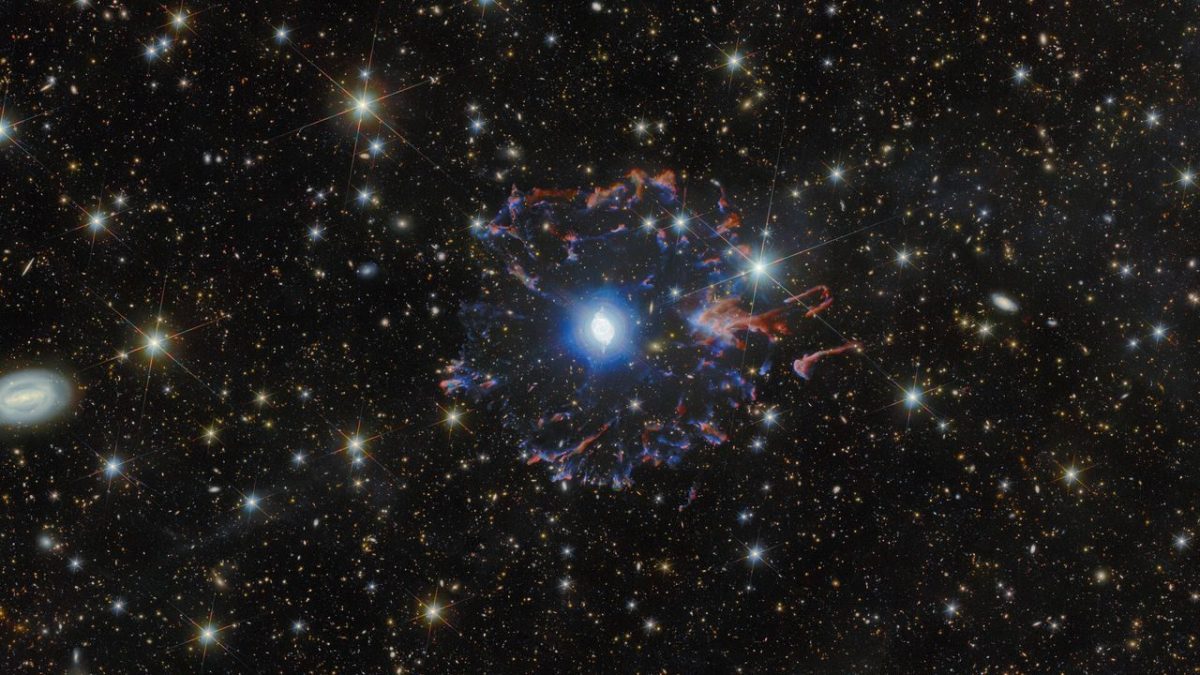
Some 4,300 light-years away, in the constellation Draco, a star is dying — and two of the most powerful space telescopes ever built just caught the whole spectacular show on camera.
The result is one of the most striking space images released in recent memory: a swirling, glowing structure of blue, orange, and red gas rings racing outward from a collapsing star, set against a deep backdrop of distant galaxies and stars. This is the Cat’s Eye Nebula, also catalogued as NGC 6543, and the new imagery of it is genuinely breathtaking.
The image was shared on March 3, 2026, and was captured through a collaboration between two major observatories — NASA’s Hubble Space Telescope and the European Space Agency’s Euclid telescope — combining their distinct capabilities to reveal the nebula in extraordinary detail.
What Exactly Is the Cat’s Eye Nebula?
The Cat’s Eye Nebula is what astronomers call a planetary nebula — a term that, despite sounding like it involves planets, actually describes the glowing shell of gas and plasma ejected by a dying star. When a mid-sized star like our own Sun nears the end of its life, it swells into a red giant, sheds its outer layers, and leaves behind a dense, hot stellar core called a white dwarf. The expelled material forms these luminous, expanding clouds.
NGC 6543 is one of the most studied and most visually complex planetary nebulae ever discovered. Its intricate, layered structure — with concentric rings, jets, and knotted filaments of gas — suggests the star’s death was not a simple, uniform event. Instead, astronomers believe the star shed material in multiple stages over thousands of years, each pulse of ejected gas forming another glowing shell around the last.
The vivid colors visible in the new image — blues, oranges, reds — correspond to different gases at different temperatures, all racing away from the dying stellar core at the center. It is, in the most literal sense, a star coming apart.
Why Two Telescopes Were Better Than One
The new image is the product of a deliberate pairing: Hubble and Euclid each bring different strengths to the table, and together they create a picture neither could produce alone.
Hubble, which has been in operation for decades, is renowned for its ability to capture fine detail in visible and ultraviolet light. It has imaged the Cat’s Eye Nebula before, producing some of the most iconic space photography in history. But Hubble’s field of view is relatively narrow — it sees deep, but not always wide.
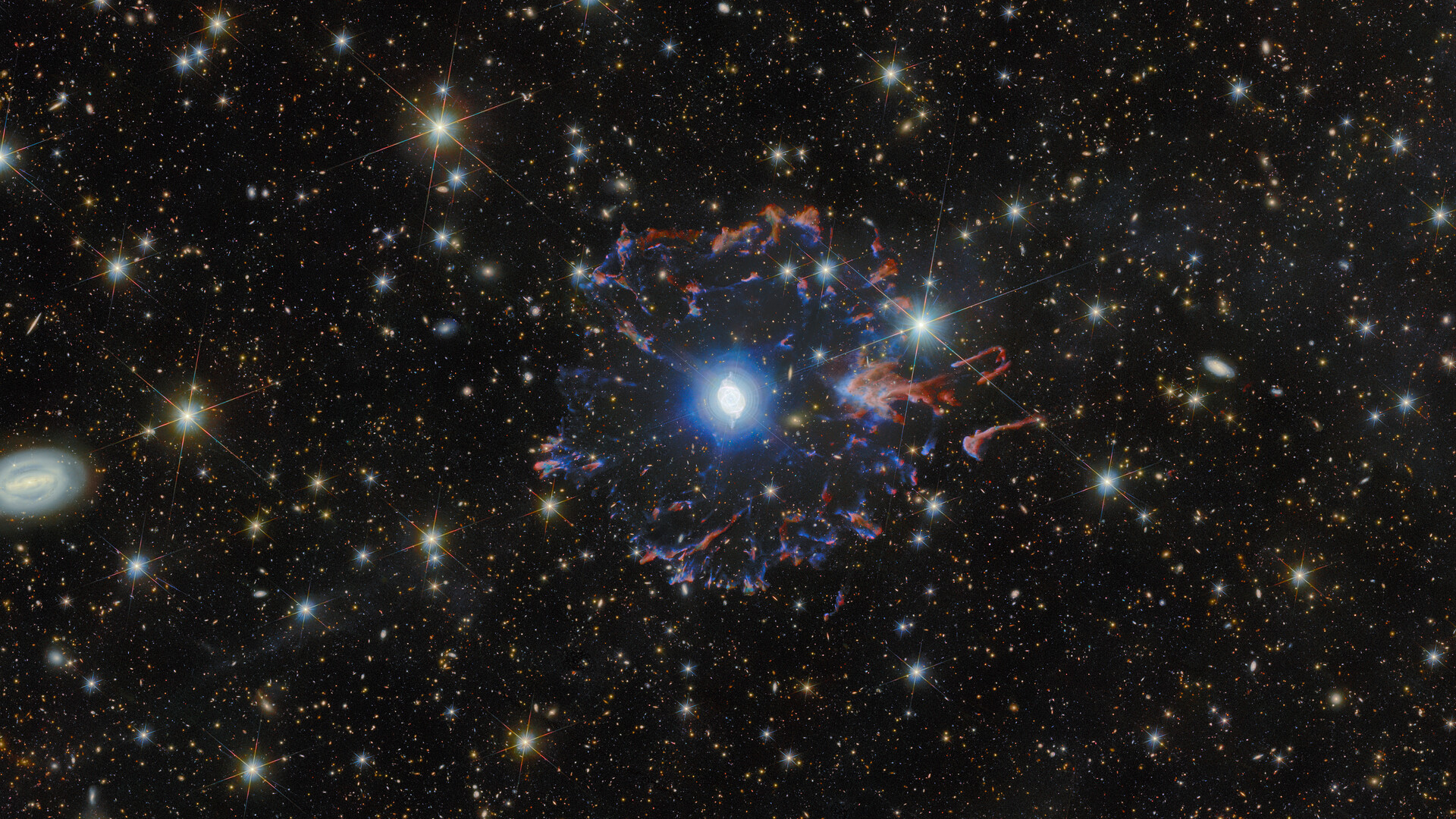
Euclid, a newer ESA mission, was designed to survey vast stretches of the sky to map the large-scale structure of the universe. Its wide-field capability allows it to capture enormous cosmic scenes, including the rich field of background galaxies and stars that frame the Cat’s Eye in this latest image.
Together, the telescopes provide both the intimate close-up detail of the nebula’s interior structure and the sweeping cosmic context that makes the image feel genuinely immersive.
Key Facts About the Cat’s Eye Nebula
| Detail | Information |
|---|---|
| Official designation | NGC 6543 |
| Common name | Cat’s Eye Nebula |
| Distance from Earth | Approximately 4,300 light-years |
| Location in sky | Constellation Draco |
| Type of object | Planetary nebula |
| Image release date | March 3, 2026 |
| Telescopes used | Hubble (NASA/ESA) and Euclid (ESA/Euclid Consortium/NASA) |
- The nebula’s glowing rings appear in blue, orange, and red, representing different gases at varying temperatures
- The structure is distorted, suggesting multiple distinct phases of mass ejection from the dying star
- The image was set against a rich backdrop of distant galaxies and stars, captured by Euclid’s wide-field instruments
- Image credit includes contributions from J.-C. Cuillandre, E. Bertin (CEA Paris-Saclay), and Z. Tsvetanov
Why This Image Matters Beyond the Beauty
It would be easy to look at something like this and treat it purely as cosmic wallpaper — gorgeous, distant, and irrelevant to daily life. But planetary nebulae like NGC 6543 carry real scientific weight.
The elements scattered outward in these stellar death events — carbon, oxygen, nitrogen, and heavier metals — are the raw ingredients of future stars, planets, and potentially life. Our own solar system was seeded by material from stellar explosions and mass-loss events like this one, billions of years before Earth existed.
Studying the Cat’s Eye Nebula in this level of detail helps astronomers understand how stars like our Sun will eventually die, what timescales those processes operate on, and how the material gets redistributed through the galaxy. The complex, layered structure visible in the new image also poses questions that researchers are still working to answer — why is the geometry so irregular? What drove each distinct pulse of mass ejection?
The combination of Hubble’s precision and Euclid’s wide-field reach gives scientists more data to work with than either mission could provide independently.
What Comes Next for Euclid and Hubble
The release of this image coincides with the early science output phase from Euclid, which has been gradually releasing observations since beginning its sky survey mission. The telescope’s Q1-2025 data release contributed to this image, suggesting researchers are actively mining Euclid’s growing archive for scientifically valuable targets.
Hubble, despite its age, continues to contribute meaningfully to modern astronomy — particularly when paired with newer instruments that can complement its capabilities. Collaborative imaging efforts like this one represent an increasingly common approach in the field, with different telescopes assigned to tasks that suit their strengths.
For the Cat’s Eye Nebula specifically, this new combined image is likely to prompt renewed scientific interest in one of the sky’s most photogenic — and scientifically complex — stellar remnants.
Frequently Asked Questions
What is the Cat’s Eye Nebula?
The Cat’s Eye Nebula, also known as NGC 6543, is a planetary nebula — a glowing shell of gas and plasma expelled by a dying star, located approximately 4,300 light-years from Earth in the constellation Draco.
Which telescopes captured this new image?
The image was captured using a combination of NASA’s Hubble Space Telescope and the European Space Agency’s Euclid telescope, with contributions from the Euclid Consortium and NASA.
When was this image released?
The image was shared on March 3, 2026.
What do the colors in the image represent?
The blue, orange, and red colors visible in the nebula correspond to different gases at different temperatures, all expanding outward from the dying star at the center.
How far away is the Cat’s Eye Nebula?
It is approximately 4,300 light-years from Earth.


Leave a Reply