
A sweeping new survey of roughly 8,000 supermassive black holes has turned up a striking finding: the universe’s most voracious cosmic monsters are slowly starving to death. After billions of years of consuming enormous quantities of gas, the hungriest black holes appear to be running out of fuel — and that discovery is reshaping how astronomers think about the long-term evolution of galaxies.
For years, one of the more stubborn mysteries in astrophysics has been why the biggest black holes in the universe have been growing far more slowly over the past 10 billion years. The new study offers a compelling answer: it’s not a mechanical slowdown — it’s a food shortage.
The research, which analyzed thousands of these cosmic giants, points to a dramatic decline in the availability of gas that supermassive black holes need to grow. And the implications stretch well beyond black hole science, touching on how entire galaxies live and die.
Why the Biggest Black Holes in the Universe Are Slowing Down
Supermassive black holes grow by consuming surrounding gas. When gas falls into a black hole, it forms a superheated accretion disk that blazes with energy — sometimes outshining entire galaxies. These active, feeding black holes are known as quasars, and they were far more common in the early universe.
The puzzle has always been: why did they slow down? The universe still exists. Gas still exists. So why aren’t the biggest black holes still feeding at the same ferocious pace they once did?
The new survey, covering around 8,000 supermassive black holes, provides a data-driven answer. The evidence suggests that as the universe aged, the supply of cold, dense gas — the kind that actually feeds black holes efficiently — became increasingly scarce around the most massive objects. Without a steady supply of that gas, even the hungriest black holes simply can’t keep growing at the same rate.
What the Survey of 8,000 Black Holes Actually Found
The scale of this survey is what makes it significant. Studying thousands of black holes across different cosmic eras allows researchers to track how feeding rates have changed over billions of years — something no single observation could reveal.
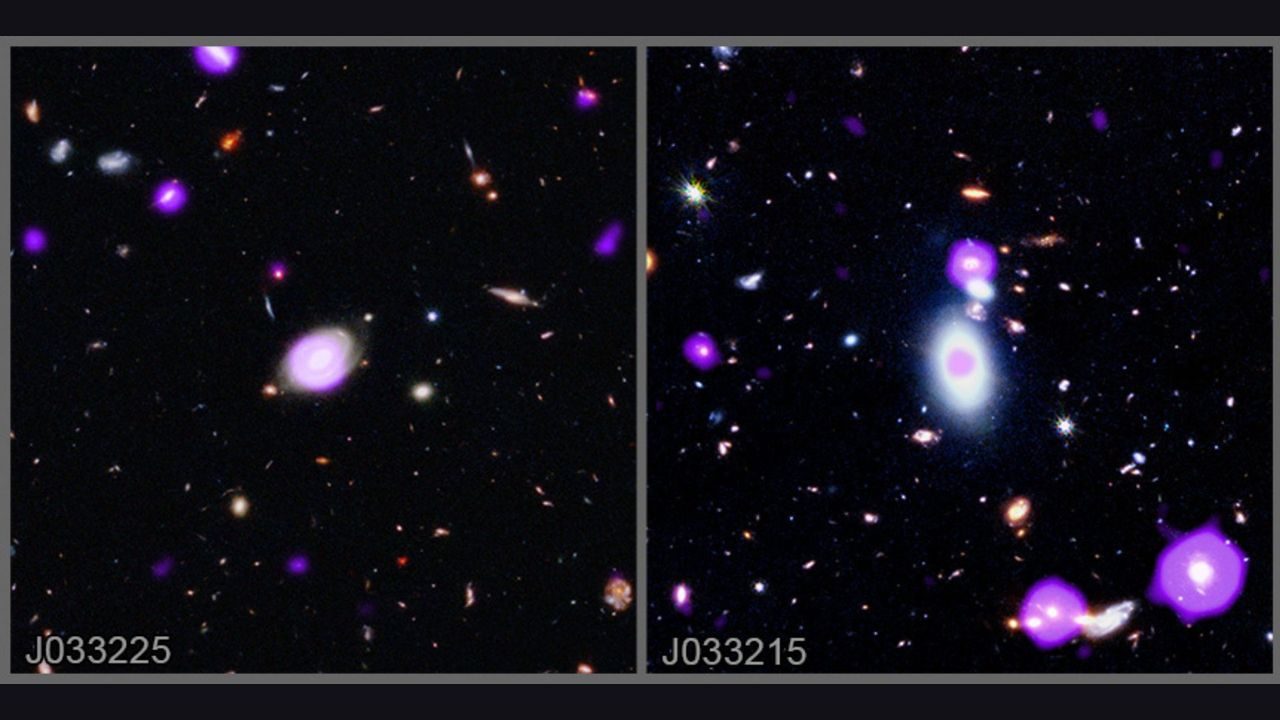
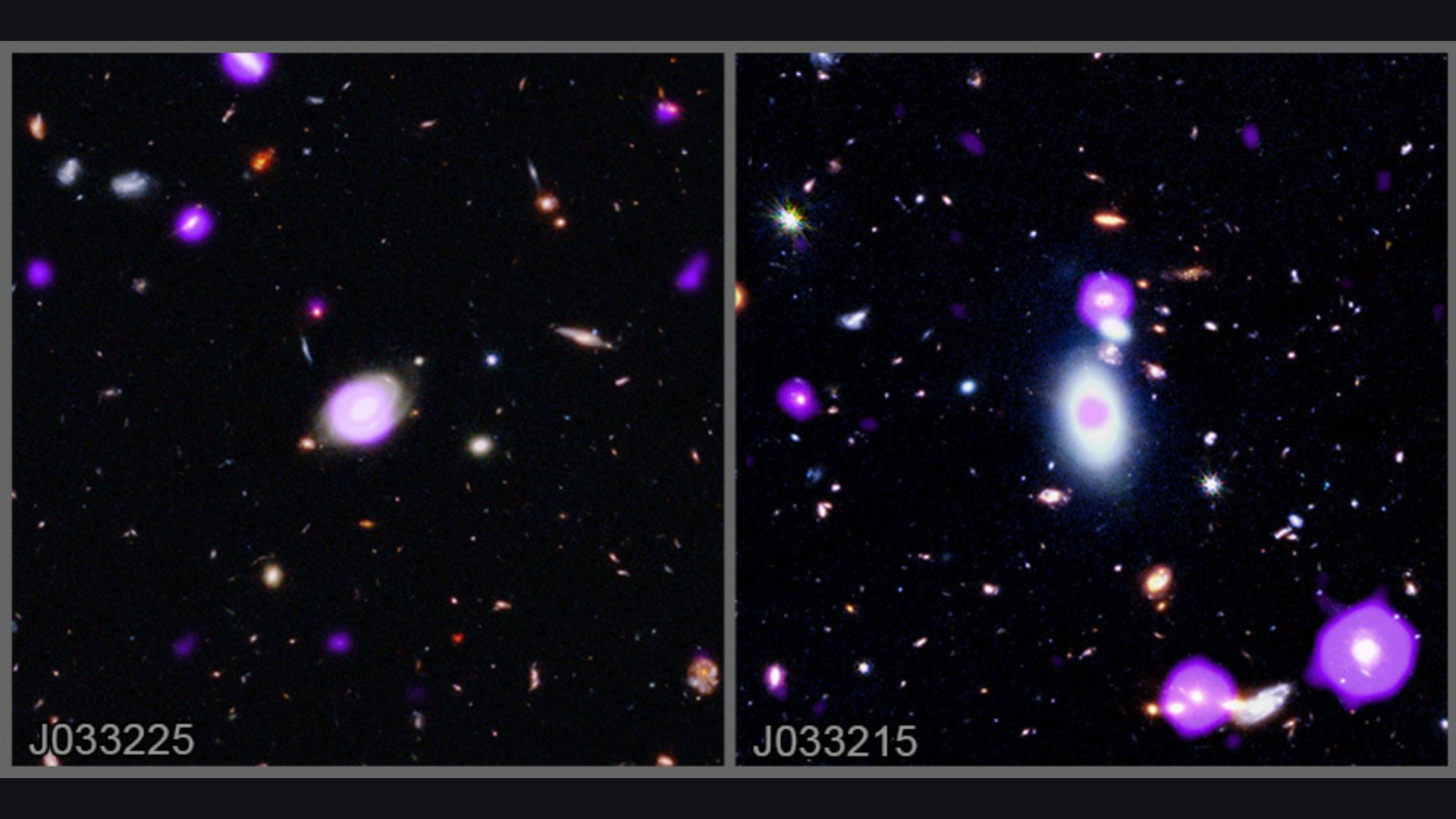
One striking visual example from the research involves two galaxies: Galaxy J033225 and Galaxy J033215. In X-ray imaging, J033225 shines dramatically brighter than J033215 — a direct reflection of its higher rate of gas consumption. That difference in brightness isn’t just aesthetic. It’s a measurable record of how much material a black hole is actively pulling in.
X-ray brightness is one of the most reliable indicators astronomers have for black hole feeding activity. The hotter and more energetic the material falling into a black hole, the more X-ray light it emits. By comparing X-ray signatures across thousands of black holes at different distances — and therefore different points in cosmic history — researchers can build a timeline of how black hole appetite has changed.
| Galaxy | X-ray Brightness | Reason |
|---|---|---|
| J033225 | Higher | Increased gas consumption by its black hole |
| J033215 | Lower | Reduced gas consumption by its black hole |
The imaging used in this research drew on data from multiple major observatories, including NASA’s Chandra X-ray Observatory, the Hubble Space Telescope, and the James Webb Space Telescope — a combination that allowed for unusually detailed cross-wavelength analysis.
The Cosmic Food Supply Problem
The core finding is essentially this: the universe used to be a much better place to be a hungry black hole. In the early cosmos, gas was abundant, chaotic, and frequently funneled toward galactic centers where supermassive black holes waited. Mergers between young galaxies were common, and those collisions drove enormous quantities of gas inward — straight into the feeding zones of black holes.
As the universe matured and expanded, that environment changed. Galaxy mergers became less frequent. The gas that once fueled explosive black hole growth became more spread out, more diffuse, and harder to capture efficiently. The largest black holes — the ones that had already consumed so much — found themselves in increasingly gas-poor neighborhoods.
This is a meaningful distinction. It’s not that some internal mechanism shut the black holes off. The engines are still there, still capable of consuming material. They’re just not getting enough delivered to them anymore.
Why This Changes How We Think About Galaxies
Black holes and their host galaxies don’t exist independently — they grow together, influence each other, and in many cases, regulate each other. When a supermassive black hole is actively feeding, it releases enormous amounts of energy that can heat surrounding gas and actually prevent new stars from forming. This process, called feedback, is thought to be a key reason why some massive galaxies stopped producing new stars billions of years ago.
If the biggest black holes are now starved of gas, that feedback mechanism weakens. But the galaxies that host them may already be so large and so gas-depleted that it doesn’t matter much — they’ve already largely stopped forming new stars anyway.
The starvation of the universe’s largest black holes, then, isn’t just a story about black holes. It’s part of a broader narrative about how the most massive structures in the cosmos gradually wind down over cosmic time.
What Comes Next for This Research
A survey of 8,000 black holes is impressive, but researchers are likely to push further. The combination of X-ray, optical, and infrared data used in this study represents a template for future large-scale surveys that could examine even more black holes across a wider range of cosmic epochs.
Future observations with next-generation telescopes may help pin down exactly when the gas supply began to decline most sharply, and whether the starvation process is uniform across black holes of different sizes or whether smaller supermassive black holes are still feeding more actively than their giant counterparts.
For now, the picture emerging from this research is one of gradual cosmic quieting — a universe where the most dramatic feeding frenzies are largely in the past, and the biggest black holes are left waiting for a meal that may never fully arrive.
Frequently Asked Questions
Why are the biggest black holes running out of food?
According to the new study, the supply of gas that supermassive black holes need to grow has declined significantly over the past 10 billion years, leaving even the hungriest black holes with less material to consume.
How many black holes were studied in this survey?
The survey examined approximately 8,000 supermassive black holes, making it a large-scale analysis of how black hole feeding rates have changed across cosmic history.
What do the two galaxies J033225 and J033215 show us?
Galaxy J033225 shines brighter in X-rays than Galaxy J033215 because its black hole is consuming more gas — a direct, measurable illustration of how feeding rates differ between black holes.
What telescopes were used in this research?
The research drew on data from NASA’s Chandra X-ray Observatory, the Hubble Space Telescope, and the James Webb Space Telescope, combining X-ray, optical, and infrared observations.
Does this mean black holes will eventually stop growing entirely?
How does black hole starvation affect the galaxies around them?
Black holes and their host galaxies are closely linked — when black holes feed less actively, the energetic feedback that can suppress star formation also weakens, though many massive host galaxies have already largely stopped forming new stars.


Leave a Reply