
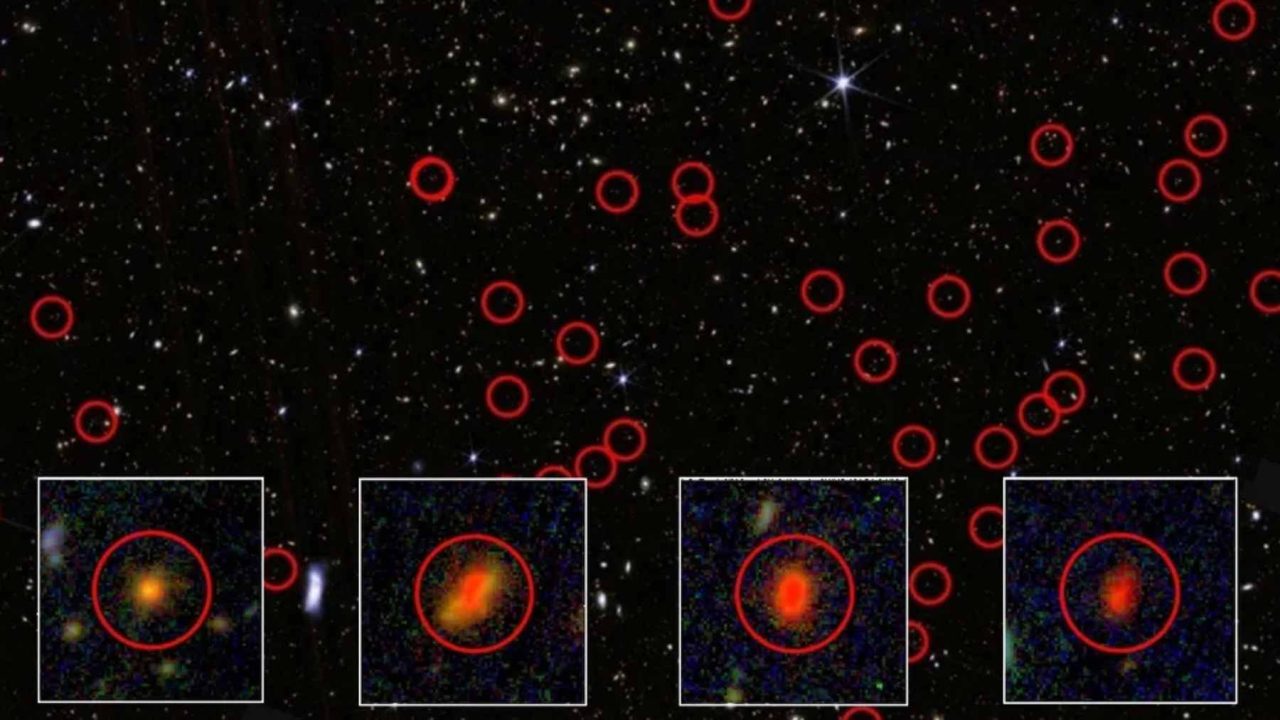
Astronomers expected Webb to find distant galaxies. What they found instead may rewrite how we understand the earliest black holes in the universe.
Since the James Webb Space Telescope began its science operations, researchers have been puzzled by a peculiar class of objects: tiny, bright, reddish points of light scattered across the early universe. They were especially common during the universe’s first 1.5 billion years. Nobody could quite agree on what they were. Now, a new study based on Webb data offers a striking answer — and it flips the original interpretation on its head.
These objects, nicknamed “little red dots,” may not be unusual or impossibly massive galaxies at all. Instead, researchers now argue they are young black holes growing at a breakneck pace, wrapped inside extraordinarily dense cocoons of ionized gas.
What the Little Red Dots Actually Are
When Webb first captured these objects, many astronomers assumed they were compact galaxies — dense collections of stars that formed unusually early in cosmic history. That interpretation created real problems. Some of these objects appeared so bright and so massive that they challenged existing models of how galaxies form and grow.
The new study suggests the scientific community may have been misreading the evidence from the start. The key issue comes down to how astronomers interpret light spectra — the chemical fingerprints that telescopes collect from distant objects.
Broad hydrogen and helium lines in the spectra of these objects were initially read as signs of gas moving at extreme speeds, which is a classic indicator of an active, feeding black hole known as an active galactic nucleus. But the new research argues that in many of the best observations, those broad lines are shaped primarily by electron scattering inside extraordinarily dense gas — not by raw velocity alone.
That distinction changes everything. If the broad spectral lines are a product of scattering rather than pure motion, it means the objects are compact galaxies powered by growing supermassive black holes, surrounded by dense cocoons of ionized gas that have been distorting the signal astronomers were reading.
Why This Finding Matters for Our Understanding of Black Holes
The little red dots had already created a headache for astronomers because of what they were not doing. Active black holes — known as quasars or active galactic nuclei — are typically bright in X-rays and radio waves. These objects appeared surprisingly weak in both. That made them hard to fit into the standard picture of a growing supermassive black hole.
The dense gas cocoon explanation helps resolve that tension. If these young black holes are buried deep inside thick clouds of ionized gas, the surrounding material could absorb or scatter the X-ray and radio emissions that would otherwise give them away. The black holes would still be there, still feeding rapidly, but hidden behind a veil that made them look different from the quasars astronomers already knew how to recognize.
The broader implication is significant. If many of the little red dots are actually rapidly growing black holes rather than extreme galaxies, it changes how scientists account for the mass and energy budget of the early universe — and raises new questions about how supermassive black holes grew so large so quickly after the Big Bang.
Key Facts About the Little Red Dots
- They are tiny, bright, and reddish in appearance — compact by astronomical standards
- They were especially common during the universe’s first 1.5 billion years
- They appeared surprisingly weak in X-ray and radio emissions, unlike typical active black holes
- Their broad hydrogen and helium spectral lines were initially interpreted as signs of extreme gas velocities
- The new study argues those lines are shaped mainly by electron scattering inside dense ionized gas
- Researchers now describe them as compact galaxies powered by growing supermassive black holes inside dense gas cocoons
| Feature | Original Interpretation | New Interpretation |
|---|---|---|
| Object type | Unusual compact galaxies | Young growing black holes |
| Broad spectral lines | Gas moving at extreme speeds | Electron scattering in dense gas |
| Weak X-ray and radio signal | Unexplained anomaly | Obscured by dense ionized gas cocoon |
| Time period of prevalence | First 1.5 billion years of universe | First 1.5 billion years of universe |
| Primary energy source | Star formation in compact galaxy | Supermassive black hole accretion |
The Part of This Story Most Reports Are Missing
What makes this finding genuinely important is not just the reclassification of a handful of strange objects. It is the methodological lesson buried inside it.
Astronomers have long relied on broad spectral emission lines as a reliable signal for active black holes. The assumption was straightforward: wider lines mean faster-moving gas, and faster-moving gas near a massive object means a black hole is feeding. The little red dots exposed a blind spot in that reasoning.
When gas is dense enough, electrons scatter light in ways that can mimic the appearance of high-velocity motion in a spectrum. Without accounting for that effect, even careful astronomers can misread what they are seeing. The Webb data, with its unprecedented sensitivity and resolution, gave researchers enough detail to spot the difference — and that capability is exactly what the telescope was built to provide.
It is a reminder that better tools do not just find new things. They also correct old assumptions that seemed perfectly reasonable at the time.
What Comes Next for Webb and Black Hole Research
This study adds to a growing body of research suggesting that the early universe contained far more actively growing black holes than previously recognized — many of them hiding behind gas and dust that earlier telescopes could not see through.
Webb’s ability to observe in infrared light, which penetrates dust more effectively than visible light, makes it uniquely suited to finding these hidden objects. Researchers are expected to continue analyzing Webb data to determine how widespread the little red dot population truly is, and what role these rapidly growing black holes played in shaping the galaxies around them in the universe’s earliest chapters.
The question that opened this story — what if the strangest lights in the early universe were not galaxies at all — now has a serious scientific answer. And if that answer holds up, it means the universe’s first billion years were even more active, and more chaotic, than anyone had imagined.
Frequently Asked Questions
What are the “little red dots” that Webb detected?
They are tiny, bright, reddish objects observed frequently in the early universe, particularly during its first 1.5 billion years. A new study suggests they are young black holes growing rapidly inside dense cocoons of ionized gas.
Why were these objects so hard to classify at first?
They appeared unusually weak in X-ray and radio emissions, which made them difficult to identify as active black holes using standard methods. Their spectral signals were also being misread, according to the new research.
What is electron scattering and why does it matter here?
Electron scattering occurs when light bounces off electrons inside very dense gas, which can make spectral lines appear broader than they actually are. The new study argues this effect was distorting the signals astronomers used to classify these objects.
Does this discovery change how we understand galaxy formation?
It potentially does, because it reframes many objects previously thought to be unusual compact galaxies as actively growing black holes — which affects how scientists model the early universe’s energy and mass distribution.
How did the James Webb Space Telescope make this finding possible?
Webb’s infrared sensitivity and resolution provided enough spectral detail for researchers to distinguish electron scattering effects from genuine high-velocity gas motion, a distinction previous telescopes could not reliably make.</p



Leave a Reply