
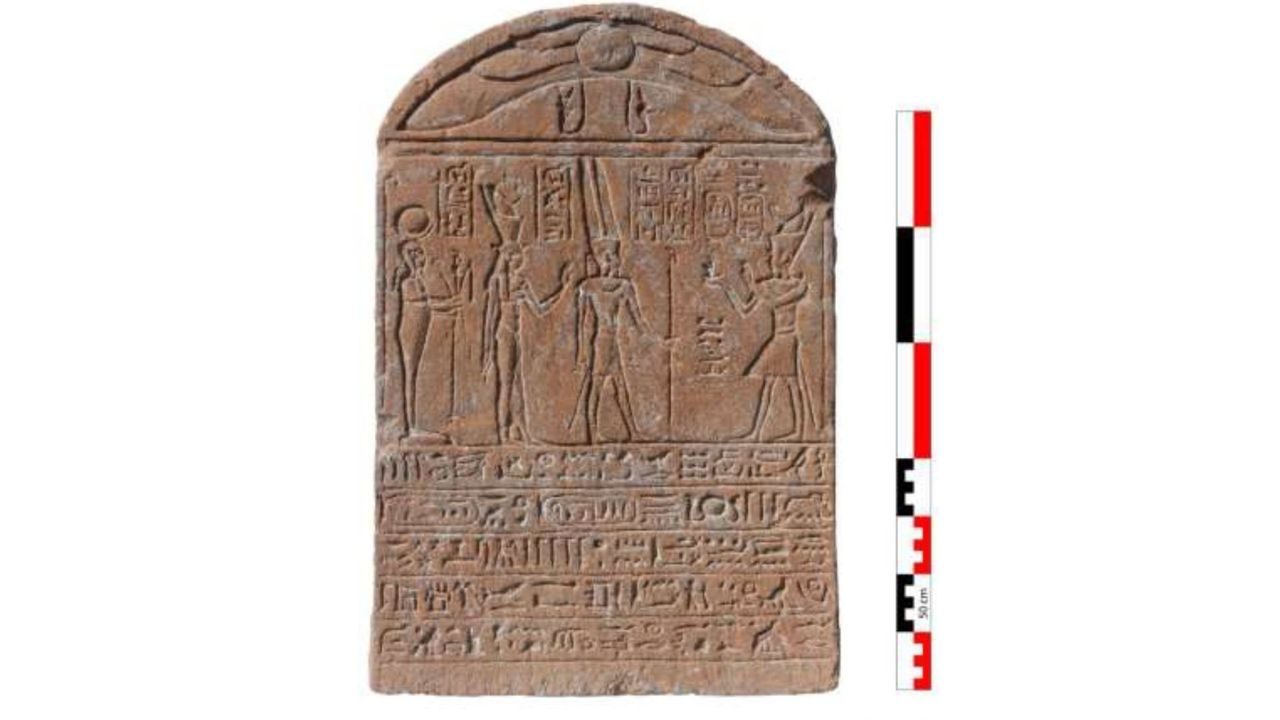
A 2,000-year-old sandstone slab unearthed at one of Egypt’s most celebrated ancient sites shows something that would have seemed extraordinary to modern eyes: a Roman emperor dressed and depicted as an Egyptian pharaoh, standing alongside the gods of ancient Thebes.
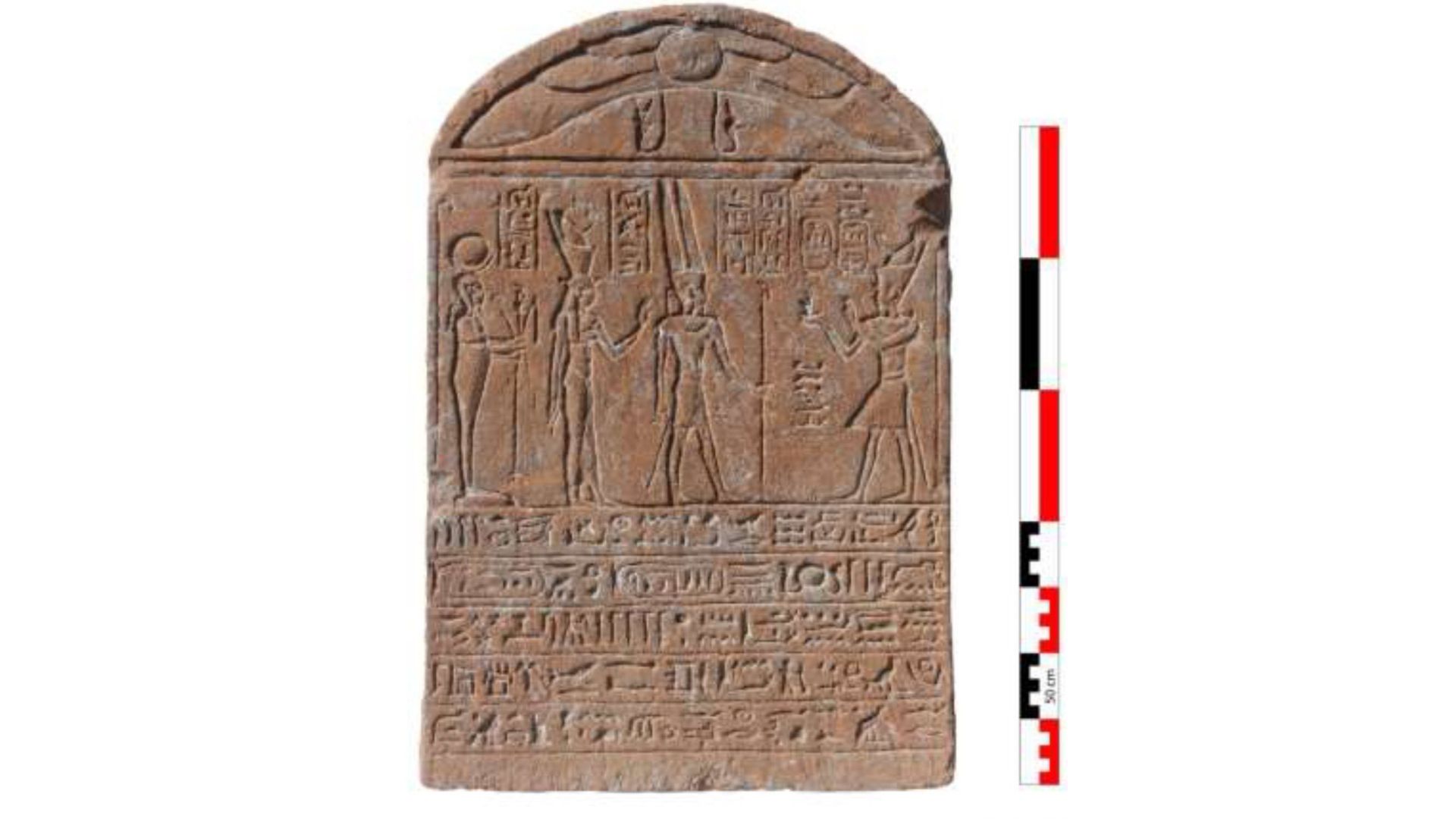
The discovery was made during restoration work at the Karnak temple complex in Luxor — the city known in antiquity as Thebes — and it offers a striking window into how Roman rulers worked to legitimize their authority over Egypt by adopting the visual language and religious traditions of the civilization they had conquered.
The monument dates to the reign of Emperor Tiberius, who ruled Rome from 14 CE to 37 CE, placing it firmly in the early decades of Roman control over Egypt. It is a small but historically resonant object — and its location inside one of the ancient world’s most sacred temple complexes makes the find all the more significant.
What Was Found at Karnak — and What It Shows
The artifact is a stela — a term archaeologists use for a standing stone slab, typically carved with images or inscriptions and used for commemorative or religious purposes. This particular stela is rectangular and made of sandstone, measuring approximately 23.6 by 15.7 inches (60 by 40 centimeters).
What makes it remarkable is its imagery. The carving depicts Emperor Tiberius in the style and regalia of an Egyptian pharaoh, positioned alongside three of ancient Egypt’s most important deities: Amun, Mut, and Khonsu — the divine triad most closely associated with the Karnak temple complex itself.
Amun was considered the king of the gods and one of the most powerful figures in the Egyptian pantheon. Mut was his consort, and Khonsu their son, a moon god. Together, they formed the sacred family at the heart of Theban religious worship. Being shown in their company was not a casual artistic choice — it was a deliberate statement of divine authority.
The stela was discovered during active restoration efforts at Karnak, announced by Egypt’s Ministry of Tourism and Antiquities.
Why Roman Emperors Presented Themselves as Pharaohs
This kind of monument was not unique to Tiberius. After Rome absorbed Egypt following the defeat of Cleopatra and Mark Antony in 30 BCE, Roman emperors faced a political and cultural challenge: how to rule a civilization with thousands of years of its own religious traditions, royal identity, and administrative systems.
Their solution was remarkably pragmatic. Rather than impose purely Roman imagery on Egyptian religious spaces, emperors allowed — and even encouraged — their portrayal in the traditional style of pharaohs. In temples across Egypt, Roman rulers appear wearing the double crown, offering gifts to Egyptian gods, and performing the ritual acts that had defined kingship along the Nile for millennia.
This was not conversion or sincere religious adoption. It was political theater, and it worked. By appearing as pharaohs within sacred Egyptian spaces, Roman emperors communicated to the local population that the divine order had not been broken — merely transferred. The gods still had a king. He just happened to speak Latin.
Tiberius, the emperor depicted on this stela, was the stepson and successor of Augustus, Rome’s first emperor. He was a relatively reclusive ruler by Roman standards, but monuments like this one demonstrate that the imperial machinery of cultural assimilation continued operating across the empire’s far reaches regardless of the emperor’s personal temperament.
Key Facts About the Discovery
| Detail | Information |
|---|---|
| Material | Sandstone |
| Type of monument | Stela (stele) |
| Dimensions | 23.6 × 15.7 inches (60 × 40 cm) |
| Emperor depicted | Tiberius (ruled 14–37 CE) |
| Deities shown | Amun, Mut, and Khonsu |
| Discovery location | Karnak temple complex, Luxor, Egypt |
| Approximate age | ~2,000 years |
| Found during | Restoration work at the site |
- The stela was found at Karnak, one of the largest religious complexes ever built — a site that was actively expanded and used for over 2,000 years before Roman rule
- Luxor, where Karnak is located, was known in ancient times as Thebes, the religious capital of Egypt during much of the New Kingdom period
- The Theban triad of Amun, Mut, and Khonsu were the presiding deities of Karnak — placing Tiberius alongside them was a direct claim to pharaonic legitimacy within this specific sacred space
Why This Find Still Matters Today
Discoveries like this one matter beyond their visual drama. They fill in the textured, complicated picture of how two of history’s greatest civilizations overlapped — not through simple domination, but through negotiation, adaptation, and the careful management of religious symbolism.
Egypt under Roman rule was not simply a conquered province stripped of its identity. It remained a place where ancient traditions held enormous power, and where even the world’s most dominant empire found it useful — essential, even — to speak the language of the pharaohs.
The Karnak complex itself is a layered record of that history. Rulers from across the ancient world left their marks there, and this stela adds one more chapter to that long story. The fact that it was found during routine restoration work is also a reminder of how much still lies undiscovered within Egypt’s most studied sites.
For archaeologists and historians, every new stela, inscription, or carved relief has the potential to refine our understanding of how power, religion, and identity intersected in the ancient world. This one, compact and precise at just 60 by 40 centimeters, carries a great deal of meaning in a small stone surface.
What Comes Next for the Stela
The discovery was announced by Egypt’s Ministry of Tourism and Antiquities. Further details about conservation plans, whether the stela will go on public display, or what additional analysis may be conducted have not yet been confirmed in available reporting.
Karnak remains an active archaeological site, and restoration projects there regularly surface new finds. This discovery is likely to prompt closer examination of the surrounding area where the stela was found, as grouped artifacts and related inscriptions often appear in proximity to one another.
Frequently Asked Questions
What is a stela?
A stela (also spelled stele) is a stone slab or pillar, typically carved with images or inscriptions, used in the ancient world for commemorative or religious purposes.
Which Roman emperor is depicted on the stela?
The stela depicts Emperor Tiberius, who ruled Rome from 14 CE to 37 CE, shown in the style of an Egyptian pharaoh.
Where exactly was the stela discovered?
It was found at the Karnak temple complex in Luxor, Egypt — the city known in ancient times as Thebes — during ongoing restoration work at the site.
Which Egyptian gods appear on the monument?
The stela shows Tiberius alongside Amun, Mut, and Khonsu — the divine triad most closely associated with the Karnak temple complex.
How big is the stela?
The sandstone monument measures approximately 23.6 by 15.7 inches, or 60 by 40 centimeters.
Why did Roman emperors portray themselves as pharaohs?
Roman rulers adopted pharaonic imagery in Egyptian religious spaces as a political strategy to legitimize their authority and signal continuity with Egypt’s ancient royal and religious traditions. This has not been confirmed specifically in relation to this stela, but is well-established historical context for Roman-era monuments found across Egypt.




Leave a Reply