
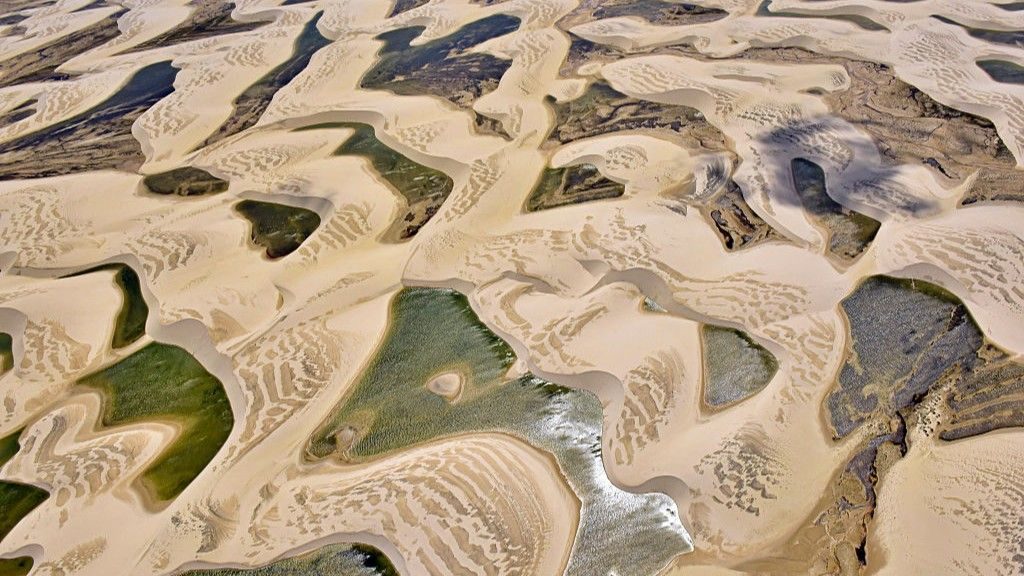
It looks like a desert. Endless white sand dunes stretch toward the horizon, sculpted by wind into soft, rolling ridges. But look closer — or wait for the rains to arrive — and the illusion breaks apart in the most spectacular way possible. Nestled between those dunes are thousands of shimmering blue and green lagoons, filling naturally every year in one of the most visually striking landscapes on Earth.
This is Lençóis Maranhenses National Park, located on Brazil’s northeast coast in the state of Maranhão. It is a place that defies easy categorization — not quite a desert, not quite a wetland, not quite like anywhere else on the planet.
For travelers, scientists, and nature enthusiasts, it represents something genuinely rare: a landscape that looks impossible but is entirely, beautifully real.
What Lençóis Maranhenses Actually Is
The name translates roughly to “bed sheets of Maranhão” — a reference to the way the vast white dunes spread across the land like linen thrown across a mattress. And while the visual comparison is poetic, the science behind this place is even more interesting.
Lençóis Maranhenses sits at a geographical crossroads, positioned at the intersection of three distinct biomes. That overlap creates ecological conditions found nowhere else, supporting plant and animal life that has adapted to an environment that swings dramatically between extremes — bone dry in one season, flooded in another.
The dunes themselves are composed of white quartz sand, and they are largely devoid of vegetation. That absence of plant life is what makes the landscape look so much like a classic desert. But the rainfall here is far too high for it to qualify as one. The region receives significant annual precipitation, and that rain is what triggers the park’s most famous feature.
Every rainy season, water collects in the natural basins formed between the dunes. Because the ground beneath is largely impermeable, the water cannot drain away easily. Instead, it pools and accumulates, forming thousands of temporary lagoons that can range in color from pale turquoise to deep emerald depending on depth, algae, and light conditions.
The Lagoons: Here Today, Gone by Summer
The lagoons of Lençóis Maranhenses are temporary by nature — but that impermanence is part of what makes them so compelling. They appear with the rains, reach their fullest and most photogenic state between roughly July and September, and then gradually shrink and disappear as the dry season takes hold.
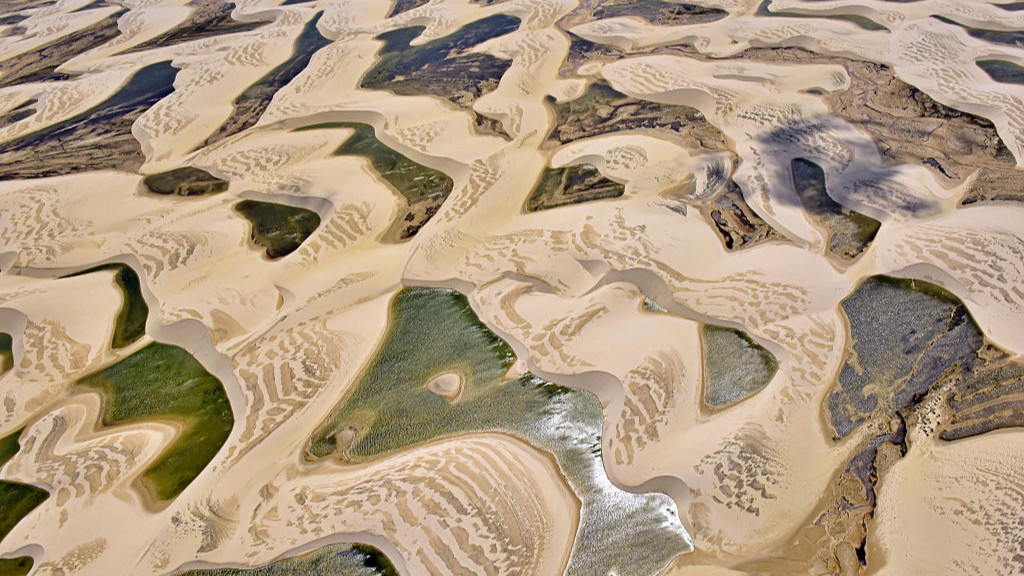
What surprises many visitors is not just the beauty of the lagoons, but the life they contain. Fish, which are thought to survive the dry season in underground water sources or are carried in by migratory birds and floodwaters, reappear in the lagoons each year. The ecosystem essentially resets and rebuilds itself on an annual cycle.
This rhythm — wet, then dry, then wet again — has shaped every living thing in the park, from the microorganisms in the water to the birds that come to feed on them.
Lençóis Maranhenses at a Glance
| Feature | Detail |
|---|---|
| Official Name | Lençóis Maranhenses National Park |
| Location | State of Maranhão, Brazil |
| Coordinates | -2.5299, -43.0250 |
| Coastline Position | Northeast coast of Brazil |
| Key Feature | Thousands of temporary seasonal lagoons |
| Biomes Intersected | Three distinct biomes |
| Lagoon Peak Season | Following the annual rainy season |
Why This Place Sits at the Edge of Three Worlds
One of the most scientifically significant things about Lençóis Maranhenses is its position at the intersection of three biomes. Biomes are large ecological zones defined by their climate, vegetation, and wildlife — think tropical rainforest, savanna, or coastal wetland. Most landscapes sit firmly within one. Lençóis Maranhenses does not.
That convergence means the park harbors a level of biodiversity that its desert-like appearance does not suggest. Species from multiple ecological zones overlap here, creating a patchwork of life that researchers continue to study.
The park’s location on Brazil’s northeast coast also places it within reach of Atlantic weather systems that deliver the rainfall responsible for the lagoons — even as the same coastal winds drive the constant movement of dunes that give the landscape its surreal, shifting quality.
- The white dunes are made of quartz sand and largely lack vegetation
- Rainfall fills natural basins between dunes each rainy season
- The lagoons are temporary — they shrink and vanish in the dry season
- The park sits at the intersection of three biomes
- Fish and other wildlife return to the lagoons each year as water levels rise
- The landscape is protected within a designated national park
What Visiting Lençóis Maranhenses Looks Like
For anyone considering the journey, timing matters enormously. The lagoons are at their fullest and most vivid in the months following the rainy season. Arrive during the dry season and you will find a striking dune landscape — but the famous blue pools will be gone or greatly reduced.
Access to the park typically involves traveling through the state of Maranhão, with the town of Barreirinhas serving as the most common base for visitors. From there, guided tours take travelers into the dunes on foot or by vehicle, depending on the area and the season.
The remoteness of the park is part of its appeal — and part of its challenge. Infrastructure is limited, and the landscape itself demands respect. Temperatures in the dunes can be extreme, and the terrain, while beautiful, is physically demanding to cross.
Frequently Asked Questions
Where exactly is Lençóis Maranhenses located?
It is a national park on the northeast coast of Brazil, situated in the state of Maranhão, at coordinates -2.5299, -43.0250.
Why does Lençóis Maranhenses have lagoons if it looks like a desert?
The region receives significant annual rainfall that collects in natural basins between the dunes, forming thousands of temporary lagoons — even though the sandy, vegetation-free landscape resembles a desert.
Are the lagoons there year-round?
No. The lagoons are temporary, forming during and after the rainy season and gradually disappearing as the dry season progresses.
What makes Lençóis Maranhenses ecologically unique?
The park sits at the intersection of three distinct biomes, creating a rare overlap of ecological zones and supporting biodiversity that its desert-like appearance does not immediately suggest.
When is the best time to visit to see the lagoons?
The lagoons are typically at their fullest and most visually striking in the period following the annual rainy season, generally reaching peak conditions between roughly July and September.
Is Lençóis Maranhenses actually a desert?
No — despite its appearance, it receives too much annual rainfall to be classified as a desert. The white dunes exist because of the type of sand and the lack of vegetation, not because of an absence of water.



Leave a Reply