
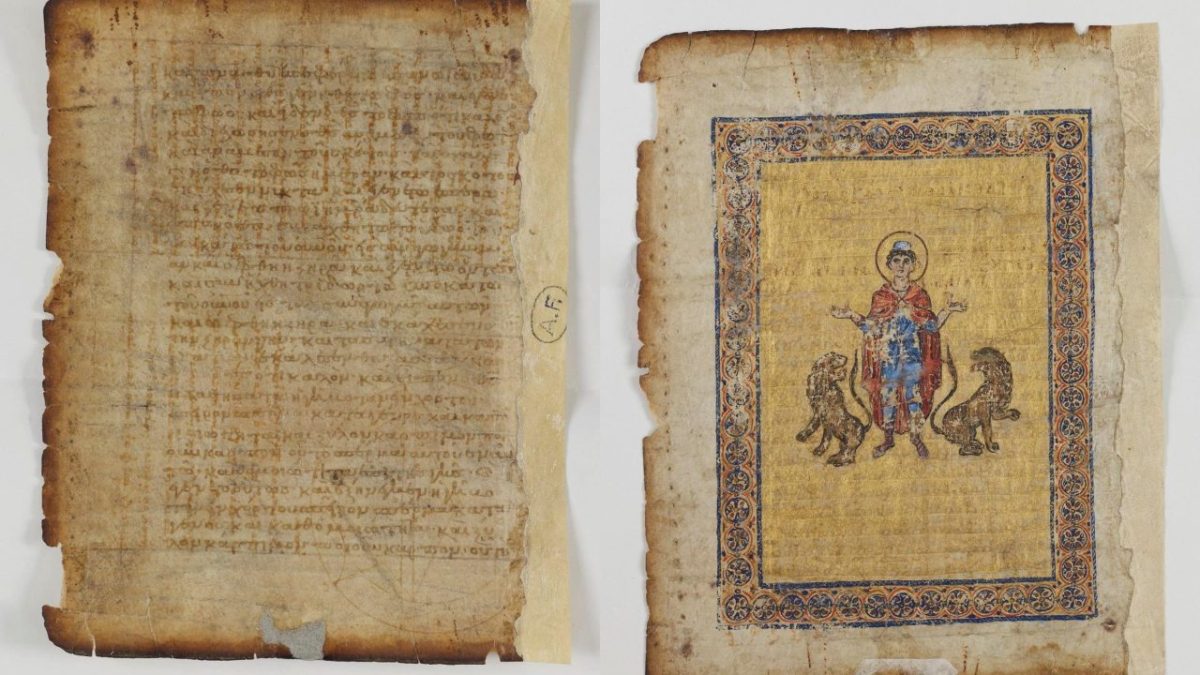
A page from one of the most important scientific manuscripts in human history — long believed to be lost forever — has just turned up in a French museum. The discovery is being described as a major find for both the history of mathematics and our understanding of how ancient knowledge survived into the modern world.
Researchers have confirmed that a missing leaf from the Archimedes Palimpsest has been identified at the Musée des Beaux-Arts in Blois, a city in central France. The find was made by Victor Gysembergh of the French National Centre for Scientific Research (CNRS), with the findings published in the journal Zeitschrift für Papyrologie und Epigraphik.

For anyone who cares about where our scientific knowledge comes from — and how close we came to losing it entirely — this story is remarkable.
What Was Actually Found, and Why It Matters
The leaf in question corresponds to page 123 of the Archimedes Palimpsest and contains a portion of Archimedes’ treatise On the Sphere and the Cylinder, specifically Book I, Propositions 39 to 41. According to researchers, much of the mathematical text remains legible despite later alterations made to the parchment.
That’s extraordinary when you consider what this manuscript has been through. The Archimedes Palimpsest is a tenth-century Greek manuscript — created roughly a thousand years after Archimedes himself lived — that preserves several of the mathematician’s works. Archimedes lived from approximately 287 to 212 BC, and is widely regarded as one of the greatest mathematical minds of antiquity.
The problem is what happened to the manuscript during the Middle Ages. Medieval scribes, working with expensive and scarce parchment, erased the original text so the material could be reused. This process — called creating a palimpsest — was common practice. It saved resources, but it also meant that irreplaceable ancient knowledge was literally scraped away and written over.
The fact that any of Archimedes’ text survived at all is something of a miracle. The fact that a previously lost page has now resurfaced in a French museum makes this discovery all the more striking.
The Archimedes Palimpsest: A Manuscript with a Remarkable History
The Palimpsest’s journey through history is almost as dramatic as its contents. Over the centuries, the manuscript passed through Jerusalem and Constantinople before attracting serious scholarly attention in the early twentieth century.
In 1906, the Danish scholar Johan Ludvig Heiberg studied the manuscript — a pivotal moment in the recovery of Archimedes’ work. That early examination helped establish just how significant the surviving text was, even in its damaged and partially erased state.
The newly identified leaf in Blois now adds another chapter to that long story of survival, loss, and rediscovery.
Key Details of the Discovery at a Glance
| Detail | Information |
|---|---|
| Location of discovery | Musée des Beaux-Arts, Blois, France |
| Researcher who identified the leaf | Victor Gysembergh, CNRS |
| Published in | Zeitschrift für Papyrologie und Epigraphik |
| Manuscript page identified | Page 123 of the Archimedes Palimpsest |
| Text contained on the leaf | On the Sphere and the Cylinder, Book I, Propositions 39–41 |
| Manuscript origin | Tenth century (Greek) |
| Archimedes lived | c. 287–212 BC |
| First major modern study of the Palimpsest | 1906, by Johan Ludvig Heiberg |
- The leaf had been considered lost before this identification
- The mathematical content remains largely legible despite medieval alterations
- The Palimpsest previously traveled through Jerusalem and Constantinople
- Creating a palimpsest — erasing and reusing parchment — was standard medieval practice
What This Tells Us About Ancient Knowledge and Medieval Book Culture
Beyond the mathematical content itself, this discovery offers something broader: a window into how ancient knowledge was transmitted, altered, and sometimes nearly destroyed across the centuries.
The fact that a medieval scribe erased Archimedes’ text to reuse the parchment isn’t evidence of ignorance — it was a practical decision in a world where writing materials were costly and rare. But it does illustrate just how fragile the thread connecting us to ancient science really was.
Researchers note that the newly found leaf provides fresh insight into both ancient science and medieval book culture — two fields that don’t always get studied together but are, in this case, deeply intertwined. Every palimpsest tells two stories at once: the original text underneath, and the life the manuscript lived after it was repurposed.
The Blois leaf is a vivid example of that dual history. A page from a tenth-century Greek manuscript, containing geometry written more than two thousand years ago, sitting in a French art museum until a CNRS researcher recognized what it actually was.
What Happens Next for the Archimedes Palimpsest
The publication of Gysembergh’s findings in Zeitschrift für Papyrologie und Epigraphik marks the formal introduction of this discovery to the scholarly community. From here, other researchers will be able to examine and build on the identification.
The mathematical content — Propositions 39 to 41 of On the Sphere and the Cylinder — will now be available for study in a form that had previously been considered inaccessible. Whether further analysis reveals additional details about the text or its transmission history remains to be seen, but the scholarly community now has a new piece of a very old puzzle.
It also raises a natural question: if one lost leaf turned up in a French museum, could others be waiting elsewhere, unrecognized in collections around the world?
Frequently Asked Questions
What is the Archimedes Palimpsest?
It is a tenth-century Greek manuscript that preserves several works by the ancient mathematician Archimedes. Parts of the original text were erased during the Middle Ages so the parchment could be reused — a process known as creating a palimpsest.
What was found in Blois, France?
A leaf identified as page 123 of the Archimedes Palimpsest was found at the Musée des Beaux-Arts in Blois. It contains part of Archimedes’ treatise On the Sphere and the Cylinder, Book I, Propositions 39 to 41.
Who made the discovery?
The identification was made by Victor Gysembergh of the French National Centre for Scientific Research (CNRS), with the findings published in the journal Zeitschrift für Papyrologie und Epigraphik.
Is the text on the newly found leaf still readable?
Yes — researchers report that much of the mathematical text remains legible despite later alterations made to the manuscript.
Who first studied the Archimedes Palimpsest in modern times?
The Danish scholar Johan Ludvig Heiberg examined the manuscript in 1906, which was a landmark moment in recovering Archimedes’ surviving works.</p



Leave a Reply