
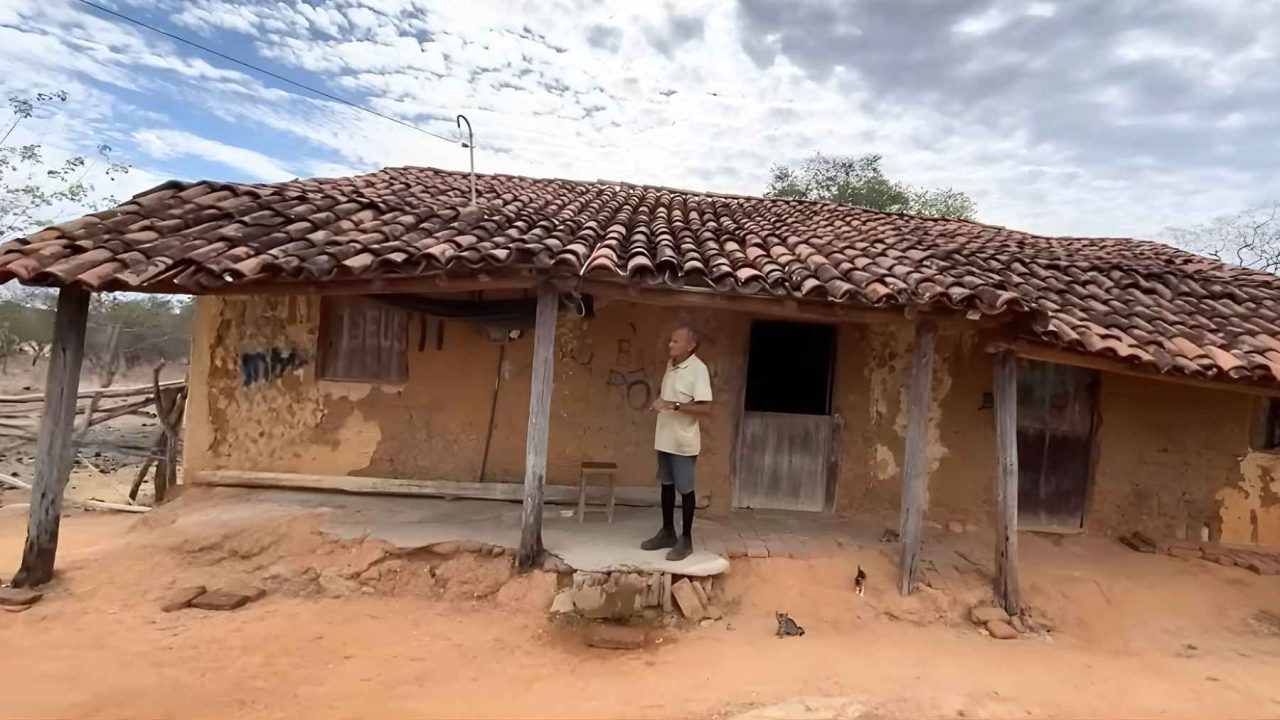
An 80-year-old man living alone in a 106-year-old clay house, hauling water from a well and cooking over a wood fire every single day — and thousands of people across the internet cannot stop watching him do it. That is the quiet power of Seu Chiquinho’s story.
Francisco Matias, known affectionately as Seu Chiquinho, lives in rural Hidrolândia in Brazil’s Northeast region. The adobe house he calls home was built in 1920 by his father, Antônio Matias. Over a century later, the structure still stands — and so does the man inside it, living largely the same way the house was designed to support.
His daily routine — drawing water from a well, storing it in clay containers, tending the land each morning, cooking on a wood stove — has drawn wide attention online. But this story is not really about nostalgia. It is about what happens when a way of life built around local materials, physical labor, and deep environmental knowledge outlasts almost everything that came after it.
The House That Has Outlasted a Century
The adobe house at the center of this story is arguably its most remarkable character. Built by hand more than 100 years ago using clay — a material pulled directly from the local earth — it has survived decades of heat, rain, and time without the intervention of modern construction methods.
Adobe, the traditional building material used throughout Brazil’s Northeast and other hot, dry regions of the world, works with the climate rather than against it. Thick clay walls absorb heat during the day and release it slowly at night, naturally regulating interior temperatures without air conditioning or mechanical cooling. In a region where heat is relentless, that is not a small thing.
Seu Chiquinho’s house stands as a living example of what advocates of traditional architecture have long argued: that pre-industrial building knowledge encoded real environmental intelligence. The people who built these structures were not working without information — they were working with centuries of accumulated, place-specific understanding of how materials, land, and climate interact.
What Seu Chiquinho’s Daily Routine Actually Looks Like
The details of his life are specific, and they matter. This is not a weekend retreat or a lifestyle experiment. It is the full shape of every day.
- He lives alone in the adobe house his father built in 1920 in rural Hidrolândia, in Brazil’s Northeast
- He draws water from a well and stores it in clay containers
- He cooks using a wood stove — firewood, not gas or electricity
- He spends part of each morning tending the land around the property
- He is 80 years old and manages this routine independently
Each of those details carries weight. Hauling water from a well is physical labor. Cooking with firewood requires sourcing, splitting, and managing fuel every day. Tending land at 80 is not a gentle hobby — it is work. The story draws attention partly because of its visual simplicity, but the reality it represents is far more demanding than it looks on a screen.
The Part of This Story Most Reactions Miss
When videos or photos of lives like Seu Chiquinho’s go viral, the response tends to split in two directions. Some viewers romanticize it — projecting a kind of peaceful simplicity onto what is, in practice, a life shaped by hard physical necessity. Others dismiss it as poverty dressed up as virtue.
Both reactions miss the more useful point. Seu Chiquinho’s home demonstrates how traditional building knowledge can work intelligently with a local climate using materials that require almost no energy to produce or maintain. That is genuinely relevant to conversations happening right now about sustainable construction, carbon footprints, and the limits of high-tech solutions to climate problems.
At the same time, the harder realities deserve acknowledgment. As the original reporting notes, hauling water and cooking with fire are not quaint details — they shape every single day. Rural self-reliance at this scale is not a choice most people would make freely if infrastructure alternatives were available. Both things can be true simultaneously.
Why Thousands of People Are Paying Attention
| Detail | Confirmed Fact |
|---|---|
| Subject’s name | Francisco Matias, known as Seu Chiquinho |
| Age | 80 years old |
| Location | Rural Hidrolândia, Brazil’s Northeast region |
| House built by | His father, Antônio Matias, in 1920 |
| House age | Over 106 years old |
| Building material | Adobe (clay) |
| Water source | A well; stored in clay containers |
| Cooking method | Wood stove (firewood) |
| Daily activity | Tending the land each morning |
The wide online attention Seu Chiquinho has received says something about the moment we are living in. There is a growing hunger — particularly among people living in cities, surrounded by digital noise and rising costs — for evidence that a different kind of life is possible. His story lands because it is concrete. It is not a theory or an influencer’s curated aesthetic. It is a man, a house, a well, and a fire.
Whether that attention translates into anything meaningful — policy interest in traditional building methods, renewed respect for rural knowledge systems, or simply a few minutes of genuine reflection — is harder to say. But the fact that his daily routine stops people mid-scroll suggests it is touching something real.
What This Moment Could Mean Beyond One Man’s Story
Seu Chiquinho is not presenting himself as a symbol. He is simply living as he has always lived. But the conversation his story has sparked points toward questions that are increasingly urgent: What do we lose when traditional building and land knowledge disappears? What does genuine self-sufficiency actually cost in daily labor? And what might modern sustainable design learn from a clay house that has quietly worked for over a century?
Those questions do not have simple answers. But they are worth asking — and a 106-year-old adobe house in rural Brazil, still standing, still inhabited, is as good a place as any to start.
Frequently Asked Questions
Who is Seu Chiquinho?
Seu Chiquinho is the nickname of Francisco Matias, an 80-year-old man who lives alone in a clay house in rural Hidrolândia in Brazil’s Northeast region.
Who built the adobe house Seu Chiquinho lives in?
The house was built in 1920 by his father, Antônio Matias, making it over 106 years old.
How does Seu Chiquinho get water and cook?
He draws water from a well and stores it in clay containers, and he cooks using a wood stove fueled by firewood.
Why has his story attracted so much attention online?
His daily routine — living alone, tending land, hauling water, and cooking with fire in a century-old adobe house — has resonated widely at a time when many people are questioning modern lifestyles and looking for examples of self-reliance and traditional knowledge.
Is adobe construction environmentally significant?
Advocates of traditional architecture point to adobe as an example of building that works with local climate using minimal energy, with thick clay walls naturally regulating interior temperatures without mechanical cooling systems.
Does Seu Chiquinho have family living with him?
Based on the available source material, he lives alone in the house. Further details about his family situation have not been confirmed in the reporting reviewed here.




Leave a Reply