
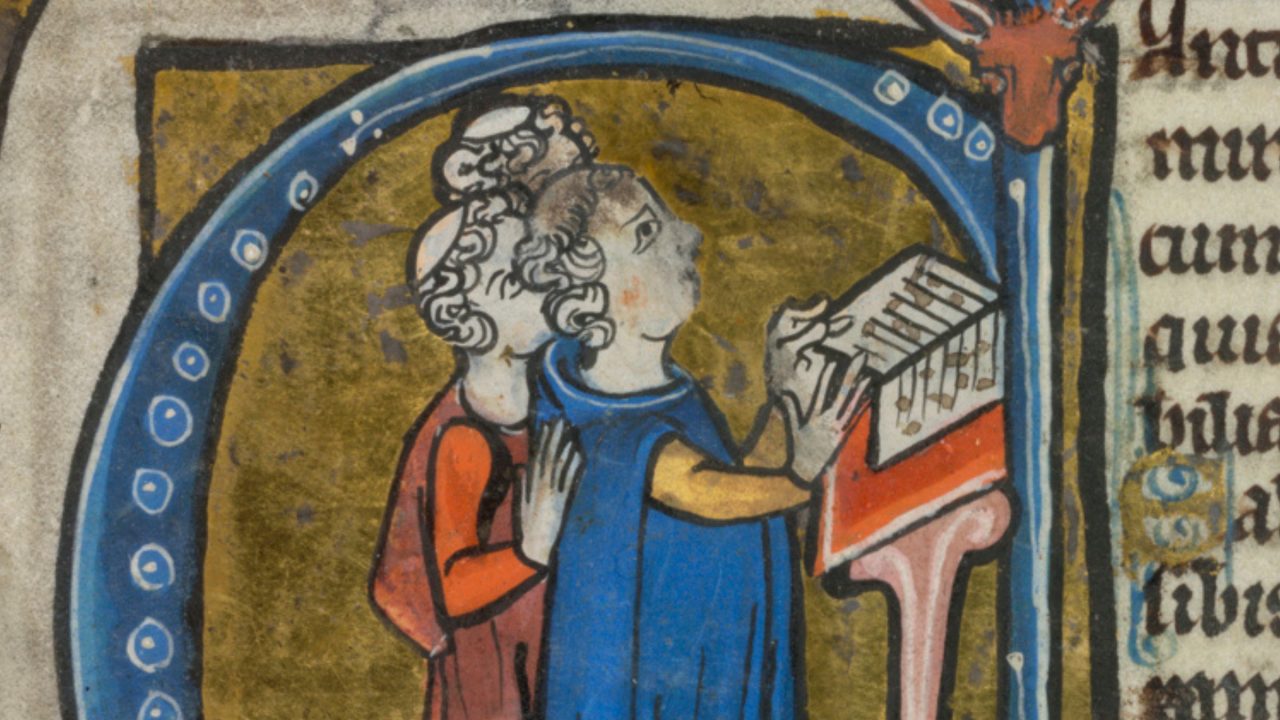
Brother Aldric paused mid-chant, his weathered hands gripping the worn parchment as unfamiliar melodies drifted through the monastery walls. The year was 1147, and the monks from across the border sang the same sacred words, yet their voices carried entirely different tunes. How could the same holy text sound so foreign just fifty miles away?
This moment of medieval confusion now makes perfect sense to researchers who’ve uncovered a fascinating truth about how music traveled in the Middle Ages. Political borders didn’t just divide kingdoms—they shaped the very songs that echoed through cathedral halls and monastery chapels across Europe.
How have politics shaped music making in the past? Using sophisticated generative network models, @timeipert's work in @TismirJ shows a close link between political boundaries in central Europe towards the end of the first millennium and the repertoire of chants in use. pic.twitter.com/T2lfaDTm8D
— Fabian C. Moss (@fabianmoss) March 2, 2026
A groundbreaking study reveals that medieval chant, the sacred music that formed the backbone of Christian worship for centuries, spread along political lines rather than religious ones. This discovery challenges everything we thought we knew about how culture moved through medieval Europe.
How Political Power Controlled Sacred Songs
The research shows that medieval chant varieties clustered within specific kingdoms and territories, creating distinct musical regions that matched political maps rather than church dioceses. This means a monk in 12th-century France was more likely to share musical traditions with a distant French monastery than with a nearby abbey across the German border.
The political boundaries acted like musical firewalls, creating distinct chant traditions that persisted for centuries even as religious authority remained unified under Rome.
— Dr. Elena Marchetti, Medieval Music Historian
Unlike today’s globalized world, medieval Europe’s fragmented political landscape created natural barriers to cultural exchange. Kings and local rulers controlled not just trade routes and military movements, but also the flow of ideas, including sacred music.
The study analyzed hundreds of medieval manuscripts from monasteries across Europe, comparing melodic patterns, rhythmic structures, and textual variations. The results painted a clear picture: political borders mattered more than religious ones when it came to how chant evolved and spread.
The Geography of Medieval Music
Researchers identified several key factors that influenced how chant traditions developed within political boundaries:
- Royal patronage systems – Kings and nobles funded specific monasteries, creating networks of influence
- Controlled travel routes – Political authorities regulated who could cross borders and carry manuscripts
- Language barriers – Different kingdoms spoke different languages, affecting musical interpretation
- Regional scribal traditions – Each kingdom developed unique ways of writing and copying music
- Court musical preferences – Royal tastes influenced what styles were encouraged or suppressed
The evidence appears in surviving manuscripts that show clear regional patterns. French monasteries preserved chant styles that differed markedly from German or Italian traditions, even when they belonged to the same religious order.
| Region | Distinctive Features | Political Influence |
|---|---|---|
| French Kingdoms | Elaborate melodic ornaments | Royal court preferences |
| Germanic Territories | Rhythmic precision | Imperial standardization |
| Italian States | Simple, direct melodies | Papal influence |
| Iberian Peninsula | Unique modal structures | Reconquista disruptions |
We found that a monastery’s musical style was predicted more accurately by its political allegiance than by its religious order or geographical proximity to other monasteries.
— Professor James Whitfield, Digital Humanities Research
What This Means for Understanding Medieval Life
This discovery fundamentally changes how historians understand medieval society. It suggests that political identity was stronger than religious unity, even in an age when the Church wielded enormous power across Europe.
The implications extend far beyond music. If sacred chant—something supposedly universal across Christian Europe—was actually fragmented along political lines, what does this tell us about other aspects of medieval culture?
The research suggests that medieval people identified more strongly with their kingdoms than with broader Christian identity. A French monk likely felt more kinship with French secular culture than with German religious traditions, even though both served the same God.
This research shows us that medieval Europe was far more politically fragmented in its cultural identity than we previously understood. The Church provided spiritual unity, but political borders created cultural boundaries that were surprisingly strong.
— Dr. Margaret Thornton, Medieval Studies Institute
The study also reveals how power structures influenced seemingly apolitical aspects of life. Even sacred music, which should theoretically transcend earthly concerns, reflected the political realities of medieval society.
For modern scholars, this opens new questions about how culture spreads and evolves. In our connected world, we might assume that shared beliefs create shared practices. But medieval evidence suggests that political control and patronage networks matter more than ideological alignment.
The research team used digital analysis to compare thousands of musical phrases across hundreds of manuscripts. This technological approach allowed them to identify patterns that would have been impossible to detect through traditional scholarly methods.
Digital humanities tools let us see the big picture in ways that studying individual manuscripts never could. We can now map cultural influence across entire continents and centuries.
— Dr. Andreas Weber, Computational Musicology
The findings also highlight how medieval monasteries, often seen as isolated religious communities, were actually deeply embedded in political networks. Monks didn’t live in spiritual bubbles—they participated in the political and cultural life of their kingdoms.
This research continues as scholars apply similar analytical techniques to other aspects of medieval culture, from architectural styles to manuscript illumination. The goal is to understand how political boundaries shaped all aspects of medieval life, not just music.
FAQs
What is medieval chant?
Medieval chant is the sacred music used in Christian worship during the Middle Ages, characterized by monophonic melodies and Latin texts.
How did researchers study these ancient songs?
They used digital analysis to compare musical patterns across hundreds of surviving medieval manuscripts from monasteries throughout Europe.
Why didn’t religious unity create musical unity?
Political borders created stronger cultural barriers than religious connections, with kingdoms controlling travel, patronage, and cultural exchange more effectively than the Church.
Were monks aware of these musical differences?
Yes, medieval sources describe monks noticing different chant styles when traveling between kingdoms, though they may not have understood the political causes.
Does this pattern exist in other medieval arts?
Researchers are now studying whether similar political influences shaped architecture, manuscript art, and other cultural expressions in medieval Europe.
How does this change our understanding of medieval Europe?
It shows that political identity was stronger than religious identity in shaping daily cultural practices, even in an age of supposed Christian unity.

Leave a Reply