
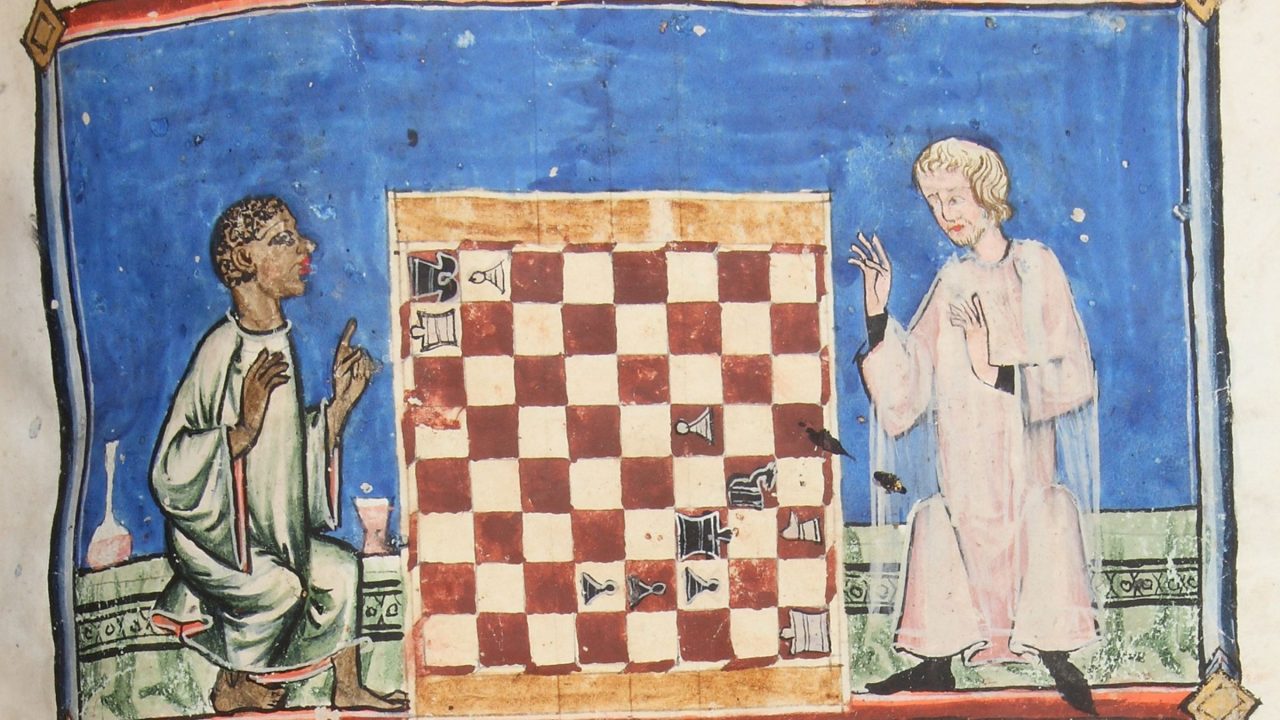
A chess board in 13th-century Seville tells a story that historians are only beginning to fully appreciate. In a richly illustrated manuscript completed in 1283 for King Alfonso X of Castile, a Black chess player sits comfortably on a finely decorated bench, a bottle of red wine nearby and a full glass at hand — and he is on the verge of beating his white opponent, a cleric. The two men face each other as equals, locked in a shared intellectual contest.
That image, nearly 750 years old, is now at the center of a prize-winning academic study that is reshaping how scholars think about race, identity, and social interaction in the medieval world.
The research, by Dr. Krisztina Ilko of Queens’ College, Cambridge, has been awarded the Medieval Academy of America’s Article Prize in Critical Race Studies. Her study, titled “Chess and Race in the Global Middle Ages,” was published in the journal Speculum and draws on manuscripts, paintings, literary texts, and surviving chess pieces to build a surprising argument: that the medieval game of chess created rare spaces where intellectual ability could matter more than skin color, status, or background.
What the Study Actually Argues About Medieval Chess and Race
The standard picture of the Middle Ages tends toward uniformity — a predominantly white, European, rigidly hierarchical world where social position was fixed and difference was rarely tolerated. Dr. Ilko’s research pushes back against that assumption directly.
By examining a wide range of evidence, Ilko argues that chess functioned as an unusual arena in medieval society. Because the game rewarded strategic thinking above all else, it created a context in which intellectual ability could, at least symbolically, take precedence over a player’s background, culture, or appearance.
The Libro de axedrez — the chess treatise commissioned by Alfonso X and completed in Seville in 1283 — is one of the study’s most compelling pieces of evidence. The manuscript’s illustrations repeatedly present players from different cultures and backgrounds engaging as genuine competitors, not as figures defined by a fixed social order. The scene of the Black chess player defeating the cleric is particularly striking precisely because neither figure is presented as superior or inferior by virtue of who they are. The game, and the skill required to play it, is what defines the moment.
This, the research suggests, is not an isolated artistic quirk. Medieval manuscripts, paintings, and chess objects together point toward a more complex and culturally diverse Middle Ages than popular imagination typically allows.
The Evidence Behind the Argument
Dr. Ilko’s study does not rest on a single image. The research draws from multiple categories of historical material, each contributing a different layer to the overall picture.
- Illuminated manuscripts — including the Libro de axedrez — showing players of different backgrounds depicted as equals at the chess board
- Medieval paintings offering visual representations of cross-cultural intellectual engagement
- Literary texts from the period that frame chess as a pursuit tied to reason and mental skill rather than social rank
- Surviving chess pieces that reflect the global origins and cultural exchange at the heart of the game’s history in Europe
Chess itself arrived in Europe via the Islamic world, traveling from South Asia through Persia and into the Mediterranean — a journey that already embedded cross-cultural exchange into the game’s very identity long before Alfonso X commissioned his treatise.
| Source Type | Key Example | What It Shows |
|---|---|---|
| Illuminated manuscript | Libro de axedrez (Seville, 1283) | Black player depicted defeating a white cleric as equals |
| Commissioned by | King Alfonso X of Castile | Royal patronage of culturally diverse chess imagery |
| Academic publication | Speculum journal | Peer-reviewed platform for the study’s findings |
| Award received | Medieval Academy of America Article Prize in Critical Race Studies | Recognition of the study’s scholarly significance |
| Researcher | Dr. Krisztina Ilko, Queens’ College, Cambridge | Author of “Chess and Race in the Global Middle Ages” |
Why This Changes How We Think About the Middle Ages
For anyone who grew up learning about the medieval period as a distant, monolithic era of European feudalism, this research offers a genuinely different perspective. The evidence suggests that cultural interaction across racial and ethnic lines was not simply an exception to medieval life — it was woven into some of the period’s most celebrated intellectual and artistic traditions.
Chess, in this reading, was more than a pastime for kings and nobles. It was a space where the usual rules of medieval hierarchy could be, at least momentarily, suspended. A skilled player, regardless of where they came from or what they looked like, could sit across from a cleric or a nobleman and compete on equal terms.
Researchers in this field argue that recovering these moments matters because the stories we tell about the past shape the assumptions we carry into the present. A medieval world understood as entirely racially homogenous leaves a very different cultural legacy than one recognized as genuinely diverse and interconnected.
The Libro de axedrez image — that relaxed Black chess player, wine glass in hand, opponent on the back foot — is a small but vivid reminder that the Middle Ages contained multitudes that later generations have sometimes been too quick to erase.
What Comes Next for This Research
Dr. Ilko’s award-winning article in Speculum represents a significant moment in the growing field of critical race studies applied to medieval history. The Medieval Academy of America’s recognition signals that this kind of interdisciplinary work — combining art history, literary analysis, and material culture — is gaining serious scholarly traction.
Whether the findings will reach beyond academic journals into broader public understanding of the medieval period remains to be seen. But the evidence is now on the record, peer-reviewed and prize-recognized: the Middle Ages were more diverse, more globally connected, and more intellectually open than the standard narrative has often suggested. A chess board, it turns out, can be a surprisingly powerful historical document.
Frequently Asked Questions
Who conducted the research on medieval chess and race?
The study was conducted by Dr. Krisztina Ilko of Queens’ College, Cambridge, and published in the academic journal Speculum.
What award did the study receive?
The research was awarded the Medieval Academy of America’s Article Prize in Critical Race Studies.
What is the Libro de axedrez?
It is a richly illustrated chess treatise completed in Seville in 1283, commissioned by King Alfonso X of Castile, which contains imagery showing players of different backgrounds competing as equals.
What does the study’s key image show?
One illustration depicts a Black chess player on the verge of defeating a white cleric, with both figures presented as equals engaged in an intellectual contest rather than a hierarchy-defined encounter.
What types of evidence does the study draw on?
The research uses manuscripts, paintings, literary texts, and surviving chess pieces from the medieval period to support its argument.
Does this mean the Middle Ages were free of racial hierarchy?
The study does not make that claim — rather, it argues that chess provided a rare space where intellectual ability could take precedence over status, background, or skin color, challenging assumptions about how rigid medieval hierarchies always were.



Leave a Reply