
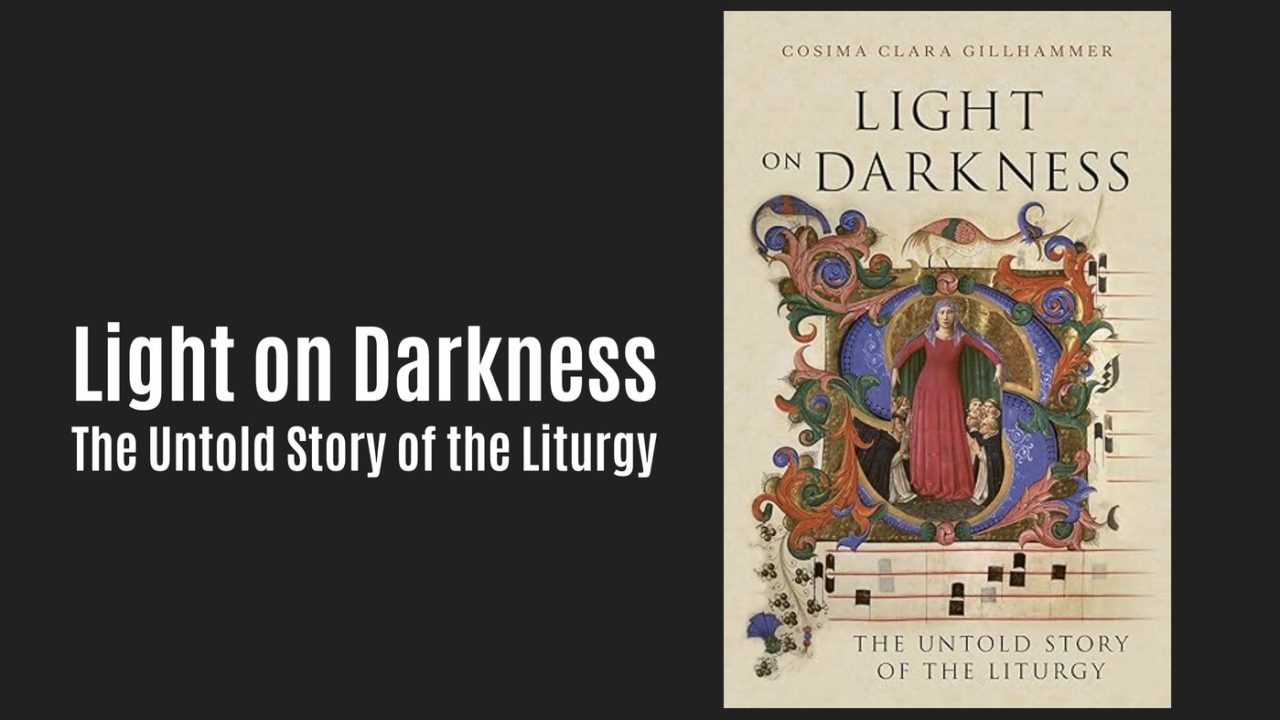
What if one of the most powerful forces shaping Western art, music, and culture for over a thousand years has been hiding in plain sight — inside church walls, mostly ignored by the modern world?
That is the central argument of Light on Darkness: The Untold Story of the Liturgy, a new book by Cosima Clara Gillhammer, published by Reaktion Books. It makes a case that Catholic liturgy — the prayers, rituals, and music of the Church — is not a relic of a forgotten past but one of the deepest roots of Western cultural history, and that most of us simply stopped paying attention to it.
Hot off the press from @reaktionbooks pic.twitter.com/c3GXPH8TvR
— Dr Cosima C Gillhammer (@olde_bookes) April 14, 2025
For anyone who has ever sat through a church service feeling baffled by the symbolism, or walked through a medieval cathedral wondering what all of it actually meant, this book is designed as a way in.
The Secret at the Centre of Western Culture
Gillhammer opens with a striking claim: liturgy has become “strange and foreign to us.” Most people today, she argues, associate it either with private religious practice or with dry academic scholarship. Neither framing does it justice.
Her argument is that this is a profound cultural blind spot. The rituals of the Catholic Church — the cycle of seasons, the candlelit ceremonies, the chanted prayers — were not merely religious observances. They were the engine behind centuries of artistic creation. Paintings, architecture, music, poetry: enormous portions of Western cultural output were shaped directly by liturgical tradition.
The book traces this influence from the Middle Ages through to the present day, using individual stories to build toward a larger picture. It is not a dry theological text. Gillhammer frames liturgy as “endlessly rich and imaginative,” generating new artistic responses across centuries rather than simply repeating old ones.
One of the book’s most vivid images captures this well. She describes the symbolism of a lighted candle being carried into a darkened church on the night before Easter — a gesture that has been repeated for over a thousand years, carrying with it layered meanings of hope, renewal, and continuity. That image, she suggests, is liturgy in miniature: old form, enduring meaning.
What the Book Actually Covers
Rather than presenting a dry survey of Church history, Light on Darkness is structured around individual stories that illuminate the broader relationship between liturgy and Western culture. The approach makes it accessible to readers who have no background in theology or medieval history.
- The book covers liturgical tradition in Western Europe from the Middle Ages to the present day
- It examines how rituals, prayers, and music were designed to communicate meaning — not just to the devout, but through art and culture to society at large
- It explores what Gillhammer describes as “extraordinary artistic beauty” and “expressions of faith and human connection” embedded in liturgical practice
- It addresses the enduring symbolism of specific rites, including the Easter Vigil ceremony involving the return of light into darkness
- It makes the case that liturgy belongs not only in religious studies but in cultural history more broadly
| Book Detail | Information |
|---|---|
| Title | Light on Darkness: The Untold Story of the Liturgy |
| Author | Cosima Clara Gillhammer |
| Publisher | Reaktion Books |
| ISBN | 978 1 83639 043 5 |
| Scope | Western Europe, Middle Ages to present day |
| Intended audience | General readers seeking an accessible introduction to liturgy |
Why This Matters Beyond the Church
The most provocative aspect of Gillhammer’s argument is not theological — it is cultural. She is not writing primarily for practicing Catholics or religious scholars. She is writing for anyone interested in where Western art, music, and symbolic tradition actually came from.
The claim that liturgy “stands at the centre of the cultural history of the West” is a bold one. It pushes back against the common modern assumption that religion and culture are separate streams, or that the Church’s influence faded after the medieval period. Gillhammer’s position is that the liturgical calendar, its ceremonies, and its artistic traditions continued generating cultural meaning long after the Reformation and well into the modern era.
For readers with an interest in medieval history specifically, the book offers a lens for understanding why so much surviving art, music, and architecture from that period looks the way it does. The visual language of a Gothic cathedral, the structure of plainchant, the iconography of altarpieces — all of it connects back to liturgical function and meaning.
That context is often missing from how medieval culture gets taught or discussed today, which is precisely the gap this book is trying to fill.
Who Should Read This Book
Gillhammer pitches the book as an introduction — accessible to the “uninitiated,” as the publisher’s description puts it. You do not need a background in Catholic theology or medieval studies to follow it.
The structure, built around individual stories rather than a comprehensive historical survey, keeps it readable. It is the kind of book that works for a general audience curious about cultural history, as well as for students or researchers looking for an entry point into liturgical studies before tackling more specialist material.
Given its framing around artistic beauty and cultural influence rather than doctrinal argument, it is also likely to appeal to readers who consider themselves secular but are genuinely curious about how medieval religious practice shaped the world they have inherited.
Frequently Asked Questions
What is Light on Darkness: The Untold Story of the Liturgy about?
It is an accessible introduction to Catholic liturgy in Western Europe, examining how rituals, prayers, and music shaped Western cultural history from the Middle Ages to the present day.
Who wrote the book?
The book was written by Cosima Clara Gillhammer and published by Reaktion Books, with ISBN 978 1 83639 043 5.
Do you need to be religious to get something from this book?
Based on the book’s framing, no — it is presented as a cultural history as much as a religious one, aimed at general readers curious about Western art, music, and tradition.
What time period does the book cover?
The book spans from the Middle Ages through to the present day, focusing on Western Europe.
What is the central argument of the book?
Gillhammer argues that liturgy stands at the centre of Western cultural history and has been a driving force behind artistic creation for over a thousand years, despite being largely overlooked today.
Is this a book for scholars or general readers?
It is positioned as an accessible introduction suitable for general readers, though it is also likely to be of interest to students and researchers in medieval history and cultural studies.

Leave a Reply