
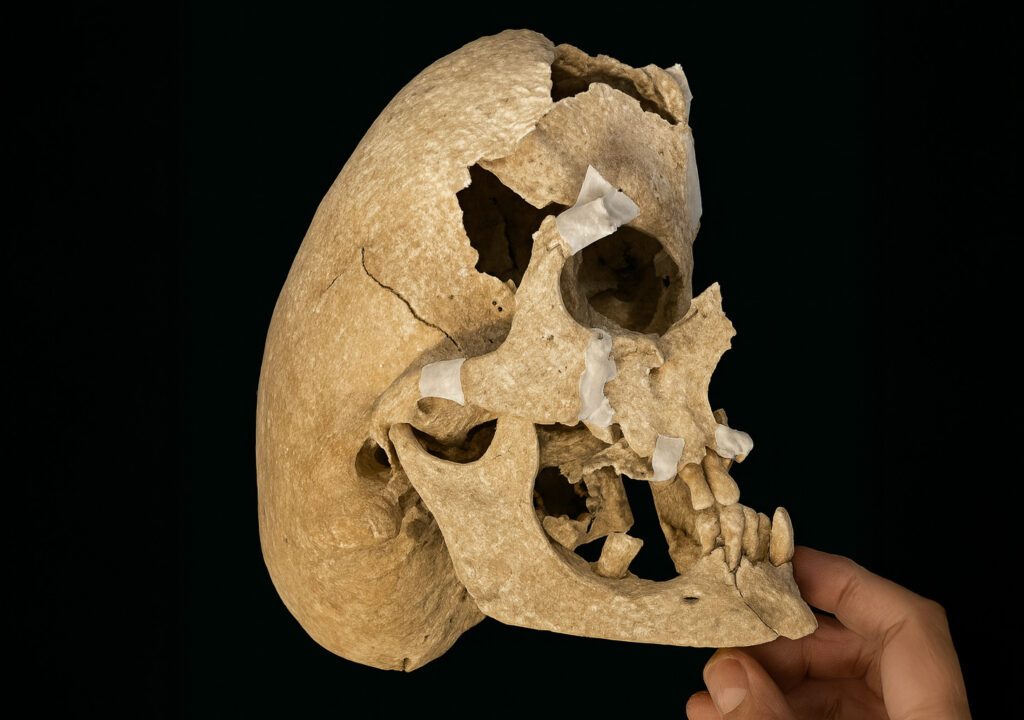
A medieval knight who lived and likely fought in battle despite having a skull so severely deformed it measured nearly twice as long as it was wide — that is the extraordinary discovery now emerging from a Spanish castle with deep military history.
Archaeologists excavating the castle of Zorita de los Canes in Guadalajara, central Spain, have uncovered skeletal remains that researchers believe belonged to a member of one of medieval Castile’s most powerful military-religious orders. What makes the find genuinely remarkable is not the man’s rank or the castle itself — it’s what the bones reveal about a life lived under extraordinary physical circumstances.
The research, led by scientists from the Universitat Rovira i Virgili (URV), has been published in the journal Heritage. And the skull at the center of it all is unlike almost anything seen in the medieval archaeological record.
A Skull That Stopped Researchers in Their Tracks
When the skeleton was first unearthed from the Corral de los Condes — a burial area associated with knights of the Order of Calatrava — it appeared to be a fairly standard medieval interment. Then researchers got a closer look at the skull.
It measured 23 centimetres in length but only 12 centimetres in width. That is an almost impossibly elongated shape for a human head. The cranial index — a ratio comparing skull width to length — came in at just 53 percent, placing it in the exceptionally rare category known as ultradolichocephaly.
The cause, researchers determined, was craniosynostosis: a congenital condition in which the bones of the skull fuse prematurely during childhood. Normally, the skull’s bony plates remain separated during early development, allowing the brain to grow. When those plates fuse too soon, the skull is forced to expand in whatever directions remain open — in this man’s case, dramatically lengthwise.
Multiple sutures had fused early in this individual, including the sagittal, squamosal, and sphenofrontal sutures. The combined effect produced one of the most extreme examples of the condition that archaeologists have documented from the medieval period.
What Craniosynostosis Actually Means — and Why This Case Is Rare
Craniosynostosis is not a condition confined to history. It still occurs today, affecting roughly one in every 2,000 live births in various forms. But the severity of this medieval knight’s case — involving multiple fused sutures rather than just one — places it in a far rarer subcategory.
In modern medicine, craniosynostosis is typically treated surgically in infancy to relieve pressure on the developing brain and allow normal skull growth. Without any such intervention, as would have been the case in medieval Castile, the condition can lead to a range of neurological complications depending on severity.
The fact that this man apparently reached adulthood, held a position within a prestigious military order, and may have participated in combat suggests either that his condition did not severely impair his cognitive or physical function — or that he possessed extraordinary resilience and determination in a world that had no medical answer for what he carried.
The Knight, the Castle, and the Order of Calatrava
The remains date to somewhere between the 13th and 15th centuries. The burial location within the Corral de los Condes points strongly toward membership in the Order of Calatrava, a military-religious brotherhood that wielded significant power across medieval Castile.
Founded in the 12th century, the Order of Calatrava was one of the foremost crusading orders on the Iberian Peninsula, playing a central role in the Reconquista — the centuries-long campaign to reclaim Iberian territory. Membership was not easily granted. Knights were expected to be capable warriors as well as men of religious devotion.
That a man with such a visibly unusual physical condition was buried among these knights — in a dedicated burial area, with what appears to be a standard interment — suggests he was regarded as a full member of the order rather than an outsider or curiosity.
Key Facts From the Discovery at a Glance
| Detail | Finding |
|---|---|
| Discovery site | Castle of Zorita de los Canes, Guadalajara, Spain |
| Burial area | Corral de los Condes, associated with Order of Calatrava knights |
| Date range of remains | 13th to 15th centuries |
| Skull length | 23 centimetres |
| Skull width | 12 centimetres |
| Cranial index | 53 percent (ultradolichocephaly category) |
| Condition identified | Craniosynostosis (multiple sutures: sagittal, squamosal, sphenofrontal) |
| Research institution | Universitat Rovira i Virgili (URV) |
| Published in | Heritage journal |
What This Find Tells Us About Medieval Life With Disability
Discoveries like this one quietly challenge the assumption that people with significant physical differences in the medieval world were simply excluded from society’s most demanding roles. Here, the evidence points in the opposite direction.
This man was not buried in isolation or in a marginal location. He was interred in a dedicated burial ground alongside fellow knights of one of medieval Iberia’s most respected military orders. Whatever his skull looked like, his community appears to have accepted him fully.
Researchers have increasingly found evidence across medieval Europe that individuals with congenital conditions, injuries, and disabilities were integrated into communities rather than cast out — sometimes occupying positions of considerable status. This knight adds a striking data point to that growing picture.
The case also raises questions that cannot yet be fully answered. Did his condition affect his cognition or cause him pain? Did those around him understand it as something other than a spiritual sign or a mark of difference? The bones can tell researchers only so much. The rest remains buried with him in the castle grounds of Guadalajara.
Frequently Asked Questions
Where was the medieval knight with craniosynostosis discovered?
The remains were found at the castle of Zorita de los Canes in Guadalajara, central Spain, in a burial area called the Corral de los Condes.
What is craniosynostosis, and how did it affect this individual?
Craniosynostosis is a congenital condition in which the skull’s bony plates fuse prematurely during childhood. In this knight’s case, multiple sutures fused early, producing an extremely elongated skull with a cranial index of just 53 percent — classified as ultradolichocephaly.
Which military order was the knight believed to belong to?
Researchers believe he was a member of the Order of Calatrava, a powerful military-religious order in medieval Castile, based on his burial location within the knights’ dedicated burial area.
When did this knight live?
The remains have been dated to somewhere between the 13th and 15th centuries.
Who conducted the research and where was it published?
The study was led by scientists from the Universitat Rovira i Virgili (URV) and published in the journal Heritage.
Did the condition prevent him from functioning as a knight?

Leave a Reply