
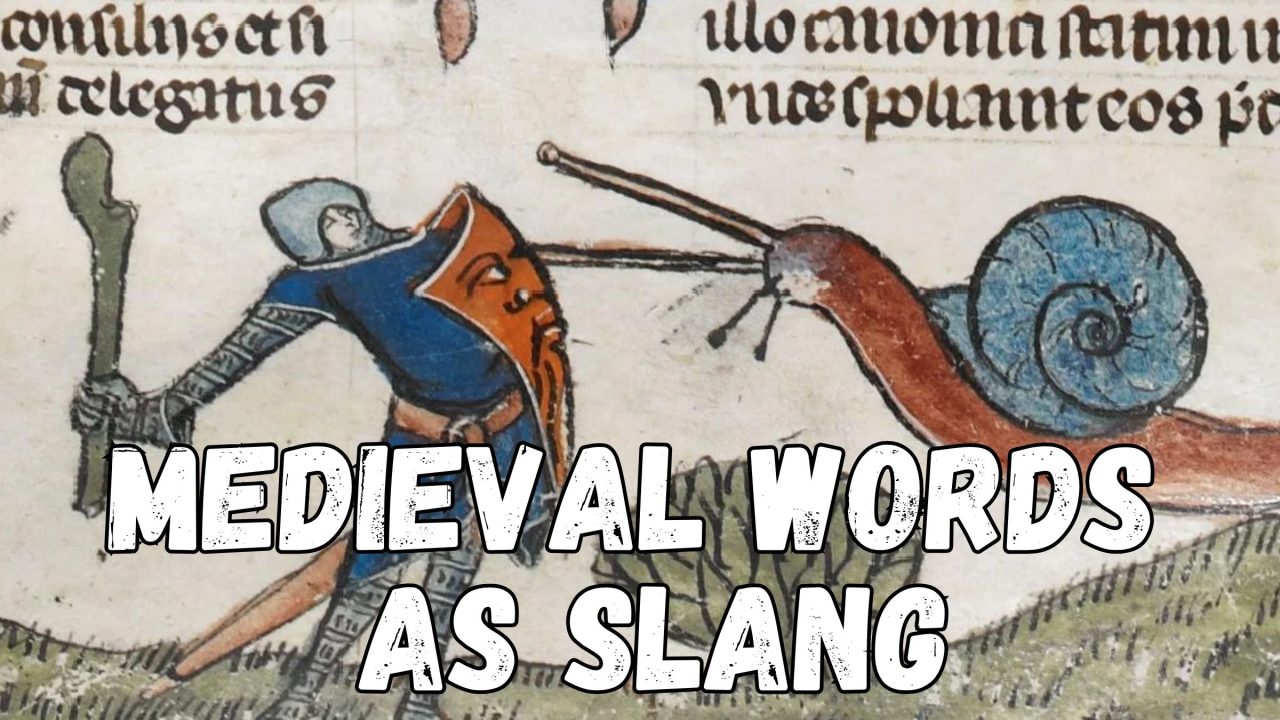
The word “chivalry” once stood for everything noble about medieval knighthood — honor, courage, and courtly conduct. Somewhere along the way, it became a euphemism for something far less dignified. That kind of transformation turns out to be surprisingly common in the history of the English language.
A closer look at Green’s Dictionary of Slang, examined by researchers at Medievalists.net, reveals that a remarkable number of words rooted in medieval life went on to develop second lives as slang — often with meanings that would have shocked the people who first used them. Some became criminal jargon. Others turned into insults or dark humor. A few ended up describing things their original speakers couldn’t have imagined.
The story of how these words changed tells us something interesting: language doesn’t move in a straight line, and the past has a way of turning up in the strangest places.
Why Medieval Words Ended Up in the Slang Dictionary
Slang tends to borrow from whatever is familiar, powerful, or slightly taboo in the culture around it. In the Middle Ages and the centuries that followed, the Church, the castle, and the forge were all central institutions — which made them perfect raw material for informal, subversive, or coded language.
Words tied to religious authority were especially popular targets. There’s something appealing, if irreverent, about taking a term associated with moral high ground and dragging it into the gutter. Words connected to craftsmanship and physical labor took different paths, picking up associations with crime, deception, or incompetence.
What’s striking is how long some of these alternative meanings persisted — not just as one-off insults but as established slang terms used across decades and even centuries.
Medieval Words That Became Slang: The Full Breakdown
The range of transformations here is genuinely surprising. Religious titles, architectural landmarks, and skilled trades all ended up meaning something very different in the mouths of slang speakers.
| Word | Original Association | Slang Meaning(s) | Era of Slang Use |
|---|---|---|---|
| Abbess | Head of a convent | A woman who kept a brothel | 17th–20th century |
| Abbot | Head of a monastery | A brothel-keeper’s husband or lover; also a prison warden | 17th–20th century |
| Bishop | Senior church official | A fly burnt in a candle; to burn something; a fraudster; a broken signpost | 16th–20th century |
| Blacksmith | Metal craftsman | A forger (UK); a safecracker (US); a bad cook (Australia) | Early 20th century |
| Castle | Fortified residence | A brothel | 19th-century American slang |
| Cathedral | Major church building | Something ancient or out-of-date | Late 17th–early 19th century |
| Chivalry | Code of noble conduct | Euphemism for sexual activity | Not fully specified in source |
A few of these deserve a closer look on their own.
- Bishop had one of the most varied careers in slang history — shifting from a burnt insect in the 16th century to outright fraud in the 18th and 19th centuries, before settling into the oddly mundane meaning of a broken signpost by the 20th century.
- Blacksmith shows how the same word could carry completely different meanings depending on which country you were in — a forger in Britain, a safecracker in America, and simply a terrible cook in Australia.
- Cathedral is perhaps the most poetic of the group: a word for something grand and enduring repurposed to mean something hopelessly out of date.
The Pattern Behind the Meanings
Look at enough of these words and a pattern starts to emerge. Religious titles — abbess, abbot, bishop — were consistently pulled toward the criminal or the scandalous. That probably wasn’t accidental. Using the language of the Church to describe brothels or fraud carried a built-in irony that speakers clearly found useful, whether as dark humor or as a way to speak in code.
Architectural words like “castle” and “cathedral” moved in a different direction. A castle becoming slang for a brothel might reflect the way large, private buildings were associated with hidden or illicit activity. A cathedral meaning something outdated captures a shift in how people related to old institutions — grand but no longer relevant.
The crafts-based words, like “blacksmith,” took on meanings connected to skilled but illegal work. Forging metal and forging documents share an obvious logic. Cracking a safe requires precision not unlike working metal. The Australian meaning — a bad cook — is the odd one out, though it may reflect a more general sense of someone who handles heat and tools badly.
What This Says About Language — and About Us
There’s a broader point here beyond the novelty of individual words. Slang is often treated as throwaway language — here today, forgotten tomorrow. But these examples show that slang can have extraordinary staying power. The word “abbess” carried its underground meaning for roughly three centuries. “Bishop” kept accumulating new slang definitions across four hundred years.
That kind of longevity suggests these words weren’t just casual jokes. They were part of working vocabularies — used by people who needed to communicate quickly, discreetly, or subversively about things that polite society preferred not to name directly.
The Middle Ages gave English a rich foundation of words tied to religion, power, and craft. Later generations didn’t discard that vocabulary — they repurposed it, twisted it, and sent it underground. The result is a language full of hidden histories, where a perfectly ordinary word might be carrying centuries of irony just beneath the surface.
Frequently Asked Questions
Where does this research come from?
The slang meanings documented in this article are drawn from Green’s Dictionary of Slang, as examined by Medievalists.net.
Did people in the Middle Ages actually use these words as slang?
Not necessarily — many of the slang meanings developed in later centuries, from the 16th century onward, though the base words themselves have medieval origins.
Which word had the longest slang history?
Based on
Did “blacksmith” mean the same thing as slang in every English-speaking country?
No — according to the source, it meant a forger in the United Kingdom, a safecracker in the United States, and a bad cook in Australia, all in the early 20th century.
Why were so many religious words repurposed as slang for disreputable things?
Is “chivalry” still used as slang today?
The source notes it became a euphemism for sexual activity but does not confirm whether that usage is still current.


Leave a Reply