
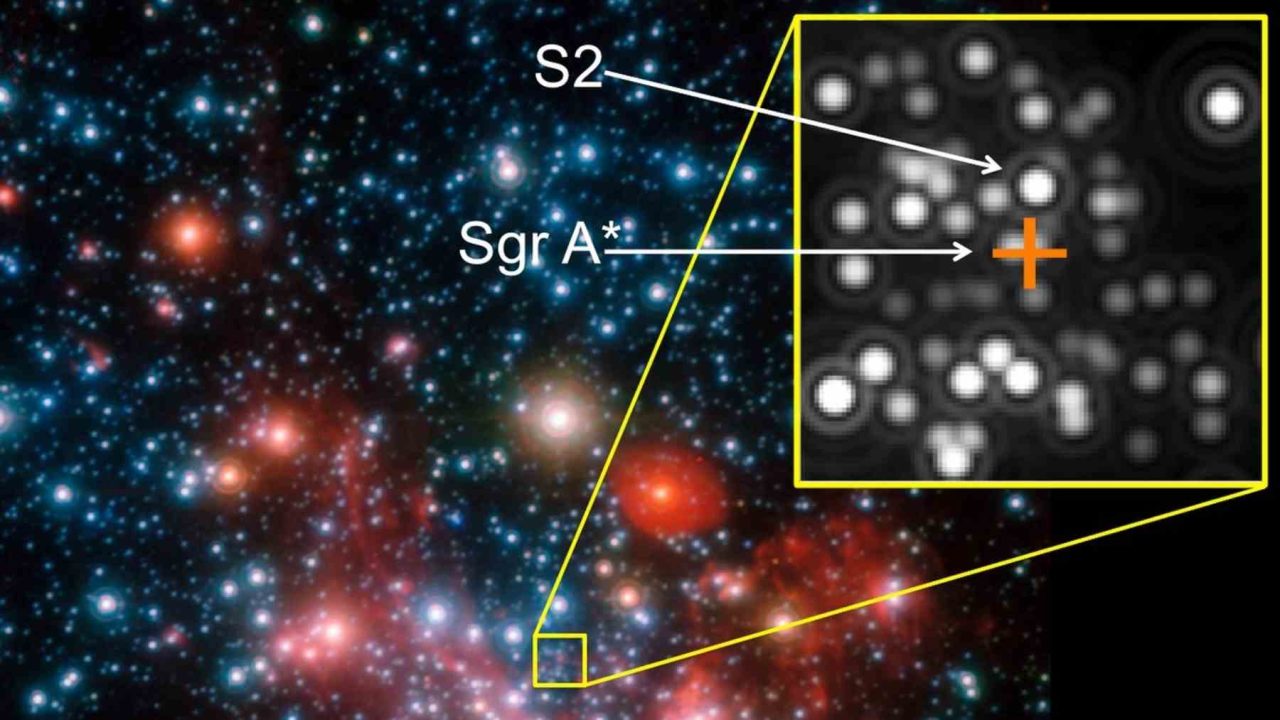
For decades, the answer to one of astronomy’s most fundamental questions seemed settled: at the center of the Milky Way sits a supermassive black hole called Sagittarius A*, a gravitational monster with a mass roughly 4.297 million times that of our Sun. But a new peer-reviewed study is now challenging that long-held picture — and the alternative it proposes is stranger than most people would expect.
According to the study, what anchors the heart of our galaxy might not be a black hole at all. Instead, it could be an ultra-compact concentration of dark matter — dense enough to pull nearby stars in almost exactly the same way a black hole would, but fundamentally different in nature.
That is not a small revision. It would mean one of the most iconic objects in modern astrophysics might be something we have never directly detected, built from particles we have never isolated, behaving in ways science is only beginning to model.
What the New Study Actually Argues
The researchers behind the study did not simply dismiss the black hole hypothesis. The evidence for Sagittarius A* is substantial. Observations of stars orbiting the galactic center have long pointed to a central mass of approximately 4.297 million solar masses. And in 2022, the Event Horizon Telescope released the first direct image of Sagittarius A*, which the scientific community widely described as visual confirmation of a black hole.
The new paper does not erase that evidence. What it does instead is ask a more precise question: could a dense, horizonless concentration of dark matter produce the same observable effects?
The authors modeled the galactic center not as a singularity surrounded by an event horizon, but as a compact cluster of light subatomic particles called fermions. In their framework, this fermion core would be dense enough to replicate the gravitational pull that makes stars near the galactic center orbit the way they do — without requiring an actual black hole.
What makes the model particularly striking is its scope. The researchers propose that this dark matter core at the galactic center and the much larger dark matter halo surrounding the entire Milky Way are part of the same unified structure. In other words, a single invisible framework could potentially explain both what happens at the galaxy’s core and how its outer regions rotate.
Why the Rotation of the Outer Galaxy Matters Here
The rotation of galaxies has been a puzzle for decades. Stars at the outer edges of spiral galaxies like the Milky Way move faster than they should if only visible matter were present. The standard explanation is dark matter — an invisible substance that adds gravitational mass without emitting light.
What this new study proposes is that the same dark matter responsible for those outer rotation patterns might also be concentrated densely enough at the galactic center to mimic a supermassive black hole. That would make dark matter not just a peripheral phenomenon but the central organizing structure of the entire galaxy, from its outermost arms to its innermost point.
That is a bold claim, and the researchers themselves acknowledge it comes with significant caveats. The 2022 Event Horizon Telescope image of Sagittarius A* remains a serious obstacle to any alternative explanation. The scientific community broadly treats that image as direct evidence of a black hole, and any competing model must account for it convincingly.
Key Claims in the Study at a Glance
| Claim | Detail |
|---|---|
| Central mass of Sagittarius A* | Approximately 4.297 million solar masses, based on stellar orbit observations |
| Proposed alternative | Ultra-compact dark matter core made of light fermion particles |
| Key behavior replicated | Gravitational pull on nearby stars, similar to a supermassive black hole |
| Additional effect explained | Rotation patterns of the outer Milky Way |
| Existing visual evidence | 2022 Event Horizon Telescope image, described as direct evidence of a black hole |
| Type of study | Peer-reviewed |
- The proposed dark matter core is described as horizonless — meaning it would not have the event horizon that defines a black hole
- The fermion particles in the model are characterized as light subatomic particles
- The model attempts to unify the galactic center and the galactic halo as a single continuous dark matter structure
- The study is peer-reviewed, meaning it passed independent scientific scrutiny before publication
What This Means for Our Understanding of the Galaxy
If the model holds up to further scrutiny, the implications stretch well beyond one object in one galaxy. Dark matter remains one of the most enduring mysteries in physics. Scientists are confident it exists based on its gravitational effects, but no one has directly detected a dark matter particle. A fermion-based model that could explain both galactic rotation and the behavior of a galactic center would represent a significant step toward understanding what dark matter actually is.
For now, the study is best understood as a serious scientific challenge rather than a settled answer. The researchers are not claiming the black hole interpretation is wrong — they are arguing that at least one alternative model fits the available data well enough to deserve attention.
That distinction matters. Science advances through exactly this kind of challenge: a model that has worked well for decades gets stress-tested by a competing explanation, and the community works to find observations that can tell the two apart.
What Happens Next in This Scientific Debate
The immediate next step is scrutiny. Other astrophysicists will examine the fermion model’s assumptions, test its predictions against existing data, and look for observations that could distinguish a dark matter core from a true black hole.
The Event Horizon Telescope image of Sagittarius A* will be a central point of that debate. The new model needs to account for what that image shows — or explain why a dense dark matter core might produce a similar visual signature.
Future observations of stars orbiting the galactic center, combined with advances in gravitational wave detection and next-generation telescope technology, may eventually provide data precise enough to settle the question. Until then, the center of the Milky Way remains one of the most contested and compelling objects in the known universe.
Frequently Asked Questions
What is Sagittarius A*?
Sagittarius A* is the name given to the object at the center of the Milky Way, long believed to be a supermassive black hole with a mass of approximately 4.297 million times that of our Sun.
What does the new study propose instead of a black hole?
The study suggests that the galactic center could instead be an ultra-compact concentration of dark matter made of light subatomic particles called fermions, dense enough to mimic a black hole’s gravitational effects.
Does the study disprove the existence of a black hole at the galactic center?
No. The study does not erase existing evidence, including the 2022 Event Horizon Telescope image. It argues that a dark matter alternative could explain much of the same observed behavior.
What is the significance of the 2022 Event Horizon Telescope image?
The Event Horizon Telescope released the first direct image of Sagittarius A* in 2022, which the scientific community widely described as visual evidence of a black hole — a key challenge any alternative model must address.
How does this relate to the rotation of the outer Milky Way?
The researchers propose that the same dark matter structure forming the compact core could also explain why the outer regions of the Milky Way rotate faster than visible matter alone would predict.
Has this model been confirmed?
The study is peer-reviewed but has not been confirmed. It represents a hypothesis that will require further observation and testing before the scientific community can assess its validity.




Leave a Reply