
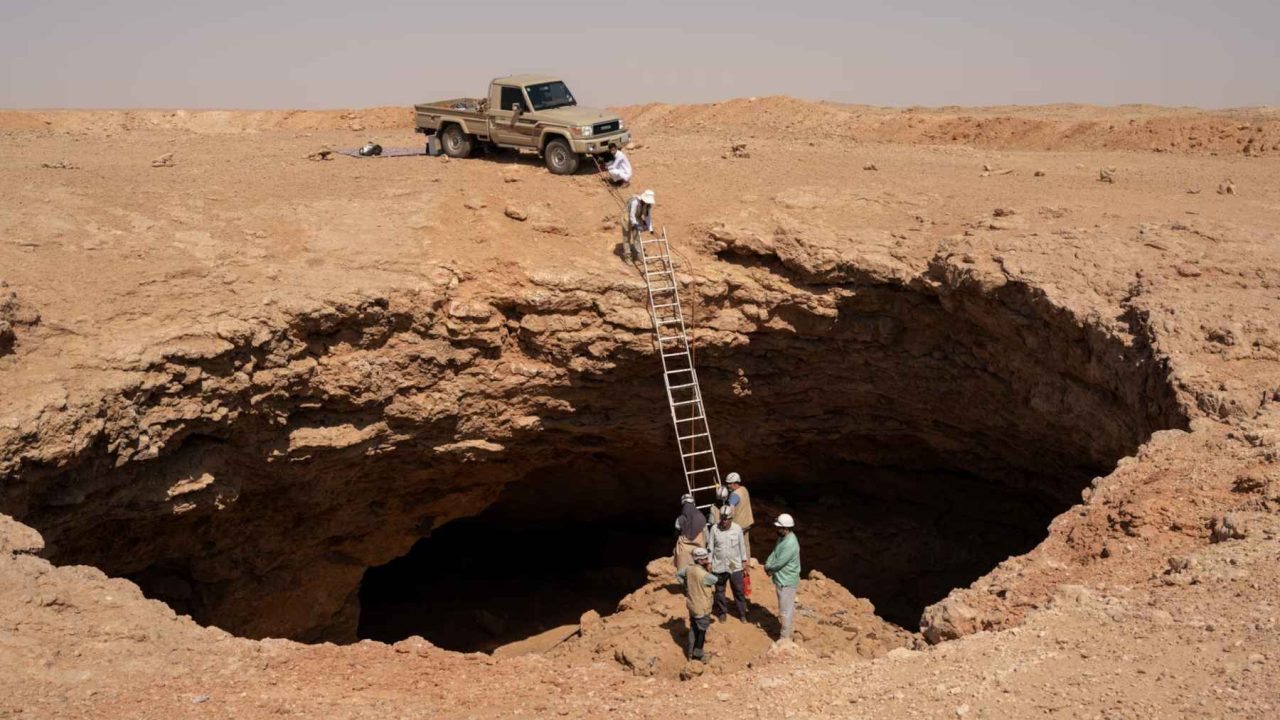
Scientists sent to survey underground caves in the Saudi Arabian desert expected to find scattered bones, maybe some fossils. What they found instead stopped them cold: whole cheetah bodies, dried and intact, lying exactly where the animals had died — fur, skin, limbs, and in some cases even brain tissue still preserved after centuries.
One outside expert described the find as something never before seen in the study of big cats. That reaction alone tells you how extraordinary this discovery really is.
The site is the Lauga cave network, located near the city of Arar in northern Saudi Arabia. And what researchers pulled from those caves is already reshaping what scientists know about cheetahs, their history on the Arabian Peninsula, and the real possibility of bringing them back.
What Researchers Found Inside the Lauga Caves
Between 2022 and 2023, a team from the National Center for Wildlife surveyed 134 underground caves spread across roughly 1,200 square kilometers of desert near Arar. Cheetah remains turned up in five of those caves. But one sinkhole cave stood out from all the rest.
Inside that single location, researchers uncovered seven naturally mummified cheetahs — complete bodies, not fragments — along with the bones of 54 additional animals. The mummies retained skin, limbs, and in some specimens, preserved brain material. That level of soft tissue survival in a wild mammal, without any human intervention or artificial preservation, is essentially unheard of.
Scientists were able to extract DNA from the remains and radiocarbon-date the specimens. The results spanned a remarkable range: some animals died roughly 130 years ago, others nearly 2,000 years ago, and some skeletal remains were even older than that.
The genetic data revealed something else significant — at least two distinct cheetah subspecies once lived across the Arabian Peninsula. That finding has direct implications for conservation efforts and any future attempt to reintroduce cheetahs to the region.
Why Natural Mummification Like This Almost Never Happens
Mummification of soft tissue in mammals requires an extremely specific set of environmental conditions to occur naturally. Temperature, humidity, airflow, and the absence of scavengers or decomposing bacteria all have to align in a very narrow window — and even then, complete preservation of an entire body is exceptionally rare.
Caves can sometimes create those conditions, particularly in arid desert environments where the air is consistently dry and cool. The sinkhole structure of the cave where most mummies were found likely played a role: animals that fell in may have had no way out, died in place, and were then preserved by the stable underground microclimate rather than exposed to the elements above ground.
What makes the Lauga discovery so striking to scientists is not just that one mummy survived — it’s that seven complete specimens were found together, alongside dozens of skeletal remains, all in varying states of preservation across nearly two millennia. That kind of layered, continuous record in a single location is almost impossible to find anywhere in the world, let alone for a species like the cheetah.
The Key Facts at a Glance
| Detail | Data |
|---|---|
| Location | Lauga cave network, near Arar, northern Saudi Arabia |
| Survey period | 2022–2023 |
| Caves surveyed | 134 caves across ~1,200 sq km |
| Caves with cheetah remains | 5 |
| Naturally mummified cheetahs found | 7 complete bodies |
| Additional skeletal remains | 54 animals |
| Date range of remains | ~130 years ago to nearly 2,000 years ago (some skeletons older) |
| Subspecies identified | At least 2 distinct cheetah subspecies |
| Tissue preserved | Skin, limbs, parts of the brain |
| Conducting organization | National Center for Wildlife (Saudi Arabia) |
- DNA was successfully extracted from the mummified remains
- Radiocarbon dating confirmed specimens spanning nearly two thousand years
- The discovery was described by at least one outside expert as unprecedented in big cat research
- The genetic findings may directly inform future cheetah reintroduction programs in the region
What This Means for Cheetahs — and for the Arabian Peninsula
Cheetahs no longer exist in the wild in Saudi Arabia or across most of the Arabian Peninsula. The Lauga find provides the clearest genetic and physical evidence yet that the species was not just passing through — it lived there, in multiple forms, across centuries.
The identification of at least two subspecies from the remains matters enormously for conservation science. Reintroduction programs depend on matching the right genetic lineage to the right environment. Without knowing which subspecies historically occupied a given region, there’s a real risk of introducing animals that are genetically mismatched to local conditions, prey availability, and disease pressures.
The Lauga data gives researchers a genetic baseline — a blueprint of what actually belonged there — that didn’t exist before this discovery. Researchers have noted that the results may now guide plans to bring the species back to the region, grounding future decisions in historical biological evidence rather than assumption.
What Comes Next for This Research
The immediate next step for the scientific community will be deeper analysis of the extracted DNA. With soft tissue preserved across multiple specimens spanning nearly two millennia, researchers have an unusually rich dataset to work with — one that could clarify the evolutionary history of Arabian cheetah populations and their relationship to subspecies found elsewhere in Africa and Asia.
The cave network itself may also warrant further exploration. Of the 134 caves surveyed, only five contained cheetah remains. It’s not yet known whether additional caves in the broader region hold similar deposits, or whether Lauga represents a unique convergence of geography and climate that won’t be replicated elsewhere.
For Saudi Arabia’s conservation programs, the findings arrive at a moment when rewilding and species recovery efforts are receiving significant national attention. Whether this discovery accelerates a formal cheetah reintroduction proposal has not yet been confirmed, but the scientific groundwork is now significantly stronger than it was before the survey team entered those caves in 2022.
Frequently Asked Questions
Where exactly were the mummified cheetahs found?
They were found in the Lauga cave network near the city of Arar in northern Saudi Arabia, with most of the seven mummified bodies discovered in a single sinkhole cave.
How were the cheetahs naturally mummified without human intervention?
The stable, dry underground environment of the cave system is believed to have created conditions that prevented decomposition, though the exact mechanisms are still being studied by researchers.
How old are the remains?
Radiocarbon dating placed the remains in a range from approximately 130 years ago to nearly 2,000 years ago, with some skeletal remains even older than that.
What makes this discovery scientifically significant?
The combination of complete soft-tissue preservation, extractable DNA, and remains spanning nearly two millennia in a single location is described as unprecedented in big cat research.
How many cheetah subspecies were identified?
DNA analysis of the remains identified at least two distinct cheetah subspecies that once lived on the Arabian Peninsula.
Could this lead to cheetahs being reintroduced to Saudi Arabia?
Researchers have noted the findings may guide reintroduction planning, but no formal program has been confirmed based on the available source material.


Leave a Reply