
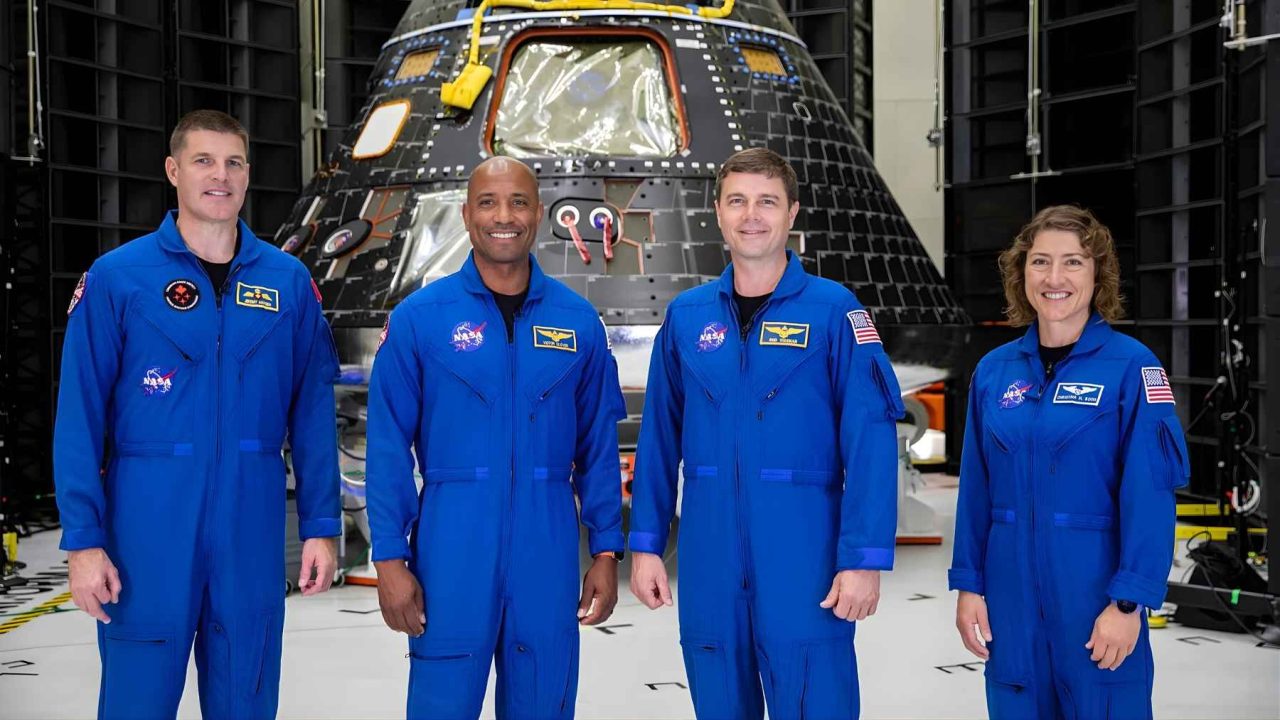
For the first time since 1972, four human beings are preparing to travel beyond low Earth orbit and loop around the Moon — not to land, but to prove that landing is possible. NASA’s Artemis II mission is a ten-day journey designed to test every critical system before the agency attempts something far more ambitious: putting boots back on the lunar surface.
The last time astronauts flew this far from Earth, the world was still watching black-and-white television sets and pocket calculators were a novelty. More than fifty years later, NASA is rolling out a rocket the size of a skyscraper and asking four crew members to trust their lives to hardware that has never carried humans this far into space.
This is not just a space story. It is a story about survival engineering, about what it takes to keep people alive in an environment that will kill them without warning — and about what comes next if it works.
What Artemis II Actually Is — and Why It Matters Now
Artemis II is explicitly described as a dress rehearsal. The mission will send four astronauts on a roughly ten-day flight that loops around the Moon and returns them safely to Earth. No landing. No moonwalk. Just the most demanding test flight NASA has attempted in living memory.
The spacecraft making this journey is the Orion capsule, riding atop NASA’s Space Launch System — one of the most powerful rockets ever built. The combination has flown once before, without crew, on the Artemis I mission. Now comes the real thing.
The stakes are enormous. If Artemis II succeeds, it clears the path for Artemis III, the mission intended to return humans to the lunar surface for the first time since Apollo 17 in December 1972. If something goes wrong, that timeline — already stretched across years of delays and billions of dollars — gets pushed further into the future.
Officials have noted that the lessons learned from flying humans this far from Earth apply far beyond space exploration. Managing limited water, power, and breathable air in one of the harshest environments imaginable produces engineering solutions and survival protocols that feed directly back into how we think about resource constraints here on Earth.
The Slow-Motion Spectacle at Kennedy Space Center
Before any of this can happen, NASA has to move a rocket. And moving this particular rocket is an event in itself.
At Florida’s Kennedy Space Center, teams are preparing to roll the fully-stacked Space Launch System — rocket, Orion spacecraft, and mobile launch tower all assembled together — out of the Vehicle Assembly Building and down to Launch Pad 39B. The distance is approximately four miles. The machine doing the moving is called the crawler transporter, and the journey can take up to twelve hours.
That is not a typo. Twelve hours to travel four miles. The crawler moves at a pace that makes a brisk walk look fast, because the hardware it carries is irreplaceable and the cost of a mistake is incalculable. Engineers have been working around the clock to close out a long checklist of pre-rollout tasks before that journey begins.
It is one of those moments that reminds you how much invisible labor goes into a single launch — the thousands of people who never make the headlines but whose work makes the headline moment possible.
Key Mission Facts at a Glance
| Mission Element | Detail |
|---|---|
| Mission name | Artemis II |
| Crew size | Four astronauts |
| Mission duration | Approximately 10 days |
| Mission type | Crewed lunar flyby — no landing |
| Launch vehicle | Space Launch System (SLS) |
| Spacecraft | Orion capsule |
| Launch site | Kennedy Space Center, Launch Pad 39B |
| Rollout distance | Approximately 4 miles |
| Rollout duration | Up to 12 hours |
| Last comparable mission | Apollo program, 1972 |
- Artemis II is the first crewed mission beyond low Earth orbit in more than 50 years
- The mission serves as the critical dress rehearsal before an attempted Moon landing
- Success clears the way for Artemis III, the planned lunar surface mission
- The crawler transporter moves the rocket stack from the Vehicle Assembly Building to the pad
What This Means for the People Watching From Earth
For anyone who grew up after the Apollo era, Artemis II represents something genuinely new in their lifetime — humans venturing further from home than any living person has ever gone. That carries weight beyond the technical achievement.
There is also a practical dimension. The mission is designed to stress-test what it means to survive in deep space with constrained resources: limited water, limited power, limited air. The engineering solutions developed for that environment have real downstream applications for how we manage scarcity in extreme conditions on Earth — from remote research stations to disaster response systems.
Supporters of the program argue that the investment in Artemis pays dividends well beyond the Moon, generating technology, talent pipelines, and scientific knowledge that benefit the broader public. Critics have pointed to the cost and the years of delays. Both conversations will intensify as launch day approaches.
What Comes After Artemis II
The immediate next step is the rollout to Launch Pad 39B, a process that engineers are actively preparing for. Once the rocket reaches the pad, a series of tests and checks will follow before a launch date is confirmed.
If Artemis II completes its ten-day mission successfully — four astronauts loop the Moon, the Orion systems perform as designed, and the crew splashes down safely — attention shifts immediately to Artemis III. That mission carries the weight of history: the first crewed lunar landing since Apollo 17, the mission that closed the original Moon program in December 1972.
More than half a century of waiting comes down to whether this dress rehearsal works. The four astronauts strapping in for Artemis II are not just testing a spacecraft. They are testing whether humanity is ready to go back.
Frequently Asked Questions
What is the Artemis II mission?
Artemis II is a ten-day NASA mission that will send four astronauts on a crewed flyby of the Moon and return them to Earth. It is a dress rehearsal for the Artemis III lunar landing mission.
Will the Artemis II crew land on the Moon?
No. Artemis II is a flyby mission only — the crew will loop around the Moon but will not attempt a landing.
When was the last time humans flew around the Moon?
The last comparable mission took place during the Apollo program in 1972, making Artemis II the first crewed lunar flyby in more than fifty years.
Where does Artemis II launch from?
The mission launches from Kennedy Space Center in Florida, specifically from Launch Pad 39B.
How long does it take to roll the rocket to the launch pad?
The crawler transporter moves the fully-stacked rocket approximately four miles from the Vehicle Assembly Building to the launch pad, a journey that can take up to twelve hours.
What comes after Artemis II?
If Artemis II succeeds, NASA will proceed toward Artemis III — the mission intended to land humans on the Moon’s surface for the first time since 1972.



Leave a Reply