
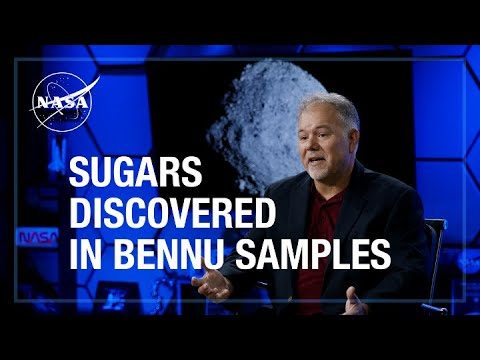
What if the building blocks of life didn’t originate in a warm, sunlit pond on early Earth — but instead formed in the frozen, radiation-blasted outer reaches of the solar system? That’s exactly the question scientists are now wrestling with after analyzing samples returned from asteroid Bennu, a 4.5-billion-year-old relic that may have just rewritten one of science’s oldest debates.
When NASA’s OSIRIS-REx spacecraft released a sample capsule over the Utah desert in 2023, researchers knew they had something extraordinary. What they didn’t fully anticipate was how profoundly the chemistry locked inside those rocks would challenge existing theories about the origin of life on Earth.

The findings are striking: key amino acids, nucleobases, carbon, nitrogen, and ammonia — the very compounds that form the foundation of biological life — have been identified in material that predates Earth itself.
What Scientists Actually Found Inside the Bennu Samples
Bennu is a dark, carbon-rich rubble pile roughly 500 meters across. Scientists believe it preserves material from approximately 4.6 billion years ago, making it one of the most ancient objects ever physically studied by humans.
The returned samples have revealed a remarkably complex chemical inventory. According to coordinated studies including a NASA analysis of the Bennu material and a Nature Astronomy paper focused on Bennu’s volatile-rich chemistry, the asteroid contains:
- Amino acids — the molecular units that build proteins in all living organisms
- Nucleobases — the chemical letters that encode genetic information in DNA and RNA
- Carbon and nitrogen — two of the most essential elements for organic chemistry
- Ammonia — a nitrogen-bearing compound linked to prebiotic chemical reactions
Finding all of these compounds together, in a single pristine sample from the early solar system, is scientifically significant in ways that are hard to overstate. It suggests that the raw ingredients for life were being assembled in space long before Earth even existed.
Why This Forces Scientists to Rethink the Origin of Life
For decades, one of the dominant theories about how life began pointed to warm, liquid water environments on early Earth — volcanic pools, hydrothermal vents, shallow coastal waters where chemistry could slowly concentrate and react. The logic was straightforward: life as we know it requires liquid water, so life probably started where liquid water existed.
The Bennu findings complicate that picture significantly. The new analysis suggests that key amino acids may have formed in frozen, radiation-soaked regions far from the young Sun — environments that look nothing like a warm primordial pond.
If true, that means the chemistry of life doesn’t necessarily require warmth or liquid water to get started. It can apparently emerge in the cold, irradiated vacuum of deep space, embedded in carbon-rich rocks drifting through the solar system for billions of years.
This has enormous implications. It raises the real possibility that asteroids like Bennu acted as cosmic delivery vehicles, seeding young planets — including Earth — with pre-assembled organic chemistry when they collided with planetary surfaces in the early solar system.
Bennu by the Numbers: What We Know About This Asteroid
| Feature | Detail |
|---|---|
| Size | Approximately 500 meters across |
| Estimated age of material | Approximately 4.6 billion years old |
| Classification | Dark, carbon-rich rubble pile; near-Earth asteroid |
| Sample return mission | NASA OSIRIS-REx, capsule dropped over Utah desert in 2023 |
| Key compounds identified | Amino acids, nucleobases, carbon, nitrogen, ammonia |
| Notable research publications | NASA sample analysis; Nature Astronomy paper on volatile-rich chemistry |
Beyond its scientific value, Bennu also carries a more unsettling distinction. It is classified as a near-Earth asteroid that periodically swings close to our planet and has been identified as a potential long-term impact risk — though scientists note the odds remain low. That dual identity, as both a threat and a treasure chest of ancient chemistry, makes Bennu one of the most closely watched objects in the solar system.
What This Means for the Search for Life Beyond Earth
The implications of the Bennu findings extend well beyond Earth’s history. If amino acids and nucleobases can form in frozen, irradiated space environments and survive for billions of years inside asteroids, then the chemistry of life may be far more widespread across the universe than previously assumed.
Every solar system that forms also produces asteroids. Every asteroid-rich system is potentially scattering organic compounds across its planets. The question of whether life exists elsewhere suddenly looks less like a long shot and more like a chemistry problem — one the universe may be solving constantly, in the cold dark between the stars.
Researchers note that Bennu is not the only carbon-rich asteroid out there. It’s simply the first one from which scientists have retrieved a pristine, uncontaminated physical sample for laboratory analysis. What they’re learning from it will shape how future missions are designed and what questions astrobiologists ask next.
What Happens Next in This Research
The Bennu samples are still being studied. The coordinated research effort — spanning NASA laboratories and peer-reviewed publications including Nature Astronomy — represents only the early stages of what will likely be years of ongoing analysis.
Scientists will continue examining the chemical relationships between the compounds found, trying to understand not just what is present but how those molecules formed and under what conditions. The distinction between amino acids assembled in frozen, radiation-rich environments versus warm liquid water environments is central to that work.
Future asteroid sample return missions, including Japan’s Hayabusa2 extended mission, will add further data points. But for now, the rocks from Bennu are delivering answers — and raising questions — that no one fully anticipated when that capsule tumbled out of the sky over Utah two years ago.
Frequently Asked Questions
What is asteroid Bennu and why does it matter?
Bennu is a dark, carbon-rich near-Earth asteroid approximately 500 meters across, believed to preserve material from about 4.6 billion years ago. It matters because samples returned from it contain key organic compounds linked to the origin of life.
How did NASA collect samples from Bennu?
NASA’s OSIRIS-REx spacecraft collected material from Bennu and returned it to Earth via a sample capsule dropped over the Utah desert in 2023.
What specific compounds were found in the Bennu samples?
Scientists identified amino acids, nucleobases (which build DNA and RNA), carbon, nitrogen, and ammonia — all compounds considered essential to the chemistry of life.
Why do the Bennu findings challenge existing theories about life’s origin?
The new analysis suggests amino acids may have formed in frozen, radiation-soaked regions far from the young Sun, rather than only in warm liquid water environments as many theories have long proposed.
Is Bennu a danger to Earth?
Bennu has been modeled as a potential long-term impact risk due to its periodic close approaches to Earth, though scientists describe the odds of an actual impact as low.
Are the Bennu samples still being studied?
Yes. The findings so far come from early coordinated analyses, including a NASA study and a Nature Astronomy paper, with further research expected to continue for years.



Leave a Reply