
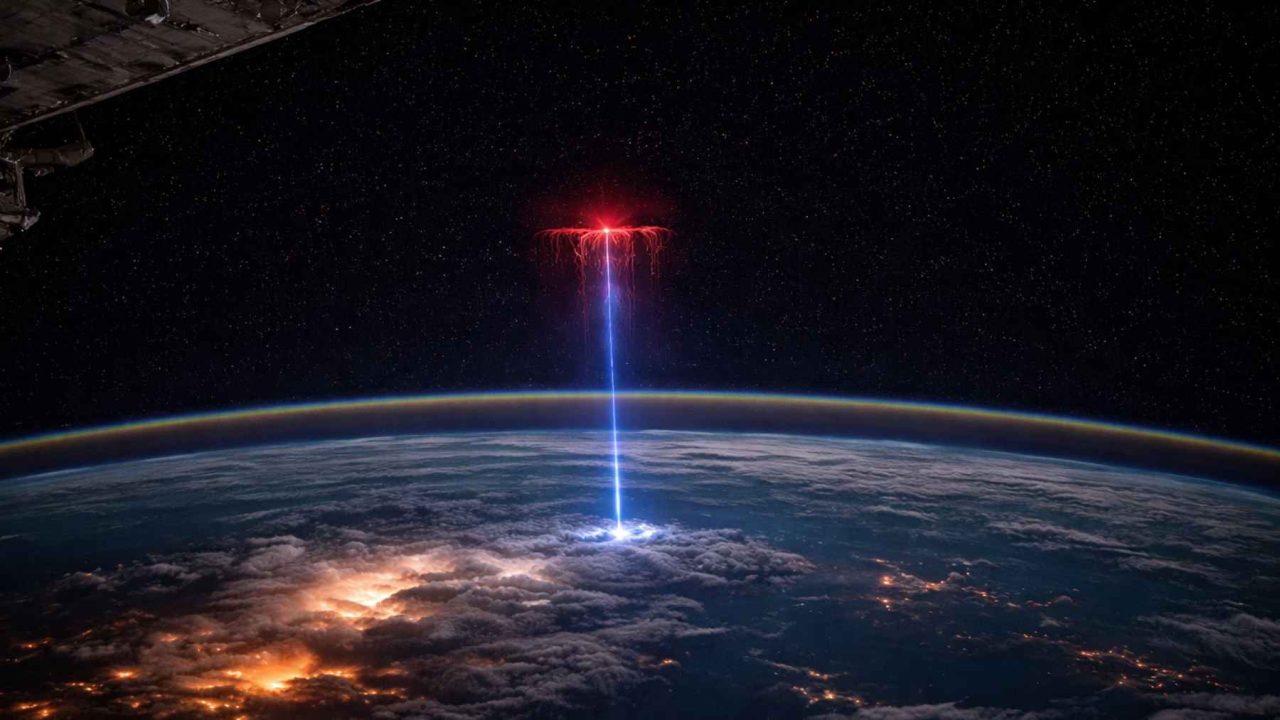
Lightning that shoots upward toward the edge of space instead of striking down to Earth — it sounds like a scene from a science fiction film, but it is very real, and NASA wants to make sure you have seen it.
The U.S. space agency is drawing renewed attention to a striking image captured from the International Space Station on July 3, 2025, showing what scientists call a “gigantic jet” — a rare form of lightning that erupts from the top of a thunderstorm and climbs to a height of nearly 100 kilometers, reaching toward the boundary between Earth’s atmosphere and space.
Most people have never heard of gigantic jets, let alone seen one. But researchers are paying close attention to these phenomena for reasons that go well beyond the visual spectacle.
What Is a Gigantic Jet — and Why Does It Go the Wrong Way?
When most people picture lightning, they picture a bolt crashing downward from a storm cloud to the ground. Gigantic jets do the opposite. They fire upward from the top of a thunderstorm, punching through the stratosphere and continuing to climb until they approach the mesosphere — nearly 100 kilometers above the surface.
That altitude puts them at roughly the same height as the aurora borealis and just below where satellites begin to orbit. The sheer scale of these events is difficult to fully grasp from the ground, which is part of why imagery from the ISS is so valuable.
Gigantic jets belong to a broader family of atmospheric phenomena known as transient luminous events, or TLEs. This group includes several related phenomena, each occurring in the upper atmosphere and each carrying its own distinct appearance and behavior.
The Full Family of Transient Luminous Events
Gigantic jets are not alone in the upper atmosphere. Scientists have identified several types of TLEs, all connected to thunderstorm activity below but each behaving differently once they reach altitude.
| Type of TLE | Description |
|---|---|
| Gigantic Jets | Lightning that shoots upward from storm tops to nearly 100 km altitude |
| Red Sprites | Brief reddish flashes appearing high above large thunderstorms |
| Blue Jets | Cone-shaped bursts of blue light ejected upward from storm clouds |
| ELVES | Rapidly expanding rings of light in the upper atmosphere |
What makes this field genuinely surprising is how recently scientists confirmed any of these events existed. Pilots had been reporting strange flashes above storm systems for decades, but the scientific community did not have confirmed recordings until 1989. That means this entire area of atmospheric science is, by research standards, still quite young.
- TLEs were considered anecdotal curiosities for most of the 20th century
- The first confirmed recordings only arrived in 1989
- The ISS has since become one of the most effective platforms for observing them
- Gigantic jets are among the rarest and most dramatic of all TLE types
Why Scientists Are Watching This More Closely Than You Might Expect
It would be easy to file gigantic jets under “cool but irrelevant.” That would be a mistake. Researchers are studying these events for a set of practical reasons that connect directly to aviation safety, spacecraft operations, and our broader understanding of how Earth’s atmosphere behaves.
High-altitude lightning events can interact with the ionosphere — the electrically charged layer of the upper atmosphere that plays a critical role in radio communications and GPS signal transmission. When events like gigantic jets discharge energy into that region, the effects can ripple outward in ways scientists are still working to fully understand.
There are also implications for aviation and spacecraft safety. Aircraft flying at high altitudes, and vehicles passing through the upper atmosphere during launch or reentry, operate in the same general zones where TLEs occur. Understanding the energy levels and frequency of these events matters for engineering and safety planning.
Beyond that, researchers have noted that high-altitude lightning may influence upper atmosphere chemistry — with potential connections to weather modeling and climate research. These are not fringe ideas. They represent active lines of scientific inquiry backed by ongoing observation programs.
What the ISS Image Actually Shows
The photograph highlighted by NASA was taken from aboard the International Space Station on July 3, 2025. From that vantage point — roughly 400 kilometers above Earth — astronauts and instruments have a unique angle on atmospheric events that ground-based observers simply cannot replicate.
The image captures the gigantic jet mid-discharge, visually connecting the storm system below to the near-space environment above. The scale is cinematic in a way that ground photography rarely achieves, which is likely part of why NASA has returned to highlighting it.
The ISS has become an increasingly important scientific platform for studying TLEs precisely because of this perspective. Events that last only milliseconds and occur at extreme altitudes are far easier to document from orbit than from the surface.
What Researchers Are Still Trying to Figure Out
Despite the progress made since 1989, TLE science still has significant open questions. Scientists are working to better understand how frequently gigantic jets occur globally, what specific storm conditions produce them, and precisely how much energy they deposit into the upper atmosphere.
The relatively short observational record — less than four decades of confirmed data — means that statistical baselines are still being established. Every new image from the ISS, including the July 2025 photograph, adds to a dataset that researchers are using to build a more complete picture.
NASA’s decision to re-highlight this particular image suggests it remains scientifically and visually significant — a reminder that some of Earth’s most dramatic natural events happen not at ground level, but in the invisible layers of atmosphere above the clouds.
Frequently Asked Questions
What is a gigantic jet?
A gigantic jet is a rare form of lightning that shoots upward from the top of a thunderstorm and rises to a height of nearly 100 kilometers, approaching the edge of space rather than striking the ground.
When was the ISS image of the gigantic jet taken?
The image was captured from the International Space Station on July 3, 2025, and NASA has since drawn renewed attention to it.
When was the first confirmed recording of a transient luminous event?
The first confirmed recordings of TLEs, the family of phenomena that includes gigantic jets, arrived in 1989, despite pilots reporting unusual flashes above storms for decades before that.
Why do gigantic jets matter beyond their appearance?
Scientists are studying them because high-altitude lightning can interact with the ionosphere, affect aviation and spacecraft safety, and may influence upper atmosphere chemistry connected to weather and climate research.
What other types of transient luminous events exist?
The TLE family includes red sprites, blue jets, gigantic jets, and ELVES — each with distinct characteristics but all connected to thunderstorm activity in the lower atmosphere.
How often do gigantic jets occur?
This has not yet been fully confirmed — establishing global frequency rates is one of the active areas of research, and scientists are still building the observational record needed to answer that question accurately.




Leave a Reply