
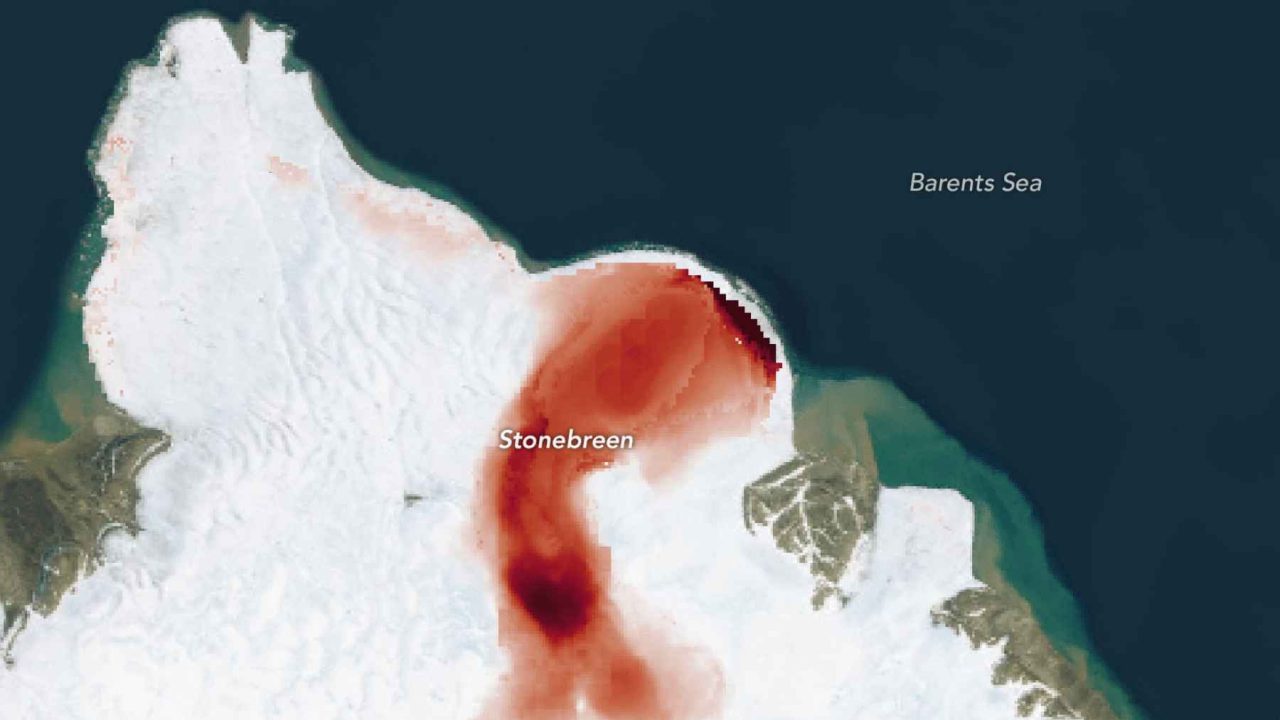
Every summer, something strange happens to a glacier on a remote Norwegian island — and NASA has captured it in a way that’s hard to look away from. Parts of Stonebreen glacier, located on Edgeøya in Norway’s Svalbard archipelago, have been recorded moving at speeds of up to 2,590 meters per year during peak summer months. That’s nearly 8,500 feet of glacial movement in a single year — a figure that challenges most people’s mental image of glaciers as slow, barely-moving sheets of ancient ice.
NASA’s new imagery visualizes this motion through color, with darker shades of red indicating faster flow. The result looks almost like a heartbeat — a glacier that pulses with the seasons. It’s visually striking. It’s also scientifically significant in ways that go well beyond aesthetics.
Edgeøya sits in southeastern Svalbard, roughly halfway between mainland Norway and the North Pole. It’s one of the more remote corners of the Arctic, the kind of place most people will never visit. But what’s happening there is part of a much larger story about how glaciers behave as the planet warms — and why scientists are paying close attention.
What NASA Actually Detected on Stonebreen
The imagery NASA released tracks how fast the surface of Stonebreen is moving over time, not any change in the glacier’s actual color. The animation covers a multi-year window from 2014 to 2022, and the pattern it reveals is consistent and clear: the glacier moves relatively slowly through winter and spring, then accelerates sharply by late summer.
During most of that period, the late-summer surge pushed flow rates past 1,200 meters per year in certain areas. But in the summer of 2020, parts of the glacier hit a recorded peak of 2,590 meters per year — more than double the already-elevated seasonal baseline.
The mechanism behind the surge is well understood in glaciology, even if the scale of what’s happening at Stonebreen is notable. When surface temperatures rise in summer, meltwater forms on top of the glacier. That water eventually finds its way down through cracks and channels to the base of the ice. Once it gets there, it raises the pressure between the glacier and the bedrock beneath it, reducing friction and allowing the ice to slide more freely. The result is a seasonal speed-up that shows up in NASA’s imagery as that distinctive red pulse.
The Numbers Behind the Pulse
To understand the scale of what’s being observed, it helps to look at the data directly. The contrast between Stonebreen’s winter and summer behavior is dramatic.
| Time Period | Observed Flow Speed | Notes |
|---|---|---|
| Winter / Spring (2014–2022) | Relatively slow | Baseline seasonal movement |
| Late Summer (typical, 2014–2022) | Over 1,200 meters per year (~3,940 ft) | Consistent seasonal surge |
| Summer 2020 (peak recorded) | 2,590 meters per year (~8,500 ft) | Highest observed in the data window |
A few things stand out here. First, the seasonal pattern is consistent — this isn’t a one-time anomaly. Second, the 2020 peak was significantly higher than what the data showed in surrounding years, suggesting that summer melt conditions that year were particularly intense. Third, the location matters: Svalbard is one of the fastest-warming regions on Earth, and glaciers there are under increasing stress.
Why Svalbard Is the Right Place to Watch This
Svalbard isn’t just a dramatic backdrop. It’s one of the most closely monitored glacial environments on the planet, precisely because the changes there are happening faster than almost anywhere else.
The archipelago sits deep in the Arctic, and the Arctic is warming at a rate significantly faster than the global average. That makes glaciers like Stonebreen early and visible indicators of broader climate shifts. When NASA trains its instruments on a glacier in southeastern Svalbard and finds it surging by late summer every year — with a 2020 peak that nearly doubled the already-elevated norm — that’s not just a local story.
- Edgeøya is located in southeastern Svalbard, roughly midway between mainland Norway and the North Pole
- Stonebreen’s behavior was tracked continuously from 2014 to 2022
- The summer acceleration is driven by meltwater reaching the glacier’s base and reducing friction with bedrock
- The 2020 surge — at 2,590 meters per year — was the highest recorded in the observation window
- The visual animation uses darker reds to indicate faster movement, creating the “pulse” effect
The pattern NASA documented isn’t unique to Stonebreen. Meltwater-driven acceleration has been observed in glaciers across Greenland and other Arctic zones. But the imagery from Stonebreen makes the phenomenon unusually visible — and that visibility has scientific value. It helps researchers track how glacial dynamics are shifting year over year, and it gives the public a rare window into what’s actually happening at the ice.
What This Means Beyond the Arctic
Faster-moving glaciers don’t just stay in place — they deliver more ice to the ocean. When glaciers accelerate their flow toward the sea, they contribute to sea level rise at a faster rate than slower-moving ice would. The summer surges at Stonebreen are a local expression of a global concern.
Scientists have noted that understanding the mechanics of these seasonal pulses — how meltwater builds at the base, how pressure changes affect flow, how peaks like the 2020 event fit into longer trends — is essential for building accurate models of future sea level behavior. Imagery like NASA’s animation isn’t just striking to look at. It feeds into the data that climate scientists rely on to make projections that affect coastal planning, infrastructure decisions, and international climate policy.
For most people, a glacier in the Norwegian Arctic is abstract — something far away and easy to ignore. NASA’s red pulse makes it harder to look away. And the numbers underneath the imagery make it harder to dismiss.
Frequently Asked Questions
What is Stonebreen, and where is it located?
Stonebreen is a glacier on Edgeøya, an island in Norway’s Svalbard archipelago, situated roughly halfway between mainland Norway and the North Pole in the southeastern part of the archipelago.
Why does Stonebreen appear to “pulse” in NASA’s imagery?
The animation uses color — darker reds indicating faster movement — to show how the glacier’s flow speed changes through the year, creating a visual effect that resembles a pulse or heartbeat.
How fast did Stonebreen move at its peak?
During the summer of 2020, parts of Stonebreen reached a recorded flow speed of 2,590 meters (roughly 8,500 feet) per year — the highest observed in the 2014–2022 data window.
What causes the summer speed-up?
Meltwater from the glacier’s surface drains down to the base, raising pressure between the ice and the bedrock beneath it, which reduces friction and allows the glacier to slide faster.
Is this seasonal surge a new phenomenon?
Based on the data NASA tracked from 2014 to 2022, the summer acceleration appears to be a consistent seasonal pattern at Stonebreen, not a one-time event — though the 2020 peak was notably higher than other years in the observation period.
Does this affect sea levels?
Faster-moving glaciers deliver more ice to the ocean more quickly, which contributes to sea level rise — making observations like these important for long-term climate modeling and coastal planning, though the full extent of Stonebreen’s specific contribution has not been detailed in the available source material.




Leave a Reply