
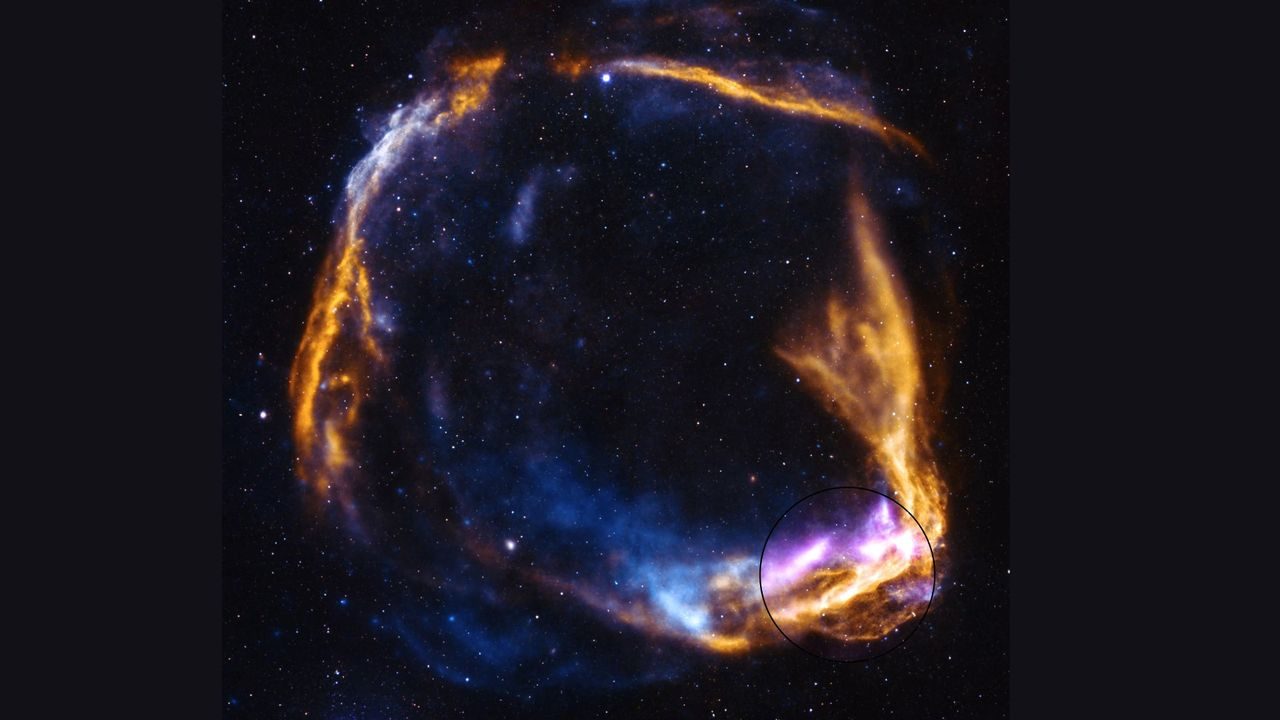
Eight thousand light-years away, in the constellation Circinus, the glowing remains of a catastrophic stellar explosion have been silently expanding through space for two millennia. Now, a NASA telescope has turned its gaze on this ancient wreckage — and what it found raises more questions than it answers.
The object is called RCW 86, a supernova remnant with a remarkable human history. Chinese astronomers first recorded the original explosion in A.D. 185, making it one of the oldest documented astronomical events in human history. Nearly 2,000 years later, NASA’s newest X-ray observatory has revealed something unexpected lurking at its outer edge.
The image, shared on March 24, 2026, captures a multi-telescope portrait of RCW 86 that layers data from some of the most powerful space observatories ever built — and the results are pulling scientists back to the drawing board.
A Star That Died While Rome Still Stood
To understand why this discovery matters, it helps to picture what RCW 86 actually is. When a massive star exhausts its nuclear fuel, it collapses and then detonates in a supernova — one of the most energetic events in the known universe. What gets left behind is an expanding shell of superheated gas and high-energy particles, called a supernova remnant.
RCW 86 is that shell. It has been spreading outward through the Milky Way ever since ancient Chinese sky-watchers noted a “guest star” appearing in their records in A.D. 185. That observation, preserved in the Book of Later Han, is now understood to be one of the earliest known written accounts of a supernova anywhere on Earth.
What makes RCW 86 scientifically valuable isn’t just its age — it’s the fact that we know roughly when the clock started. That gives astronomers a rare fixed reference point for studying how supernova remnants evolve over time.
What NASA’s New Telescope Actually Found
The fresh imagery comes from NASA’s Imaging X-ray Polarimetry Explorer, known as IXPE. The telescope focused specifically on the outer rim of RCW 86 — the leading edge of the expanding shockwave — which is highlighted in purple in the processed image released this week.
Multiple observatories contributed to the final composite image, each capturing a different layer of the remnant’s complex physics:
- Chandra X-ray Observatory (NASA/CXC/SAO) — high-resolution X-ray data
- XMM-Newton (ESA) — broad X-ray coverage across the remnant
- IXPE (NASA/MSFC) — X-ray polarization measurements at the outer rim
- Ground-based optical imaging (NSF/NOIRLab) — visible-light context for the surrounding region
The image processing itself was handled by NASA/CXC/SAO, with J. Schmidt credited for the final composite work.
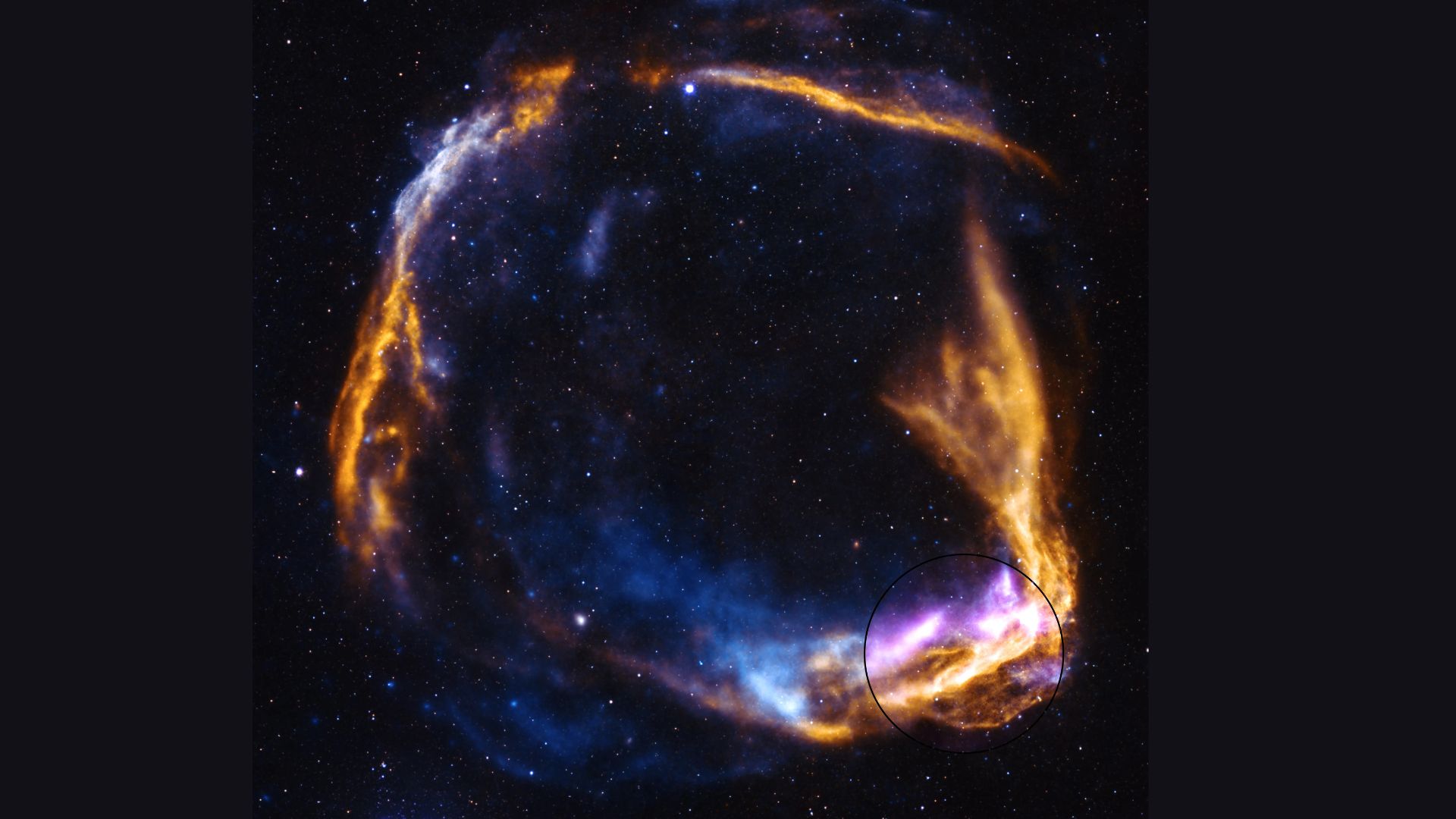
IXPE’s specific contribution is its ability to measure X-ray polarization — essentially, the directional alignment of X-ray light waves. This technique reveals information about magnetic field structures and the behavior of high-energy particles at the shockwave boundary that no previous telescope could capture in this way.
Key Facts About RCW 86 at a Glance
| Detail | Information |
|---|---|
| Object name | RCW 86 |
| Object type | Supernova remnant |
| Distance from Earth | 8,000 light-years |
| Location | Constellation Circinus |
| Original explosion recorded | A.D. 185 |
| First observers | Chinese astronomers |
| New image shared | March 24, 2026 |
| Key telescope used | NASA’s Imaging X-ray Polarimetry Explorer (IXPE) |
Why the Outer Rim Is the Most Interesting Part
Supernova remnants aren’t uniform structures. The outer shock boundary — where the expanding debris slams into surrounding interstellar gas — is where some of the most energetic and poorly understood physics happens. Particles get accelerated to extreme speeds at this boundary, a process scientists believe contributes to the production of cosmic rays that constantly rain down on Earth.
IXPE’s polarization data from RCW 86’s rim is designed to probe exactly how that acceleration works. The magnetic field geometry at the shockwave determines how efficiently particles get boosted to high energies, and polarization measurements offer a direct window into that geometry.
The fact that the new data is described as uncovering a “new mystery” suggests the rim isn’t behaving exactly as current models predict — though the full scientific analysis and peer-reviewed findings represent the next step in understanding precisely what IXPE detected.
What This Means for Cosmic Ray Science
For most people, a glowing cloud of gas 8,000 light-years away might seem like a purely academic concern. But supernova remnants like RCW 86 are directly connected to the high-energy particle environment throughout our galaxy — including the cosmic rays that constantly interact with Earth’s atmosphere.
Understanding how shockwaves in supernova remnants accelerate particles helps physicists build more accurate models of cosmic ray production across the Milky Way. Every new data point from objects like RCW 86 refines those models.
There’s also something quietly remarkable about the human thread running through this story. Chinese astronomers recorded a light in the sky nearly 2,000 years ago. That record survived. And now, spacecraft carrying some of the most sophisticated instruments ever engineered are studying the same event — still unfolding, still expanding, still giving up its secrets one observation at a time.
Frequently Asked Questions
What is RCW 86?
RCW 86 is a supernova remnant located 8,000 light-years from Earth in the constellation Circinus. It is the expanding debris shell left behind by a stellar explosion first recorded by Chinese astronomers in A.D. 185.
Which NASA telescope observed RCW 86 in this new image?
NASA’s Imaging X-ray Polarimetry Explorer, or IXPE, captured new data focused on the outer rim of RCW 86, highlighted in purple in the composite image shared on March 24, 2026.
Why is RCW 86 historically significant?
The supernova that created RCW 86 was observed and recorded by Chinese astronomers in A.D. 185, making it one of the oldest confirmed astronomical events documented in human history.
What other telescopes contributed to the image?
The composite image combined data from NASA’s Chandra X-ray Observatory, ESA’s XMM-Newton, NASA’s IXPE, and ground-based optical imaging from NSF/NOIRLab.
What is the “new mystery” IXPE uncovered?
The full details of the mystery have not yet been confirmed in The new IXPE polarization data from the remnant’s outer rim appears to raise unexpected questions about the physics at the shockwave boundary.
How far away is RCW 86?
RCW 86 is approximately 8,000 light-years from Earth, located in the southern constellation Circinus.



Leave a Reply