
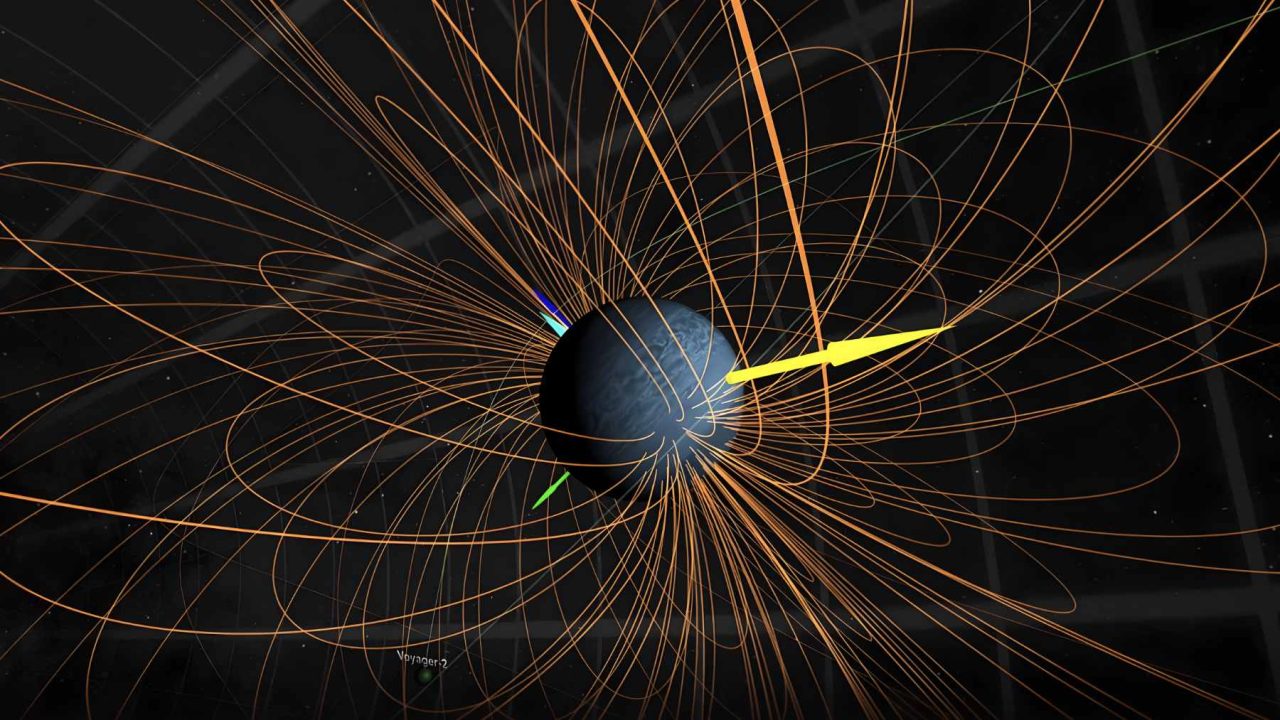
When Voyager 2 flew past Neptune in August 1989, the images it sent back were breathtaking. But the real shock didn’t come from the cameras — it came from the magnetometers. Neptune’s magnetic field looked nothing like what scientists expected. Instead of a clean, orderly north-south alignment like Earth’s, the field was tilted, offset from the planet’s center, and riddled with extra magnetic poles that simply refused to line up with Neptune’s spin axis. Something didn’t add up, and for decades, nobody could fully explain it.
Now, more than 35 years later, a new study published in the journal Nature may finally have the answer. An international team of researchers has recreated the extreme conditions found deep inside Neptune in a laboratory setting — and what they found is a form of water so bizarre it sounds more like science fiction than physics.
The culprit, researchers now believe, could be something called dark ice — a strange, electrically conductive phase of water that exists only under pressures and temperatures that are almost impossible to imagine.
Neptune’s Magnetic Mystery, Explained
Earth’s magnetic field is generated deep in its liquid iron core, and it aligns reasonably well with the planet’s rotational axis. Neptune is different in almost every way. Its magnetic field is tilted at a steep angle relative to its spin, offset from the planet’s geometric center, and far more complex in structure — displaying what scientists describe as a multipolar field, meaning it has several magnetic poles rather than just two.
Planetary scientists have long suspected that the answer to this mystery lies deep inside Neptune’s interior, in a region where water is subjected to conditions so extreme that it stops behaving like water at all. The challenge has always been recreating those conditions well enough to study them.
Neptune is classified as an ice giant, meaning a large portion of its interior is thought to be composed of water, ammonia, and methane — but not in any form you’d recognize. At the crushing depths of Neptune’s interior, these materials are compressed and heated to extremes that transform their fundamental properties.
What “Dark Ice” Actually Is — And Why It Matters for Neptune
The new research focuses on a phase of water known as superionic water, which forms under extraordinarily high pressures and temperatures. In this state, water behaves as neither a true solid nor a true liquid. The oxygen atoms lock into a rigid crystal lattice, while hydrogen ions flow freely through that structure — making the material both solid and electrically conductive at the same time.
What the research team discovered is that under the specific conditions found inside Neptune, this superionic water takes on a dark appearance — absorbing light rather than reflecting it. That’s where the term “dark ice” comes from. It is not ice in any familiar sense. It is a fundamentally alien material that happens to be made of the same two hydrogen atoms and one oxygen atom as the water in your glass.
The conditions required to produce this material are staggering:
- Pressures of approximately 150 to 180 gigapascals — roughly 1.5 to nearly 2 million times the atmospheric pressure at Earth’s sea level
- Temperatures of around 2,500 kelvin — far beyond the boiling point of most metals
- Under these conditions, water enters the superionic phase and becomes electrically conductive
That electrical conductivity is the key. A layer of conductive, flowing material deep inside a rotating planet is exactly the kind of thing that can generate a magnetic field — and a strange, asymmetric one at that.
The Numbers Behind Neptune’s Strange Interior
| Condition | Earth (Core) | Neptune (Interior, Estimated) |
|---|---|---|
| Pressure | ~360 gigapascals (inner core) | ~150–180 gigapascals (relevant zone) |
| Temperature | ~5,000–6,000 kelvin | ~2,500 kelvin (superionic zone) |
| Magnetic field alignment | Near-axial (roughly aligned with spin) | Tilted, offset, multipolar |
| Primary field-generating material | Liquid iron | Possibly superionic “dark” water |
Why This Discovery Reaches Beyond Neptune
The implications of this research stretch well past one distant planet. Uranus, Neptune’s fellow ice giant in our solar system, shares many of the same magnetic oddities — a tilted, off-center field that has puzzled scientists since Voyager 2 visited it in 1986. If dark ice is responsible for Neptune’s unusual magnetism, it likely plays the same role at Uranus.
More broadly, ice giants are now understood to be among the most common types of planets in the galaxy. Exoplanet surveys have identified thousands of worlds in roughly the Neptune-to-Uranus size range orbiting other stars. Understanding what happens inside these planets — how their magnetic fields form, how they evolve, what their interiors actually look like — is one of the central questions of modern planetary science.
This research gives scientists a new physical model to work with. Instead of treating the interiors of ice giants as poorly understood blobs of compressed material, researchers can now begin building more precise models that account for the behavior of superionic water at specific pressures and temperatures.
What Comes Next for Ice Giant Research
Despite everything Voyager 2 revealed during its 1989 Neptune flyby, no spacecraft has returned to the ice giant since. The probe’s brief visit remains the only close-up data humanity has ever collected from Neptune. Scientists have been working from those decades-old measurements ever since — which makes laboratory-based discoveries like this one especially valuable.
There is growing scientific interest in a dedicated ice giant mission, though no such mission has been confirmed or launched. In the meantime, laboratory experiments that recreate planetary interiors will continue to be one of the primary tools researchers use to understand what lies beneath the clouds of these distant worlds.
The study published in Nature represents a significant step forward — not just in explaining a 35-year-old mystery, but in reshaping how scientists think about the interiors of some of the most common planets in the universe.
Frequently Asked Questions
What did Voyager 2 discover about Neptune’s magnetic field in 1989?
Voyager 2’s magnetometers revealed that Neptune’s magnetic field is tilted, offset from the planet’s center, and has multiple poles — unlike the relatively orderly north-south field found on Earth.
What is “dark ice” and how does it form?
Dark ice refers to a superionic phase of water that forms under pressures of roughly 150 to 180 gigapascals and temperatures of around 2,500 kelvin. In this state, oxygen atoms form a rigid lattice while hydrogen ions flow freely, making the material electrically conductive and dark in appearance.
How could dark ice explain Neptune’s strange magnetism?
Because superionic water is electrically conductive, a layer of it flowing inside a rotating planet could generate a complex, asymmetric magnetic field — which matches what Voyager 2 observed at Neptune.
Does this discovery affect our understanding of other planets?
Yes. Uranus shares similar magnetic anomalies, and ice giants are now known to be among the most common planet types in the galaxy, making this research relevant to understanding thousands of exoplanets as well.
Has any spacecraft visited Neptune since Voyager 2?
No. Voyager 2’s 1989 flyby remains the only close-up mission to Neptune, which is why laboratory research recreating its interior conditions is so scientifically important.
Where was this research published?
The study was published in the journal Nature, according to reporting from March 2026.



Leave a Reply