
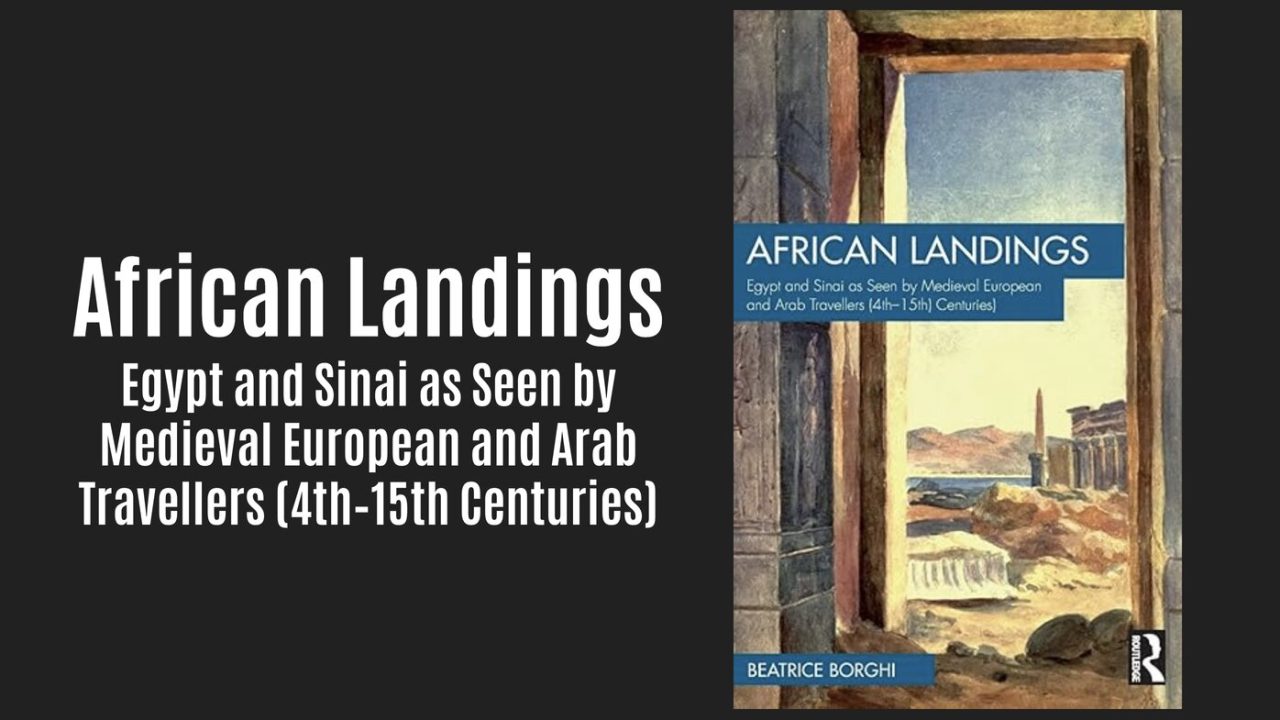
What did medieval Europeans actually think when they set foot in Egypt? The answer, it turns out, is far more complex — and far more revealing — than most history books let on.
A new academic book is bringing those long-forgotten voices back to the surface. African Landings: Egypt and Sinai as Seen by Medieval European and Arab Travellers (4th–15th Centuries), written by Beatrice Borghi and published by Routledge, draws on dozens of medieval travel accounts to reconstruct how outsiders experienced one of the ancient world’s most consequential crossroads.
The book spans more than a thousand years of recorded journeys — from the 4th century through the 15th — and covers everything from the geography of Egyptian cities to the religious life of the Sinai Peninsula. It is a reminder that the medieval world was far more connected than popular imagination tends to allow.
Egypt as the Crossroads of the Medieval World
Egypt has always attracted travellers. In the medieval period, it sat at the intersection of three continents and served as a passage point for Christian pilgrims, Arab scholars, merchants, and diplomats alike. The country’s ports, deserts, and sacred sites drew people from across Europe and the Arab world, many of whom left written records of what they saw.
Borghi’s book takes those records seriously. Rather than treating medieval travel writing as mere curiosity, African Landings uses these accounts as historical evidence — windows into how different cultures perceived one another across centuries of encounter and exchange.
The question Borghi poses is pointed and timely. As she writes in the book’s excerpt: “What is the relevance of those medieval stories of exchanges and migrations around the ‘lands amidst’ the liquid continent — particularly Africa — to a present day that seems to have shrouded in oblivion the very records that produced them?”
It is a question worth sitting with. The medieval Mediterranean was a space of constant movement, and Egypt was among its busiest nodes. Recovering that history matters — not just for scholars, but for anyone trying to understand how cultures have always moved, clashed, and learned from one another.
What the Book Actually Covers
The book is organized into four thematic sections, each approaching medieval Egypt from a different angle. Together, they build a layered portrait of the country as outsiders experienced it across more than ten centuries.
| Section | Focus |
|---|---|
| 1. Geography and Urban Spaces | How travellers described Egyptian cities, landscapes, and physical terrain |
| 2. The People of Egypt | Observations on Egyptian society, communities, and inhabitants |
| 3. Religious Life | Christian pilgrimage sites, the Sinai Peninsula, and spiritual encounters |
| 4. Daily Life | Everyday customs, practices, and cultural observations recorded by visitors |
Many of the travellers whose accounts Borghi examines were Christian pilgrims, drawn to Egypt and the Sinai by sacred geography — sites tied to biblical history and early Christianity. But the book also incorporates Arab travel writers, giving it a genuinely comparative dimension that single-tradition studies often lack.
The Medieval Travel Writers Most People Have Never Heard Of
One of the book’s most practical contributions is its function as a reference guide. For researchers and students, African Landings offers what amounts to a curated list of medieval travel accounts focused on Egypt — a resource that would otherwise require significant archival effort to assemble independently.
These accounts come from a wide range of perspectives:
- Christian pilgrims travelling to sacred sites in Egypt and the Sinai Peninsula
- Arab travellers recording their own observations of Egyptian life and society
- Writers spanning the 4th through 15th centuries — more than a millennium of recorded impressions
The sheer span of time covered is significant. It means the book can trace how perceptions of Egypt shifted over centuries, capturing not just individual snapshots but longer patterns of how outsiders understood — and misunderstood — the country and its people.
Who Should Read This Book
Borghi’s work is an academic publication, and it reads like one — it is aimed primarily at scholars and serious students rather than casual readers. But its subject matter carries broader relevance.
The book is likely to appeal to several distinct audiences:
- Medieval historians focusing on Egypt, North Africa, or cross-cultural exchange in the pre-modern period
- Scholars of pilgrimage and religious travel, particularly those interested in Christian engagement with the Middle East and Sinai
- Researchers in European perceptions of Africa, given the book’s explicit framing around how European travellers viewed the continent
- Anyone compiling primary sources on medieval Egypt, for whom the book’s reference function alone may justify its use
Beatrice Borghi is Associate Professor of Medieval History at the University of Bologna, and her academic grounding is evident in the book’s structure and scope. The work is published by Routledge under ISBN 978-1-032-67393-6.
Why These Forgotten Records Still Matter
There is something quietly urgent in Borghi’s framing. Her opening question — about why these medieval records of African travel and exchange have been forgotten — is not purely academic. It gestures toward a larger cultural blind spot: the tendency to treat medieval Africa, and Egypt in particular, as peripheral to the main story of history rather than central to it.
Egypt was not peripheral. It was where pilgrims from Europe landed on their way to Jerusalem. It was where Arab geographers mapped the known world. It was where traders, diplomats, and wanderers of every background left footprints — and, crucially, left words.
Recovering those words, and reading them carefully, is exactly what African Landings sets out to do. Whether the book succeeds in making that case to a wider audience beyond the academy remains to be seen. But as a scholarly resource for understanding medieval Egypt through the eyes of those who actually went there, it fills a genuine gap.
Frequently Asked Questions
What is African Landings about?
The book examines how medieval European and Arab travellers experienced Egypt and the Sinai Peninsula between the 4th and 15th centuries, drawing on dozens of recorded travel accounts.
Who wrote African Landings?
The book was written by Beatrice Borghi, Associate Professor of Medieval History at the University of Bologna.
Who published the book and what is its ISBN?
It was published by Routledge with ISBN 978-1-032-67393-6.
What are the four sections the book is divided into?
The book covers geography and urban spaces, the people of Egypt, religious life including Christian sites in the Sinai, and aspects of daily life as recorded by medieval travellers.
What types of travellers does the book focus on?
The book draws on accounts from Christian pilgrims as well as Arab travellers, giving it a comparative perspective across different cultural traditions.
Is this book suitable for general readers or mainly academics?
It is primarily aimed at scholars and students of medieval history, though anyone interested in medieval Egypt or the history of travel writing may find it a useful reference.
Leave a Reply