
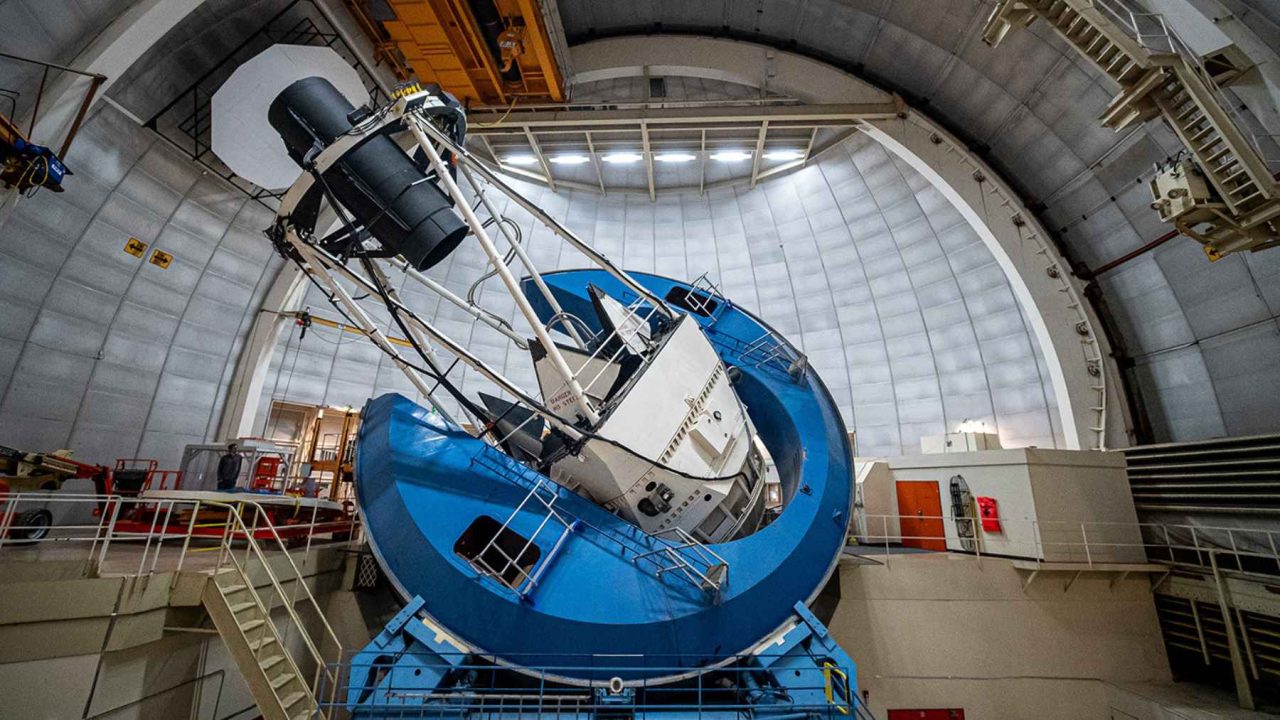
For almost three decades, the story of how the universe ends has felt settled. Expand forever, cool down, fade to black. That was the consensus, and it shaped everything from textbooks to documentary narration. Now, new data is forcing scientists to ask a question they thought was closed: what if the universe doesn’t expand forever after all?
Fresh measurements of dark energy — the mysterious force responsible for pushing space apart — suggest it may be weakening over time. If that trend holds, gravity could eventually take over, slow the expansion, stop it entirely, and then reverse it. The result would be a cosmic collapse known as the Big Crunch, where everything that exists — every galaxy, star, planet, and atom — gets crushed back into an unimaginably dense point.
Scientists are careful to say the case is not closed. But the fact that serious researchers are revisiting this idea at all marks a significant shift in how cosmology is thinking about the ultimate fate of everything.
What Dark Energy Actually Is — and Why It Matters So Much
To understand why this new data is so significant, it helps to understand what dark energy actually means. It is not a substance you can touch or measure directly. Instead, it is the name scientists gave to a strange effect they observed in the late 1990s: distant galaxies are not just moving away from us, they are accelerating away. Something is pushing space itself apart, faster and faster.
That discovery, confirmed through observations of distant supernovae, earned the scientists behind it a Nobel Prize. It also locked in the idea that the universe would expand forever — because whatever was causing that acceleration showed no sign of stopping.
For more than twenty years, schoolbooks and science programs repeated that story. The universe expands, keeps expanding, and eventually stretches so thin that stars burn out, galaxies drift apart, and existence ends not with a bang but with an endless, frozen silence.
The new data challenges the core assumption underneath all of that: that dark energy is constant.
What the New Measurements Are Actually Showing
Researchers analyzing large-scale galaxy maps and revisiting supernova data have found hints that dark energy may not be a fixed quantity. Instead, it appears to be changing — and potentially weakening — over time.
If dark energy is a constant, the universe expands forever. If it is weakening, the balance of forces in the cosmos shifts. Gravity, which pulls matter together, could eventually overcome the pressure pushing space apart. The expansion slows, stops, and reverses.
That reversal is what leads to the Big Crunch scenario. Galaxies that are currently racing away from each other would gradually slow down, stop, and begin falling back together. Over an enormous stretch of time, the entire observable universe would collapse inward, growing hotter and denser until everything is compressed into a single catastrophic point.
| Scenario | What Happens to Dark Energy | Ultimate Fate of the Universe |
|---|---|---|
| Eternal Expansion | Remains constant or grows stronger | Universe expands forever, cools, fades |
| Big Crunch | Weakens over time until gravity wins | Expansion reverses, universe collapses inward |
| Current Status (2025–2026 data) | New evidence suggests it may be weakening | Under active scientific debate |
Scientists are excited by these findings, but they are also urging caution. The signals are real enough to take seriously, but not yet strong enough to overturn nearly thirty years of established cosmological thinking.
Why the Big Crunch Theory Was Abandoned — and Why It’s Back
The Big Crunch was actually a mainstream idea before the late 1990s. Before scientists confirmed that the universe’s expansion was accelerating, the collapse scenario was considered a plausible end state. Once the acceleration was confirmed, it fell out of favor quickly. If space was speeding up, there was no obvious mechanism to reverse it.
What’s changed now is the quality and scale of the data. Huge galaxy surveys are giving researchers far more detailed maps of how matter is distributed across the cosmos, and how that distribution has changed over billions of years. When that information is fed into models of dark energy’s behavior, some of those models suggest the force is not as stable as previously assumed.
A reanalysis of older supernova data — the same kind of observations that originally revealed the accelerating expansion — has also contributed to the renewed uncertainty. Researchers examining those datasets with modern techniques have found results that don’t fit as neatly into the constant dark energy model as once thought.
What This Means for Anyone Paying Attention to Cosmology Right Now
On a practical, day-to-day level, none of this changes anything. Even if the Big Crunch is real, it would unfold over timescales so vast they are almost impossible to imagine — billions upon billions of years from now.
But the significance of this debate goes beyond the distant future. It touches something fundamental about how science works and how confident we should ever be in any single model of reality. For nearly thirty years, the accelerating expansion was treated as settled fact. The new data is a reminder that cosmology is still an open field, and that the universe has a habit of surprising us.
It also raises deeper questions that physicists are actively wrestling with. If dark energy is not constant, what is it? Is it a field that changes over time? Something tied to the age of the universe? These are not small questions — they go to the heart of how the cosmos is structured and where it came from.
What Scientists Are Watching For Next
The coming years will be critical. Researchers are waiting for more data from ongoing galaxy surveys and next-generation space telescopes that can map dark energy’s behavior across even larger stretches of cosmic history.
If the weakening trend in dark energy holds up under that scrutiny, the Big Crunch will move from fringe possibility back toward serious contender. If the signal disappears or turns out to be a measurement artifact, the eternal expansion model will be reinforced.
Either way, scientists say the debate itself is healthy. Cosmology advances when assumptions get tested, and right now, one of its biggest assumptions is being tested harder than it has been in decades.
Frequently Asked Questions
What is the Big Crunch?
The Big Crunch is a theoretical scenario in which the universe’s expansion eventually reverses, causing all matter to collapse inward and compress into an extremely dense point.
Why did scientists stop talking about the Big Crunch?
In the late 1990s, observations confirmed that the universe’s expansion was accelerating, which made a reversal seem unlikely. That finding dominated cosmological thinking for nearly thirty years.
What new data is challenging the idea of eternal expansion?
New measurements from large-scale galaxy surveys and a reanalysis of supernova data suggest that dark energy — the force driving expansion — may be weakening over time rather than remaining constant.
Is the Big Crunch now considered the most likely outcome?
No. Scientists describe the new data as significant enough to take seriously, but the case is far from closed and the eternal expansion model has not been overturned.
How soon could the Big Crunch happen?
Even if the Big Crunch scenario is correct, it would occur on timescales of billions upon billions of years — far beyond any human or civilizational concern.
What is dark energy?
Dark energy is the name given to the mysterious effect that causes distant galaxies to accelerate away from each other, acting as a kind of pressure within space itself rather than a conventional physical substance.


Leave a Reply