
“`html
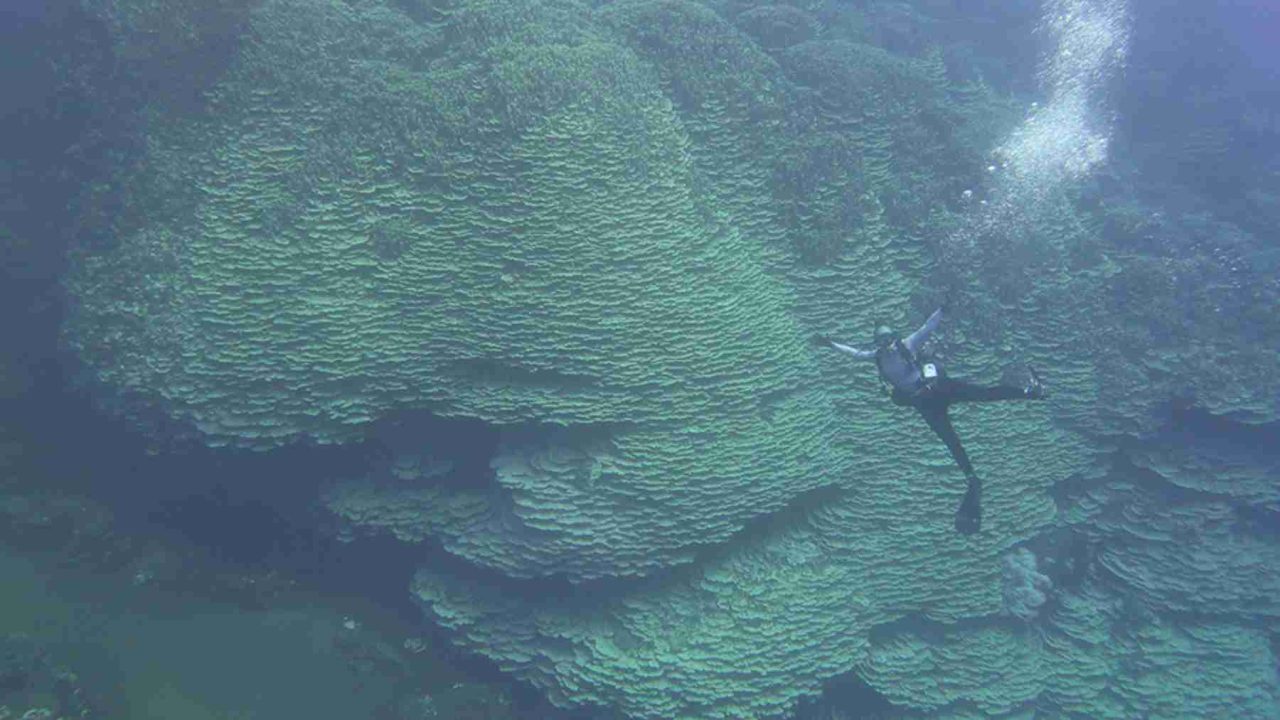
Somewhere beneath the surface of the Pacific Ocean, inside the submerged crater of an ancient volcano, sits a coral formation so massive that scientists couldn’t fully measure it during their first dive — not because of its depth, but because of its sheer size. This single coral colony stretches roughly 200 feet wide at its base, rises more than 100 feet tall, and covers approximately 14,500 square feet of seafloor. It may be over 2,000 years old.
That would make it older than the Colosseum in Rome, older than the construction of the Pantheon, and older than most landmarks we consider ancient. And until recently, the scientific world had barely taken notice.
Now NOAA researchers believe this extraordinary formation — discovered in the Maug caldera in the Mariana Islands — could be one of the most important coral structures ever found. Not just because of its size, but because of where it lives, and what that location might tell us about the future of reefs everywhere.
The Largest Porites Coral Ever Recorded
The coral was built by colonies of Porites rus, a stony coral species known for slow, steady growth. What makes this particular formation remarkable is its scale: NOAA scientists confirmed it is the largest Porites coral ever reported anywhere in the world.
People living in the area had known about the giant coral for years before scientists formally documented it. It wasn’t until the 2025 National Coral Reef Monitoring Program surveys that NOAA researchers took the first approximate measurements — and even then, the sheer scale of the structure created logistical challenges.
“This coral was so big, we actually couldn’t easily measure it due to dive safety restrictions,” said Thomas Oliver, a chief scientist with the program.
That quote says a lot. When a coral formation is too large to measure safely in a single dive, you’re dealing with something genuinely extraordinary. Most individual coral colonies fit within a few feet. This one spans the length of two-thirds of a football field at its base.
What Makes the Maug Caldera So Significant
The location of this coral isn’t just dramatic — it’s scientifically critical. The Maug caldera is a submerged volcanic crater in the Northern Mariana Islands, and it’s an unusual environment. Carbon dioxide vents in the caldera release gas into the surrounding water, creating naturally acidic seawater in certain areas nearby.
Ocean acidification is one of the most serious threats facing coral reefs globally. As oceans absorb more CO2 from the atmosphere, the water becomes more acidic, making it harder for corals to build and maintain their calcium carbonate skeletons. The process is already damaging reefs around the world, and scientists expect it to accelerate.
That’s what makes this coral so valuable as a research subject. It has survived for roughly 2,000 years in an environment where acidic conditions are a natural feature of the landscape — not a future threat, but a present reality. Studying how it has managed to thrive offers a rare window into the mechanisms that might allow some corals to endure what others cannot.
Key Facts About the Maug Coral at a Glance
| Feature | Detail |
|---|---|
| Species | Porites rus (stony coral) |
| Estimated height | Over 100 feet tall |
| Base width | Nearly 200 feet across |
| Total coverage | Approximately 14,500 square feet |
| Estimated age | More than 2,000 years |
| Location | Maug caldera, Mariana Islands |
| Record status | Largest Porites coral ever reported |
| Surveyed by | NOAA, 2025 National Coral Reef Monitoring Program |
- The coral sits inside a submerged volcanic crater with active CO2 venting nearby
- The acidic conditions created by those vents mirror what many reefs worldwide will face as climate change accelerates
- Local communities in the area were already aware of the coral before NOAA formally documented it
- Dive safety restrictions prevented a complete measurement during initial surveys
Why This Matters for Reefs You’ll Never See
Coral reefs cover less than one percent of the ocean floor, yet they support roughly a quarter of all marine species. They protect coastlines from storm surge, sustain fishing industries that feed hundreds of millions of people, and generate billions in tourism revenue each year. They are also disappearing at an alarming rate.
Warming ocean temperatures cause mass bleaching events — when corals expel the algae living in their tissues and turn white, often dying if conditions don’t improve. Acidification compounds the damage by weakening the physical structures corals build. The combination has already devastated portions of the Great Barrier Reef and reef systems across the Caribbean, Southeast Asia, and the Indian Ocean.
Against that backdrop, a coral that has spent two millennia surviving in naturally acidic, CO2-rich water isn’t just impressive — it’s potentially instructive. Researchers hope that understanding what has allowed this formation to persist could offer insight into which coral species, or which genetic traits, might give reefs a fighting chance as conditions worsen globally.
It won’t reverse what’s already been lost. But it could help scientists identify where to focus conservation efforts, and which corals are worth protecting most urgently.
What Researchers Are Watching Next
The 2025 surveys represent an early stage of what is likely to become a more intensive research effort. The initial measurements were approximate — the scale of the formation made precise documentation difficult under existing dive safety protocols. More detailed study will presumably require additional expeditions and possibly different survey methods.
The broader context is the ongoing National Coral Reef Monitoring Program, through which NOAA tracks the health of reef systems across U.S. territories including the Mariana Islands. The Maug coral’s formal documentation through that program means it is now part of the scientific record in a way it wasn’t before — a starting point for the longer research process ahead.
Whether this coral holds the answers scientists are hoping for remains to be seen. But finding a 2,000-year-old reef structure thriving in conditions that should theoretically work against it is the kind of anomaly that tends to drive science forward.
Frequently Asked Questions
What species is the giant Maug coral made of?
The formation was built by colonies of Porites rus, a species of stony coral known for its slow and durable growth.
How big is the Maug coral exactly?
It stands over 100 feet tall, spans nearly 200 feet wide at its base, and covers approximately 14,500 square feet — making it the largest Porites coral ever reported.
How old is the coral, and how was that determined?
NOAA estimates the coral may be more than 2,000 years old, though
Why is the Maug caldera location so important to scientists?
Carbon dioxide vents in the caldera create naturally acidic seawater nearby, mimicking the ocean acidification conditions that threaten reefs globally — making the coral a rare natural study site.
Who discovered the coral?
Local people in the area were already aware of it, but NOAA scientists formally measured and documented it during the 2025 National Coral Reef Monitoring Program surveys. Thomas Oliver, a chief scientist with the program, led the effort.
Why couldn’t scientists measure it more precisely?
According to Thomas Oliver, the coral was so large that a complete measurement wasn’t possible under existing dive safety restrictions during the initial survey.</p


Leave a Reply