
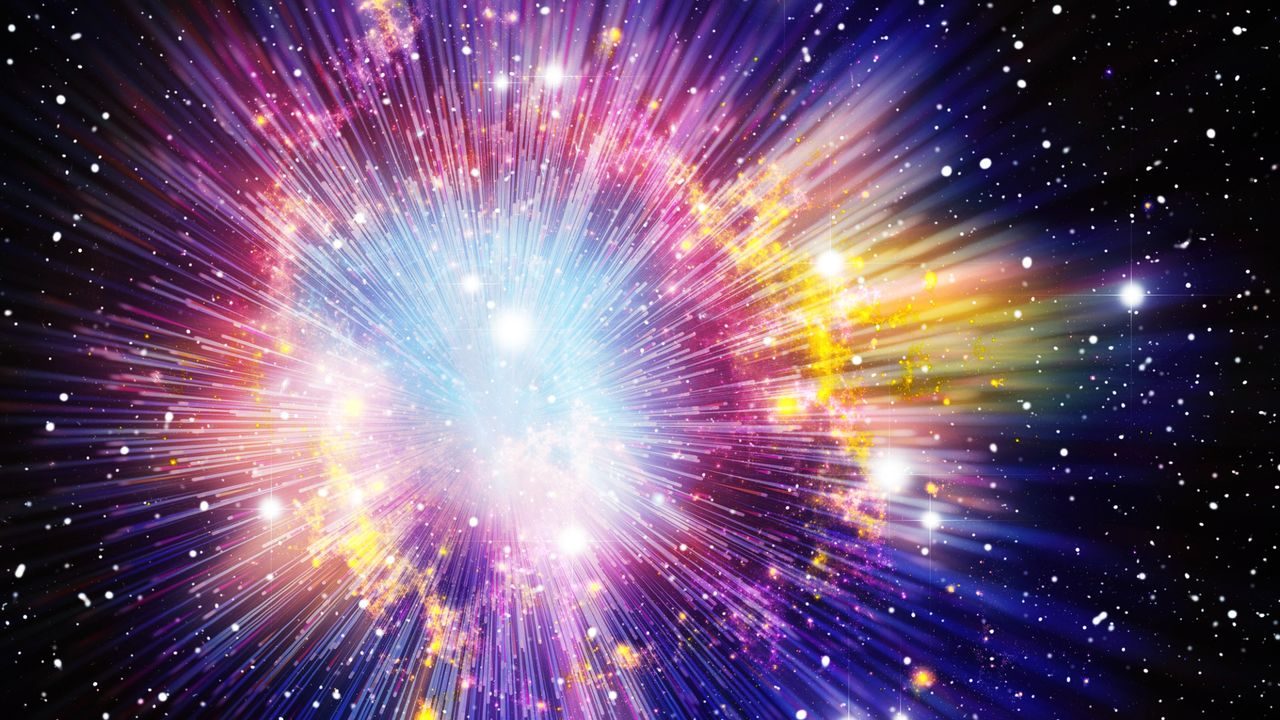
What if everything we thought we knew about the beginning of the universe is missing a crucial piece? That question is now sitting at the center of a serious scientific debate — and a new study suggests that one of physics’ most celebrated theories may need a fundamental revision.
The Big Bang is the story most of us learned: the universe began from a single point of infinite density, a so-called singularity, where temperature, pressure, and energy were beyond anything our equations can properly describe. It is a moment where the laws of physics, as we understand them, simply break down. But a newly proposed tweak to Einstein’s theory of relativity suggests that singularity may never have existed at all.
If the researchers are right, the universe did not begin from a point of infinite collapse. It began differently — and that difference could reshape our understanding of the Big Bang itself.
The Problem With the Singularity That Scientists Have Long Known About
Einstein’s general theory of relativity is one of the most tested and confirmed theories in all of science. It explains how gravity works, how massive objects warp space and time, and how the universe expands. It has passed every experimental test thrown at it for over a century.
But it has a well-known weakness. When you wind the clock of the universe all the way back to the very first moment — the Big Bang — general relativity predicts a singularity. A point of infinite density. And in physics, “infinity” is usually a sign that something has gone wrong with your theory, not a description of reality.
Scientists have long suspected that a more complete theory, one that merges general relativity with quantum mechanics, would eventually smooth out that singularity and replace it with something more physically meaningful. The trouble is that no one has managed to build that unified theory yet. It remains one of the biggest unsolved problems in all of physics.
The new study takes a different approach. Rather than waiting for a full theory of quantum gravity, the researchers propose a targeted modification to Einstein’s relativity itself — a tweak that changes what happens at the extreme conditions of the early universe without dismantling everything that makes the original theory work so well everywhere else.
What the Proposed Change to Einstein’s Relativity Actually Does
The core idea is that by adjusting how general relativity behaves under conditions of extreme density and curvature — the kinds of conditions that only exist at the very birth of the universe — the singularity at the Big Bang can be eliminated.
Instead of the universe emerging from a point of infinite density where physics breaks down, this modified framework suggests the universe had a beginning that the laws of physics can actually describe. The breakdown disappears. The singularity is replaced by something finite, something the equations can handle.
This matters enormously because the singularity is not just a mathematical inconvenience. It represents a genuine limit on human knowledge. If the universe truly began as a singularity, then physics cannot tell us anything about what happened at or before that moment. The question of the universe’s origin becomes permanently unanswerable.
Remove the singularity, and that wall comes down. The Big Bang becomes a moment that science can, in principle, actually describe and understand.
Why This Approach Is Different From Previous Attempts
| Approach | Core Idea | Key Challenge |
|---|---|---|
| Standard General Relativity | Gravity described by Einstein’s original equations | Predicts a singularity at the Big Bang where physics breaks down |
| Quantum Gravity (e.g., Loop Quantum Gravity) | Merges quantum mechanics with general relativity | No complete, experimentally confirmed theory yet exists |
| New Proposed Modification | Tweaks Einstein’s relativity at extreme early-universe conditions | Eliminates the singularity without requiring a full quantum gravity theory |
Most previous attempts to solve the singularity problem have relied on building an entirely new theoretical framework from the ground up. That is an enormous undertaking, and decades of effort have not yet produced a complete answer.
The appeal of this new proposal is its relative modesty. It does not claim to be a theory of everything. It targets a specific problem — the Big Bang singularity — and proposes a specific fix, while leaving the rest of Einstein’s framework intact. Whether that fix holds up to further scrutiny is a question the broader physics community will now work to answer.
What This Could Mean for Our Understanding of the Big Bang
The implications extend well beyond abstract mathematics. If the universe did not begin from a singularity, then the very first moments of existence become something science can meaningfully investigate. Researchers could potentially model what the universe looked like at the earliest possible instant — not just a fraction of a second after the Big Bang, but at the Big Bang itself.
That could, in turn, shed light on some of the deepest mysteries in cosmology: why the universe has the structure it does, why matter dominated over antimatter, and what set the initial conditions that eventually led to galaxies, stars, planets, and us.
The proposal also arrives at a moment when cosmology is already grappling with significant tensions and open questions. Observations of the early universe through the cosmic microwave background and, more recently, through the James Webb Space Telescope have continued to surface puzzles that the standard model of cosmology struggles to fully explain. A revision to the foundations of how we model the Big Bang could have ripple effects across the entire field.
What Happens Next in This Research
A single study proposing a modification to Einstein’s relativity is a beginning, not an ending. The next steps involve the wider physics and cosmology community examining the proposal — testing its mathematical consistency, checking whether it produces predictions that match what we already observe about the universe, and identifying any new predictions it makes that could be tested against future observations.
If the modified framework survives that scrutiny, it could become a serious contender for resolving one of the oldest standing problems in physics. If it does not, it will still have contributed to the ongoing conversation about what a complete theory of the early universe actually needs to look like.
Either way, the question it raises is one of the most profound in science: not just how the universe evolved, but whether its very first moment is something human knowledge can ever truly reach.
Frequently Asked Questions
What is the singularity problem with the Big Bang?
General relativity predicts that the universe began from a point of infinite density called a singularity — a condition where the laws of physics break down and can no longer make meaningful predictions.
What does the new study propose?
The study proposes a modification to Einstein’s theory of relativity that, under the extreme conditions of the very early universe, eliminates the singularity — suggesting the universe did not begin from a point of infinite density.
Does this mean Einstein’s theory of relativity is wrong?
Not exactly. The proposal is a targeted tweak to how the theory behaves at extreme early-universe conditions, not a rejection of general relativity as a whole, which remains one of the most well-confirmed theories in science.
Has this modification been confirmed or tested?
The proposal is new and has not yet been independently confirmed. It will need to undergo rigorous review by the broader physics community and be tested against observational data.
Why does it matter whether the universe began from a singularity?
If the universe began from a true singularity, physics cannot describe what happened at that moment, making the ultimate origin of everything permanently unknowable. Removing the singularity could open that question back up to scientific investigation.
How is this different from previous attempts to solve the singularity problem?
Most previous approaches have tried to build an entirely new theory merging quantum mechanics and gravity. This proposal instead makes a more limited modification to existing relativity theory, targeting the singularity problem specifically without requiring a complete new framework.



Leave a Reply