
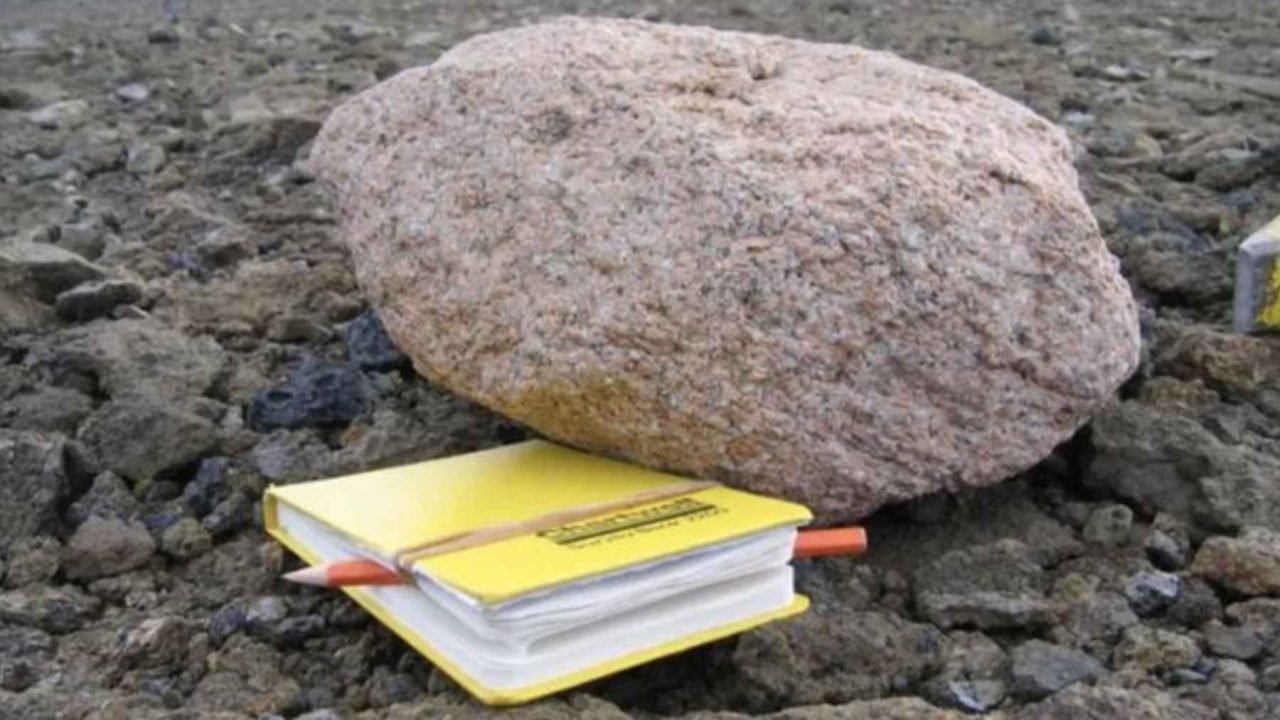
Scattered across the dark volcanic peaks of Antarctica’s Hudson Mountains, pale pink boulders sit where they have no geological right to be. The local bedrock is black lava. So where did the pink granite come from — and what does it mean for millions of people living along the world’s coastlines?
The answer, it turns out, has been locked under one of Antarctica’s most dangerous glaciers for roughly 175 million years. And scientists have only just found a way to read the clues sitting in plain sight on the ice.
A team from the British Antarctic Survey has used those misplaced boulders — combined with airborne surveys flown over the region — to map a massive hidden granite structure beneath Pine Island Glacier, one of the fastest-thinning glaciers on the continent and a significant driver of rising seas worldwide.
What Are “Glacial Erratics” and Why Do Scientists Care So Much About Them?
The pink boulders have a name in geology: glacial erratics. They are rocks that were plucked from the floor of an ice sheet, carried along for many kilometers as the glacier moved, and then deposited far from their point of origin once the ice thinned and pulled back.
On their own, erratics are not unusual. Glaciers have been moving rocks around for millions of years. What made these particular boulders so striking was the mismatch. The Hudson Mountains are built from dark volcanic lava. There is no local source for pale pink granite. That contrast told scientists immediately that the boulders had traveled a long way — and that something significant had to be sitting beneath the ice to have produced them.
The British Antarctic Survey team combined detailed chemical dating of the erratics with airborne gravity and magnetic surveys flown across the region. The results, published in the journal Communications Earth & Environment, confirmed what the rocks had been hinting at: a large granite body hidden beneath Pine Island Glacier, formed approximately 175 million years ago during the Jurassic period.
A Jurassic Structure Hidden Under Pine Island Glacier
Pine Island Glacier is already one of the most closely watched pieces of ice on Earth. It is among Antarctica’s fastest-thinning glaciers and has been identified as a major contributor to sea level rise in recent decades. Understanding what lies beneath it — the geology of its bed — is critical to modeling how quickly it might continue to retreat.
The newly identified granite structure changes that picture in important ways. Granite behaves differently from volcanic rock under the pressure and movement of ice. Its presence beneath the glacier affects how the ice slides, how meltwater moves, and ultimately how fast the glacier loses mass into the ocean.
The discovery also demonstrates how surface clues — rocks that a casual observer might walk past without a second glance — can reveal deep structural secrets that no drill or satellite has yet directly measured.
Key Facts About the Discovery
| Detail | Finding |
|---|---|
| Location | Hudson Mountains, near Pine Island Glacier, Antarctica |
| Rock type on surface | Dark volcanic lava (local bedrock) |
| Erratic rock type | Pale pink granite (non-local) |
| Age of hidden granite body | Approximately 175 million years old (Jurassic period) |
| Research team | British Antarctic Survey |
| Methods used | Chemical dating of erratics; airborne gravity and magnetic surveys |
| Published in | Communications Earth & Environment |
| Glacier significance | One of Antarctica’s fastest-thinning glaciers; major contributor to sea level rise |
- Glacial erratics are boulders transported by ice from their original geological source and deposited elsewhere as ice retreats.
- The Hudson Mountains peaks are littered with pink granites and other exotic rocks that do not match the local volcanic geology.
- Airborne gravity and magnetic surveys were used alongside chemical dating to identify and map the buried granite structure.
- The granite body formed during the Jurassic period, roughly 175 million years ago.
Why This Matters for Sea Level Rise
Pine Island Glacier is not just a remote scientific curiosity. It is one of the glaciers that researchers around the world are watching most carefully as global temperatures rise. Its ongoing thinning and retreat feeds directly into projections for how much ocean levels will climb over the coming decades — projections that affect low-lying cities, coastal communities, and island nations far from Antarctica.
Knowing the precise geology beneath a glacier helps scientists build more accurate models of its behavior. A hidden granite body changes estimates of how the glacier’s base interacts with meltwater, how friction affects ice flow, and where the glacier is most vulnerable to accelerated retreat.
In that sense, a handful of pink rocks on a remote Antarctic peak carries implications for flood risk assessments in places like Miami, Mumbai, Jakarta, and Amsterdam — cities that have nothing visibly in common with a frozen mountain range at the bottom of the world.
What the Research Team Did — and What Comes Next
The British Antarctic Survey’s approach in this study was notably creative. Rather than relying solely on expensive and logistically difficult deep drilling, the team used rocks already sitting on the surface as natural samples of what lies below. Chemical dating techniques established the age of the granite fragments precisely enough to match them to a buried geological formation.
Airborne surveys — flying instruments over the glacier to measure subtle variations in gravity and magnetism — then allowed the team to trace the outline and extent of the hidden granite body without ever needing to reach it directly.
The findings, published in Communications Earth & Environment, add a significant new layer to the geological map of one of the planet’s most consequential ice systems. Researchers are expected to use this structural data to refine existing models of Pine Island Glacier’s future behavior, though the precise timeline for follow-up studies has not been confirmed in the current reporting.
What is clear is that the ice beneath our feet — even in the most remote places on Earth — still holds secrets that matter urgently to the world above it.
Frequently Asked Questions
What are the pink rocks found in Antarctica?
They are glacial erratics — pale pink granite boulders transported by the ice sheet from a buried granite formation and deposited on the volcanic peaks of the Hudson Mountains.
How old is the hidden granite structure beneath Pine Island Glacier?
According to the British Antarctic Survey research, the granite body formed approximately 175 million years ago during the Jurassic period.
Who conducted this research and where was it published?
The research was carried out by a team from the British Antarctic Survey and published in the journal Communications Earth & Environment.
What methods did scientists use to find the hidden structure?
The team combined chemical dating of the surface granite boulders with airborne gravity and magnetic surveys flown over the Pine Island Glacier region.
Why does the geology beneath Pine Island Glacier matter?
Pine Island Glacier is one of Antarctica’s fastest-thinning glaciers and a major contributor to sea level rise, so understanding its underlying geology helps scientists build more accurate models of future ice loss.
Will this discovery change sea level rise predictions?
The structural data is expected to help refine glacier behavior models, but specific updated projections have not yet been confirmed in the current research reporting.



Leave a Reply