
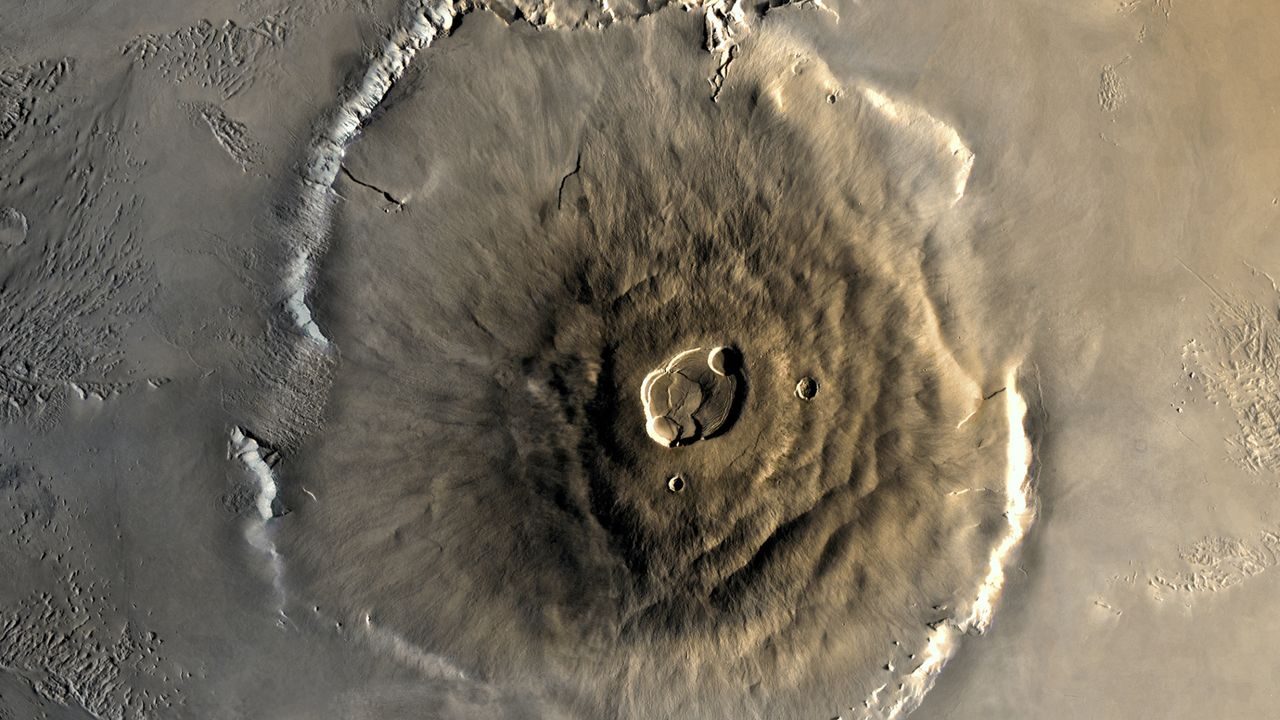
Mars is spinning faster every year — and for a long time, scientists had no satisfying explanation for why. Now, a new study published on February 18 in the Journal of Geophysical Research: Planets points to something extraordinary happening beneath the Martian surface: a massive plume of buoyant rock stirring deep underground, potentially driving the planet’s accelerating rotation.
It’s the kind of discovery that reframes how we think about Mars — not as a cold, geologically dead world, but as a planet that may still be very much alive beneath its dusty red crust.
The research connects this underground activity to one of the most dramatic features in the entire solar system: Olympus Mons, the tallest volcano and mountain on any known planet. And the implications stretch far beyond one impressive peak.
Why Mars Is Spinning Faster — And Why That’s So Strange
Scientists have known for some time that Mars is gradually increasing its rotation speed. What they haven’t been able to pin down is the mechanism behind it. A planet speeding up its spin without an obvious external cause is genuinely puzzling — on Earth, for comparison, our rotation is actually slowing down very slightly over time due to tidal interactions with the Moon.
Mars doesn’t have the same kind of large stabilizing moon. So when data showed the Red Planet was spinning faster year after year, researchers had to look inward — literally.
The new study suggests the answer lies in a large plume of hot, buoyant rock rising through Mars’s mantle. This kind of geological feature, sometimes called a mantle plume, occurs when material deep inside a planet is heated and pushes upward through the surrounding rock. On Earth, mantle plumes are responsible for hotspot volcanic activity — think Hawaii or Iceland. The idea that Mars has an active one is significant.
The Role of a Rare Active Volcano on Mars
Olympus Mons sits at the center of this story. Already famous as the solar system’s tallest volcano — and its tallest mountain — it now appears to be more than just an ancient relic of Mars’s volcanic past. The region around it may be geologically active in ways scientists are only beginning to understand.
The underground plume described in the new research could be the source of ongoing volcanic activity in this area, making Olympus Mons not just a record-holder for size, but potentially one of the rare active volcanoes on Mars. That alone would be a remarkable finding. Combined with the connection to the planet’s accelerating spin, it suggests the interior of Mars is far more dynamic than the planet’s barren surface implies.
The mechanism works roughly like this: as the plume pushes buoyant material upward and redistributes mass within the planet’s interior, it alters the distribution of mass across Mars. Changes in how mass is distributed inside a rotating body affect how fast it spins — the same basic physics principle that causes a spinning figure skater to speed up when they pull their arms inward.
What We Know — And What Remains Uncertain
| Key Detail | What the Source Confirms |
|---|---|
| Study publication date | February 18, Journal of Geophysical Research: Planets |
| Observed phenomenon | Mars spinning faster each year |
| Proposed cause | A large plume of buoyant rock beneath the Martian crust |
| Volcano connected to the finding | Olympus Mons — tallest volcano and mountain in the solar system |
| Nature of the plume | Described as stirring beneath the Red Planet’s crust |
| Mars’s volcanic status | Potentially active, contrary to long-held assumptions |
Specific measurements of how much faster Mars is spinning, and precise data about the plume’s depth or size, have not been confirmed in the available
Why This Changes How We See Mars
For decades, the dominant picture of Mars was a world that burned bright early in the solar system’s history and then went quiet. Massive volcanoes like Olympus Mons were thought to be monuments to an active past, not signs of an active present.

This new research challenges that assumption directly. If a mantle plume is genuinely active beneath Mars right now, it means the planet retains significant internal heat — enough to drive geological processes, potentially including ongoing volcanic activity. That has consequences well beyond planetary science trivia.
- An internally active Mars raises fresh questions about the planet’s potential to support — or have once supported — life, since geological activity is often linked to chemical energy sources that organisms can use.
- It changes how mission planners might think about future Mars exploration, particularly where to look for signs of recent geological change.
- It suggests that other seemingly “dead” rocky worlds in the solar system might be worth a second look.
- It adds a new variable to models predicting Mars’s long-term behavior — including its climate and atmospheric conditions.
There’s also something philosophically striking here. Mars has long been held up as a cautionary tale — a world that lost its magnetic field, its thick atmosphere, and its surface water. The idea that it still has a beating geological heart, however faint, makes it a more complicated and more interesting story.
What Comes Next for Mars Research
The February 18 study opens a new line of inquiry, but it’s far from the final word. Researchers will need to gather additional data to confirm whether the plume is truly active and to measure its precise effect on Mars’s rotation rate.
NASA’s InSight lander, which operated on Mars and studied the planet’s interior using seismometers, generated data that researchers continue to analyze. Future missions focused on Mars’s geology and interior structure could help test the predictions made in this new study.
For now, the finding stands as a compelling argument that Mars deserves to be watched — not just as a destination for future human explorers, but as a living geological system that is still, quietly, changing.
Frequently Asked Questions
Why is Mars spinning faster?
A new study published February 18 in the Journal of Geophysical Research: Planets suggests a large plume of buoyant rock stirring beneath the Martian crust may be responsible for the planet’s gradually increasing spin rate.
What is Olympus Mons and why does it matter here?
Olympus Mons is the tallest volcano and mountain in the solar system. The new research connects it to the underground mantle plume, suggesting the region may still be geologically — and possibly volcanically — active.
Does this mean Mars is still volcanically active?
The study raises that possibility. If the mantle plume described in the research is genuinely active, it would suggest Mars retains significant internal heat and could have ongoing volcanic activity, contradicting long-held assumptions about the planet being geologically dead.
How does an underground plume affect a planet’s spin?
When a plume redistributes mass within a planet’s interior, it changes how that mass is spread across the rotating body — similar to how a figure skater speeds up by pulling their arms inward, altering their rotational dynamics.
Where was this study published?
The study was published on February 18 in the Journal of Geophysical Research: Planets.
Could this discovery affect future Mars missions?
Potentially, yes. Evidence of ongoing geological activity could influence where scientists choose to search for signs of recent change — or even conditions that might support life — on future Mars missions. Specific mission changes have not yet been confirmed.



Leave a Reply