
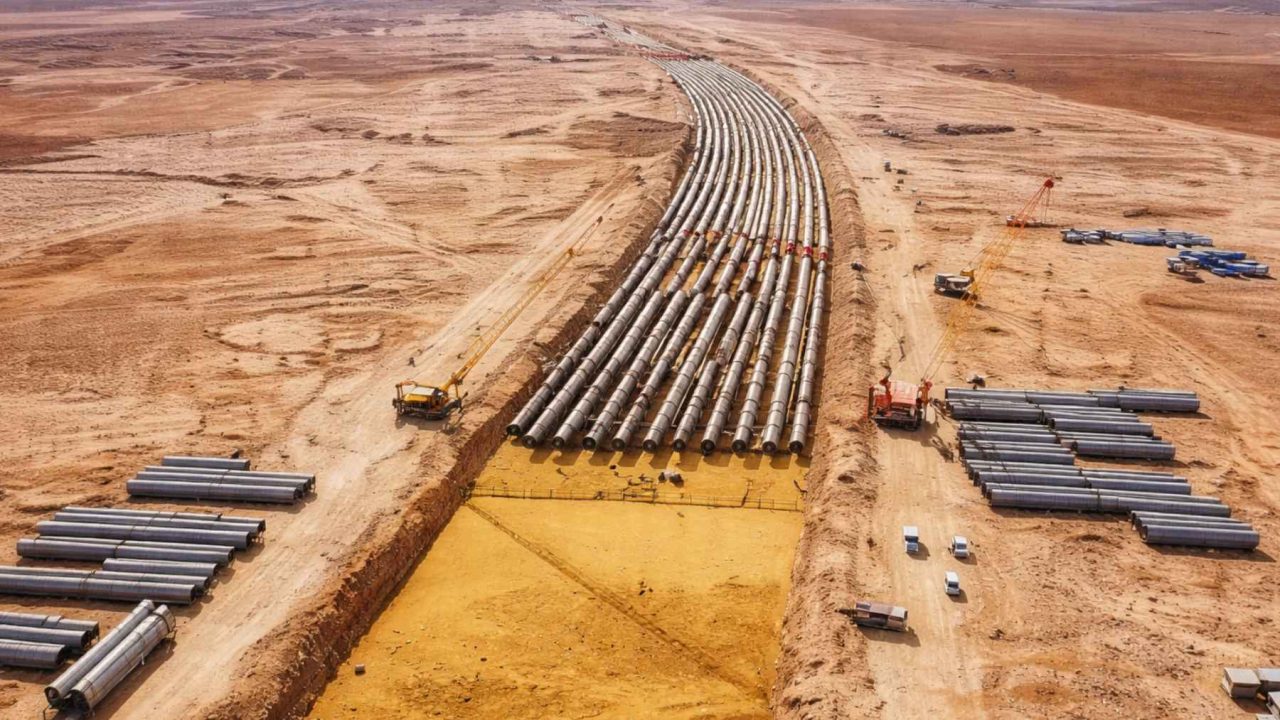
Every single day, roughly one million cubic meters of water — about 264 million gallons — flows through a desert valley in the heart of Saudi Arabia’s capital city. Most of it starts its journey not as rainfall or a mountain spring, but as urban wastewater that has been treated and redirected into a living, flowing waterway cutting through Riyadh.
That is not a typo. In one of the driest places on Earth, a city of millions has engineered what amounts to a permanent river — and built a green corridor around it.
The project is centered on Wadi Hanifah, a natural valley that runs through Riyadh for approximately 120 kilometers, or about 75 miles. What was once a dry, largely neglected landscape is now fed by a continuous stream originating from a wastewater treatment plant. The result is something that would have seemed impossible just a generation ago: a self-sustaining green belt threading through the Arabian Desert.
How Saudi Arabia Turned Wastewater Into a Desert River
The concept behind the Wadi Hanifah project is straightforward, even if the engineering is anything but. Instead of treating urban water as waste to be disposed of, Riyadh’s planners chose to recycle it — sending treated water back into the wadi to create a continuous flow.
The Royal Commission for Riyadh City describes Wadi Hanifah as a valley with sections hundreds of feet wide and up to a few hundred feet deep in places. It is not a small drainage ditch tucked behind an industrial zone. It is a significant geographic feature running directly through the Saudi capital, and the scale of the water flowing through it reflects that ambition.
The water supply comes from a combination of groundwater and treated wastewater, with the treated component playing the central role in keeping the wadi flowing year-round. In a region with no permanent natural rivers nearby, this recycled water effectively acts as the source of a new, human-engineered waterway.
The bigger challenge, as observers have noted, is that recycled water does not leave all of its risks behind at the treatment plant gate. Once it enters an open valley system and begins behaving like a natural river, it can create habitat — but it can also carry contaminants and ecological complications that require ongoing management.
What the Green Corridor Actually Looks Like
Wadi Hanifah is not just a water channel. The presence of a consistent water source has allowed vegetation to take hold along its banks, creating a green corridor that stands in sharp visual contrast to the surrounding desert landscape.
Here is what It represents a real-world test case for something that water-stressed cities around the world are increasingly being forced to consider: what happens when you stop treating wastewater as a problem and start treating it as a resource?
Riyadh sits in one of the most water-scarce environments on the planet. There are no permanent rivers. Rainfall is minimal. Groundwater reserves, while present, are finite. The decision to redirect treated urban water back into a natural valley — and then build habitat around it — is a direct response to those constraints.
Supporters of this kind of approach argue that reusing water at this scale can reduce pressure on groundwater supplies, create urban green space in cities that desperately lack it, and demonstrate that large-scale ecological restoration is possible even in extreme environments.
But the project also raises legitimate questions. Treated wastewater, even when processed to high standards, can still carry trace contaminants. When that water enters an open valley system and begins supporting wildlife and plant life, the long-term ecological effects require careful monitoring.
The Part of This Story That Often Gets Overlooked
Most coverage of projects like this focuses on the visual transformation — the green against the sand, the water in the desert. And that visual is genuinely striking. But the harder story is about what comes next.
Creating a living waterway from recycled water is one thing. Maintaining water quality, managing the ecosystems that develop, and ensuring the corridor continues to expand safely over time is an ongoing responsibility. The wadi is described as an ever-expanding green corridor, which means the project is not static — it is growing, and so are its management demands.
Officials have framed the project as a model for sustainable urban water use in arid environments. Whether it fully delivers on that promise over the long term will depend on how well the ecological and water-quality challenges are addressed as the corridor continues to develop.
What Comes Next for Wadi Hanifah
The Royal Commission for Riyadh City remains the overseeing body, and the daily flow of treated water continues to sustain and grow the corridor.
The broader context also matters here. Saudi Arabia has invested heavily in environmental transformation projects in recent years, and Wadi Hanifah fits into that larger national narrative around sustainability and greening. Whether similar wastewater-to-waterway projects could be replicated in other arid cities — in the Middle East or elsewhere — is a question that urban planners and water engineers are likely watching closely.
For now, the most remarkable fact remains the simplest one: in a desert with no permanent rivers, a city has built one out of its own wastewater — and it keeps flowing, every single day.
Frequently Asked Questions
Where is the Wadi Hanifah green corridor located?
Wadi Hanifah is a natural valley that runs approximately 120 kilometers (about 75 miles) through Riyadh, the capital city of Saudi Arabia.
Where does the water in Wadi Hanifah come from?
The water comes from a combination of groundwater and treated wastewater, with the treated water originating from an urban wastewater treatment plant that feeds into the valley daily.
How much water flows through Wadi Hanifah each day?
According to the Royal Commission for Riyadh City, roughly one million cubic meters — approximately 264 million gallons — flows into the wadi each day.
Is treated wastewater safe to use in this way?
Who manages the Wadi Hanifah project?
The Royal Commission for Riyadh City is the official body overseeing the project, according to
Could other desert cities replicate this approach?


Leave a Reply