
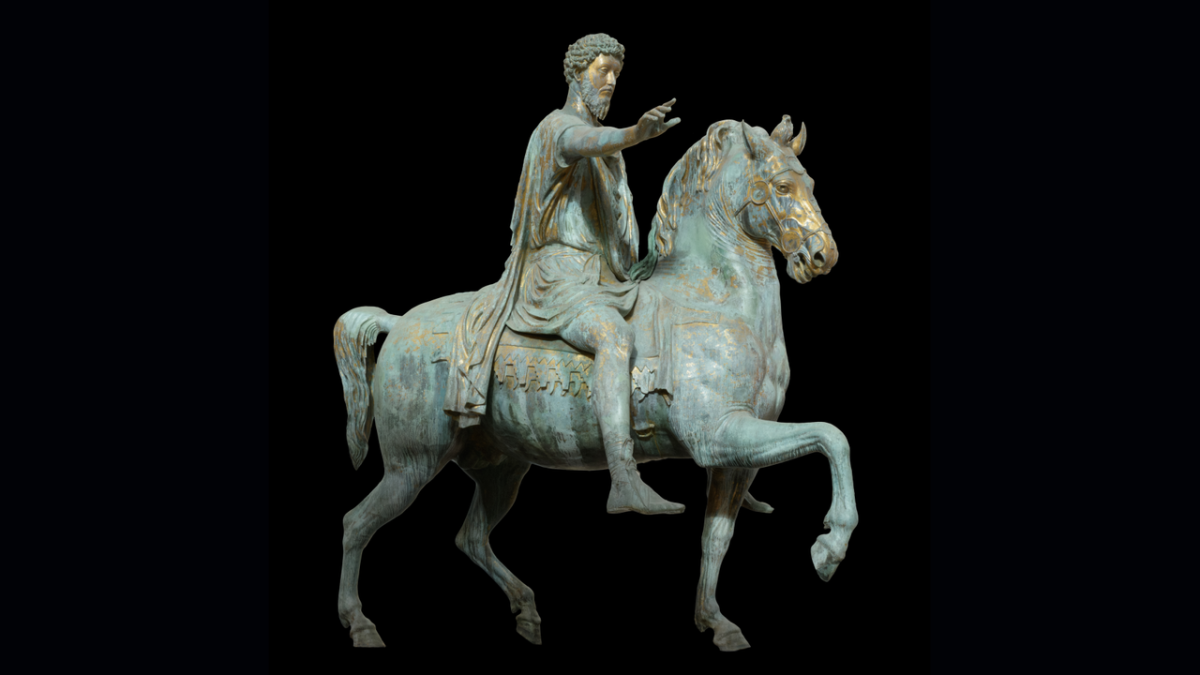
Of all the equestrian statues ever erected to honor Roman emperors — and there were many — only one has survived to the present day. That single survivor is the bronze equestrian statue of Marcus Aurelius, a larger-than-life-size masterpiece standing 13.9 feet tall (4.24 meters) that has endured wars, religious upheaval, and the slow erosion of nearly two millennia.
The fact that it exists at all is something of a miracle. And the story of how it survived is, in many ways, just as remarkable as the statue itself.
Created around A.D. 175, the statue depicts the Roman emperor Marcus Aurelius — who ruled from A.D. 161 — mounted on horseback in the commanding pose that Roman leaders used to project power and authority. It is the only known larger-than-life-size bronze equestrian statue of a pagan Roman emperor still standing anywhere in the world.
Why the Equestrian Statue of Marcus Aurelius Is Unlike Anything Else That Survived
Equestrian statues were far from rare in ancient Rome. Depicting an emperor on horseback was a well-established symbol of leadership, military dominance, and divine favor. Emperors commissioned them regularly, and they were displayed across the empire in public squares, forums, and civic centers.
So why does only one survive? The answer is largely religious. As Christianity became the dominant force in the Roman world, pagan imagery was systematically destroyed or melted down. Bronze statues were especially vulnerable — the metal was valuable and could be repurposed. Thousands of bronze works from antiquity were lost this way.
The Marcus Aurelius statue escaped this fate almost certainly because of mistaken identity. Medieval Christians are widely believed to have confused the emperor with Constantine the Great — Rome’s first Christian emperor — and therefore spared it from destruction. Had anyone recognized it as a depiction of a pagan ruler, it almost certainly would not have survived.
Key Facts About the Statue
| Detail | Information |
|---|---|
| Name | Equestrian statue of Marcus Aurelius |
| Type | Bronze equestrian statue |
| Origin | Rome, Italy |
| Date created | Circa A.D. 175 |
| Height | 13.9 feet (4.24 meters) |
| Subject’s reign | A.D. 161 onward |
| Material | Bronze |
| Significance | Only surviving larger-than-life-size pagan Roman emperor equestrian statue |
- The statue is larger than life-size, designed to project imperial grandeur in a public setting
- It is cast in bronze, a material widely used for prestige sculpture in ancient Rome
- It is the sole surviving example of what was once a common type of Roman imperial monument
- Michelangelo himself worked on the statue’s restoration and placement
- Its survival is largely attributed to a case of mistaken medieval identity
The Part Most People Don’t Know: Michelangelo’s Role
The statue’s story doesn’t end with ancient Rome. Centuries later, it gained a second chapter when Michelangelo — one of the most celebrated artists in history — became directly involved with it.
Michelangelo refurbished the statue and is associated with its placement on the Capitoline Hill in Rome, one of the city’s most historically significant locations. The commission came as part of a broader redesign of the Capitoline — a project that transformed the hilltop into one of Renaissance Rome’s most impressive civic spaces.
Having Michelangelo’s hand in its presentation cemented the statue’s status not just as an ancient relic but as a living piece of Western art history, bridging the ancient and Renaissance worlds in a single object.
What the Statue Tells Us About Marcus Aurelius
Marcus Aurelius is remembered today as one of Rome’s most thoughtful rulers — a philosopher-emperor whose personal writings, known as the Meditations, are still widely read. His reign, beginning in A.D. 161, marked one of the high points of Roman imperial governance.
The choice to depict him on horseback — at a scale that literally towered over viewers — was deliberate. Equestrian monuments in Rome were reserved for the most powerful figures. The pose communicated military authority, civic leadership, and a connection to the gods that Romans associated with their emperors.
That this particular statue survived while all others were lost gives it a weight that goes far beyond its physical size. It is the only window of its kind into how Rome publicly celebrated its rulers in bronze on this scale.
Where the Statue Stands Today
The original bronze statue is now housed and protected indoors to preserve it from further environmental damage. A replica stands in its place on the Capitoline Hill, ensuring the site retains its historical atmosphere while the irreplaceable original is kept safe.
For historians, archaeologists, and anyone interested in the ancient world, the statue remains one of the most significant surviving objects from Roman antiquity — a unique artifact that outlasted an entire civilization’s worth of similar works.
Its survival was accidental. Its preservation is now deliberate. And its place in history — as the only statue of its kind — is secure.
Frequently Asked Questions
What is the equestrian statue of Marcus Aurelius?
It is a larger-than-life-size bronze statue depicting Roman emperor Marcus Aurelius on horseback, standing 13.9 feet (4.24 meters) tall and created around A.D. 175.
Why is this statue so rare?
It is the only surviving larger-than-life-size bronze equestrian statue of a pagan Roman emperor — all similar statues were destroyed, most likely melted down as Christianity replaced Roman paganism.
How did the statue survive when all others were destroyed?
It is widely believed the statue survived because medieval Christians mistakenly identified it as a depiction of Constantine the Great, Rome’s first Christian emperor, rather than the pagan Marcus Aurelius.
What did Michelangelo have to do with the statue?
Michelangelo refurbished the statue and was involved in its placement on the Capitoline Hill in Rome as part of a Renaissance-era redesign of that historic site.
Where can the statue be seen today?
The original bronze is now preserved indoors to protect it from environmental damage, while a replica stands in its historical position on the Capitoline Hill in Rome.
When did Marcus Aurelius reign as Roman emperor?
According to the source, Marcus Aurelius began his reign in A.D. 161. He is also remembered as a philosopher-emperor known for his personal writings.



Leave a Reply