
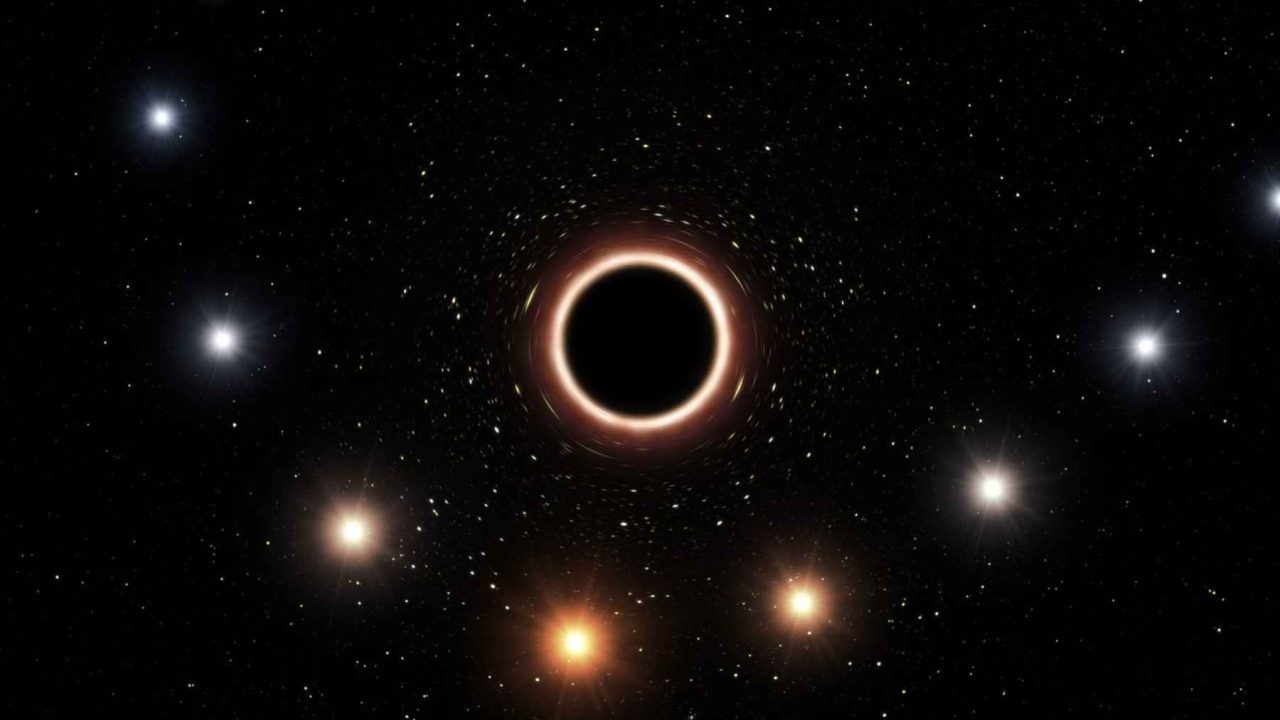
What if the object at the center of our galaxy — the gravitational anchor of the entire Milky Way — is not a black hole at all? That question, once unthinkable in mainstream astronomy, is now being asked seriously by researchers whose new study challenges more than fifty years of accepted science.
For decades, astronomers have pointed to Sagittarius A* as one of the clearest examples of a supermassive black hole in the known universe. A new study now proposes a radically different explanation for what sits at the heart of our galaxy — and the answer could reshape our understanding of both dark matter and one of physics’ most famous predictions.
The implications stretch far beyond one radio source in the night sky. If the researchers are right, it forces a rethink of how galaxies form, what dark matter actually does, and whether Stephen Hawking’s most celebrated theoretical work will ever find real-world confirmation.
Fifty Years of Certainty About Sagittarius A*
The story of Sagittarius A* begins with observations stretching back to 1974, when astronomers confirmed the existence of a compact, extraordinarily massive object at the galactic center. Over the following decades, the case for a supermassive black hole became overwhelming — at least on the surface.
The most persuasive evidence came from a group of stars known as the S stars. These objects orbit the galactic center at extraordinary speeds, some reaching several thousand kilometers per second. The only thing physicists and astronomers believed could generate the gravitational pull needed to whip stars around at those velocities was a black hole with a mass roughly four million times that of the Sun.
That figure — four million solar masses — became one of the most cited numbers in modern astrophysics. It anchored textbooks, shaped galactic models, and earned researchers Nobel Prize recognition for the work confirming it.
What the New Study Actually Argues About Sagittarius A*
The new research, led by Valentina Crespi of the Institute of Astrophysics La Plata, does not dispute the orbital data. The S stars really do move the way observations say they do. What Crespi’s team challenges is the assumption about what is causing those orbits.
Their proposal: the central mass is not a black hole, but a super-dense clump of fermionic dark matter. In this model, enormous numbers of lightweight dark matter particles crowd together under their own gravity, forming a compact core that is dense enough to produce the same gravitational effects on surrounding stars that a black hole would.
From the outside, looking only at how nearby stars behave, the two objects would appear almost identical. That is precisely what makes this hypothesis so difficult to dismiss — and so difficult to confirm.
The researchers argue that the S star orbits can be fully explained by this dark matter core, without requiring a singularity or an event horizon at all. If correct, Sagittarius A* may never have been a black hole in the traditional sense.
Key Differences: Black Hole vs. Fermionic Dark Matter Core
| Feature | Traditional Black Hole | Fermionic Dark Matter Core |
|---|---|---|
| Event horizon | Yes — no light escapes | No event horizon present |
| Gravitational effect on S stars | Matches observed orbits | Also matches observed orbits |
| Composed of | Collapsed matter / singularity | Lightweight fermionic dark matter particles |
| Hawking radiation | Theoretically possible | Would not apply |
| Estimated equivalent mass | ~4 million solar masses | ~4 million solar masses (equivalent) |
Why Hawking’s Legacy Hangs on a Technical Detail
This is where the story takes an even more consequential turn. Stephen Hawking’s most famous theoretical contribution — Hawking radiation — predicts that black holes slowly emit energy over time due to quantum effects near the event horizon, eventually evaporating entirely.
It is one of the most celebrated ideas in modern physics. It elegantly bridges quantum mechanics and general relativity. It has shaped theoretical physics for half a century. And it has never been directly observed or confirmed.
If Sagittarius A* turns out not to be a black hole — if it lacks an event horizon entirely — then one of the primary candidate objects for testing Hawking radiation is removed from the table. The fermionic dark matter core proposed by Crespi’s team would not produce Hawking radiation, because Hawking radiation depends on the existence of an event horizon.
The “technical detail” that will decide the matter is essentially whether an event horizon can be confirmed or ruled out at the galactic center. That is far easier to state than to actually measure. Current observational technology can tell us how objects orbit Sagittarius A*, but peering close enough to confirm or deny the existence of an event horizon remains at the frontier of what is physically possible.
What Happens Next — and Why It Is So Hard to Resolve
The challenge facing astronomers is that both competing explanations — a classical black hole and a fermionic dark matter core — produce nearly identical gravitational signatures when viewed from Earth. Distinguishing between them requires either dramatically sharper imaging of the galactic center or the detection of signals that only one of the two objects would produce.
The Event Horizon Telescope, which produced the first image of Sagittarius A* in 2022, was a landmark achievement. But even that image cannot settle this particular debate on its own. The resolution needed to confirm an event horizon versus a dark matter core pushes beyond current capabilities.
Future generations of radio telescope arrays, combined with advances in gravitational wave detection and theoretical modeling, may eventually close this gap. Until then, the question remains genuinely open — and the center of the Milky Way remains one of the most contested objects in science.
What is clear is that the study by Crespi and colleagues at the Institute of Astrophysics La Plata has introduced a credible alternative that the broader astronomical community will need to engage with seriously. Fifty years of consensus does not disappear overnight, but in science, the right question asked at the right moment can change everything.
Frequently Asked Questions
What is Sagittarius A*?
Sagittarius A* is a bright, compact radio source located at the center of the Milky Way galaxy. It has long been identified as a supermassive black hole with a mass approximately four million times that of the Sun.
What does the new study suggest instead of a black hole?
The study, led by Valentina Crespi of the Institute of Astrophysics La Plata, proposes that Sagittarius A* could be a super-dense core of fermionic dark matter rather than a traditional black hole.
How can a dark matter core mimic a black hole?
According to the research, a sufficiently dense clump of fermionic dark matter particles would exert the same gravitational pull on surrounding stars as a black hole of equivalent mass, making the two objects observationally difficult to distinguish.
What are the S stars and why do they matter?
The S stars are a group of stars that orbit very close to the galactic center at speeds of several thousand kilometers per second. Their orbital behavior has historically been used as key evidence for the black hole interpretation of Sagittarius A*.
How does this relate to Stephen Hawking?
Hawking radiation — Hawking’s famous prediction that black holes slowly evaporate by emitting energy — requires an event horizon to exist. If Sagittarius A* has no event horizon, it cannot produce Hawking radiation, leaving his theory without one of its most prominent potential test cases.
Can current telescopes resolve this debate?
Not definitively. While the Event Horizon Telescope has imaged Sagittarius A*, confirming or ruling out the existence of an event horizon at the level of precision needed to settle this question remains beyond current observational capabilities.



Leave a Reply