
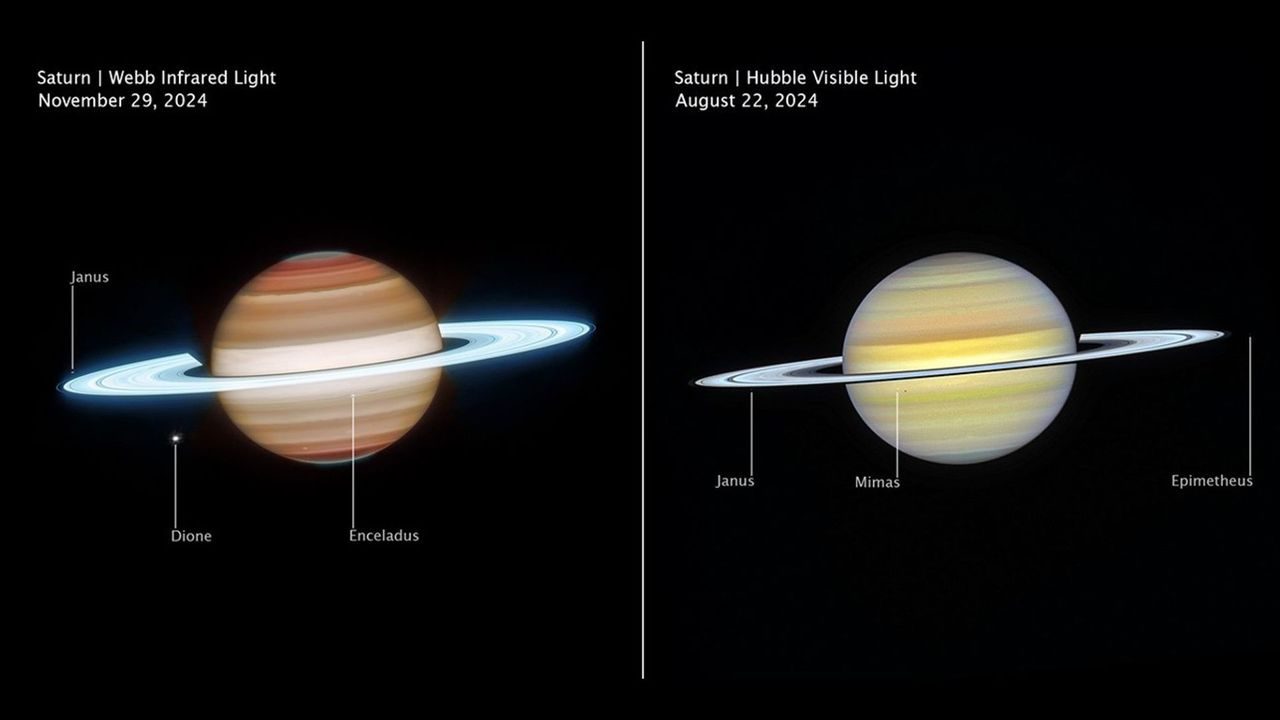
Saturn has captivated astronomers for centuries, but two of the most powerful space telescopes ever built have now combined forces to deliver something genuinely new: the most complete and detailed portrait of the ringed planet ever assembled. The result reveals a world far more turbulent and complex than its serene, jewel-like appearance suggests.
NASA’s James Webb Space Telescope and the Hubble Space Telescope have each captured Saturn from their own unique vantage points, and together their images paint a picture of a planet defined not just by its iconic rings, but by a restless, churning atmosphere that has long puzzled scientists. Fierce winds, stubborn megastorms, and strange weather patterns that can persist for years — Saturn’s atmosphere is anything but quiet.
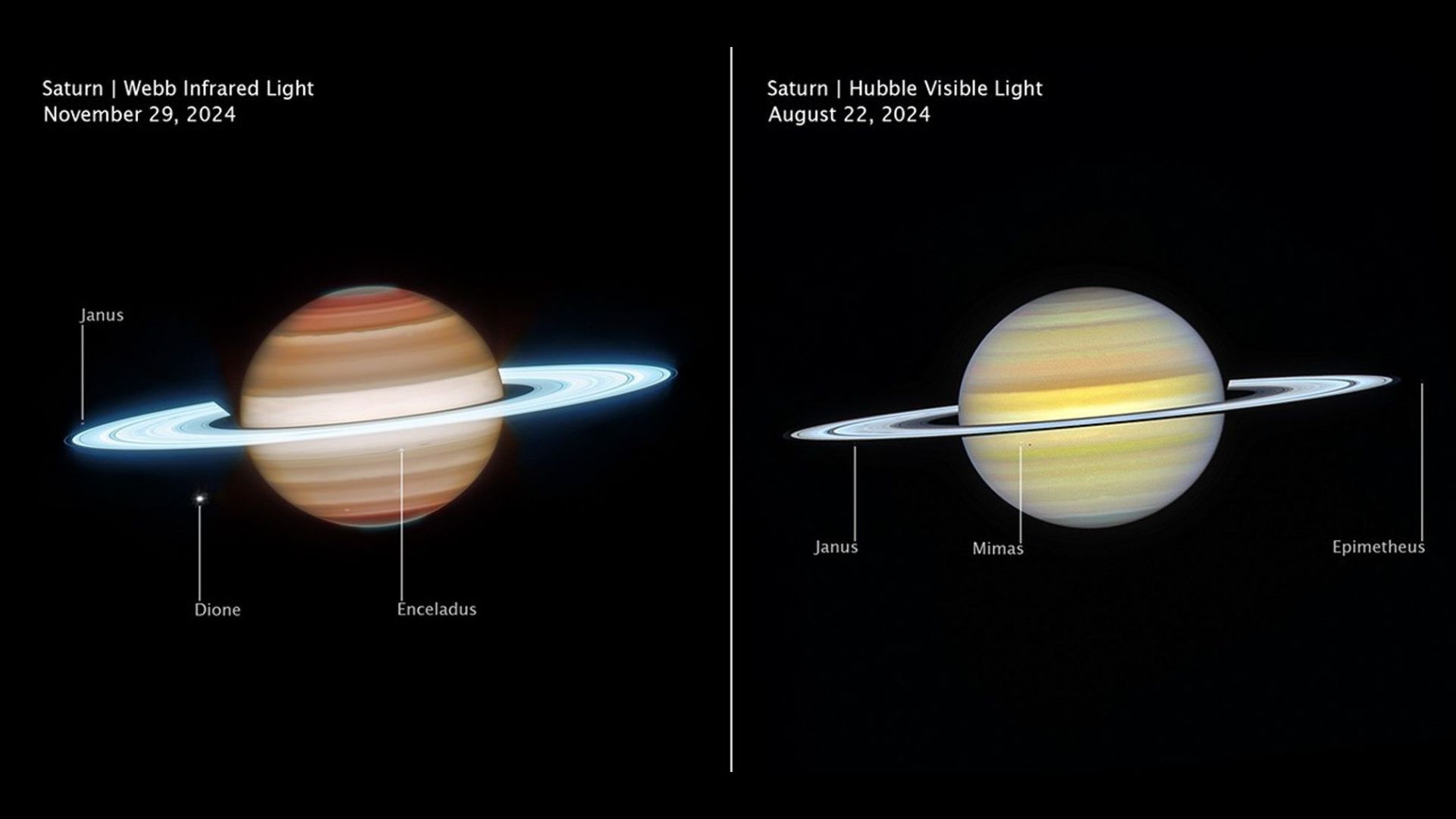
These new views mark a significant moment in planetary science. By layering what Webb and Hubble each do best, researchers now have a richer window into one of the solar system’s most dramatic and enduring mysteries.
Why Saturn’s Atmosphere Has Always Been the Real Story
Most people think of Saturn and picture its rings. That’s understandable — they are among the most visually stunning structures in the known solar system. But for scientists, Saturn’s atmosphere has always been the deeper puzzle.
The planet’s atmosphere is shaped by forces that operate on timescales and scales that dwarf anything on Earth. Winds tear across its cloud bands at extraordinary speeds. Megastorms — massive, long-lived storm systems — periodically erupt and can dominate entire regions of the planet for extended periods. And some weather patterns appear to simply refuse to dissipate, lingering in ways that challenge existing models of atmospheric dynamics.
Understanding these patterns matters beyond Saturn itself. What scientists learn about how gas giant atmospheres behave informs broader models of planetary formation, climate systems across the solar system, and even the study of exoplanets orbiting distant stars.
What James Webb and Hubble Each Brought to the Table
The power of this new combined view comes from what each telescope does differently. Webb and Hubble observe the universe across different wavelengths of light, meaning they are sensitive to different physical features and atmospheric layers.
Hubble, which has been observing Saturn for decades, provides a familiar optical baseline — capturing the planet roughly as human eyes would see it, with sharp detail across its cloud structures and ring system. Webb, operating primarily in infrared, cuts through layers of atmosphere that are invisible to optical telescopes, revealing temperature variations, chemical compositions, and structural features buried beneath Saturn’s visible cloud tops.
Together, the two telescopes offer something neither could achieve alone: a layered, multi-dimensional view of the planet that spans from its outer atmosphere down into regions that have never been clearly imaged before.
| Telescope | Primary Wavelength | Key Contribution to Saturn Observations |
|---|---|---|
| Hubble Space Telescope | Optical (visible light) | Detailed surface cloud structures, rings, and moons in visible light |
| James Webb Space Telescope | Infrared | Atmospheric layers, temperature data, and features hidden beneath cloud tops |
| Combined View | Multi-wavelength | Most comprehensive portrait of Saturn’s atmosphere and environment ever produced |
The images credit a team that includes Amy Simon of NASA’s Goddard Space Flight Center and Michael Wong of UC Berkeley, with image processing by Joseph DePasquale of the Space Telescope Science Institute — a collaboration that reflects the scale of effort behind results like these.
Megastorms, Fierce Winds, and Weather That Won’t Quit
One of the most striking things the combined images help illuminate is just how chaotic Saturn’s atmosphere truly is. The planet is home to some of the most extreme weather in the solar system, and the new observations add detail to that picture.
- Megastorms: Saturn periodically experiences enormous storm systems that dwarf anything in Earth’s atmosphere. These aren’t brief events — they can persist and reshape atmospheric patterns for extended periods.
- Fierce winds: The winds in Saturn’s atmosphere are among the strongest of any planet, driving the banded cloud structures visible even through a backyard telescope.
- Lingering weather patterns: Some atmospheric features appear to be remarkably stable over time, refusing to dissipate in ways that scientists are still working to explain.
- Orbiting moons: The new images also capture Saturn’s moons, adding context to the broader Saturnian system beyond the planet itself.
These features aren’t just visually dramatic. They represent real scientific puzzles about how energy moves through gas giant atmospheres, how storms form and sustain themselves without a solid surface to interact with, and why some weather systems on Saturn can outlast entire seasons on Earth.
Why This Matters Beyond Beautiful Images
It would be easy to look at these images and appreciate them purely as spectacular photography. But the scientific value runs much deeper than aesthetics.
Saturn is the closest large gas giant to Earth that allows detailed atmospheric study at this resolution. Every observation of its winds, storms, and chemical layers feeds into models that scientists use to understand gas giants across the universe — including the thousands of gas giant exoplanets discovered in recent decades.
Webb in particular represents a generational leap in what’s possible. Its infrared sensitivity allows researchers to probe atmospheric chemistry and temperature gradients in ways that simply weren’t achievable before its launch. Pairing that capability with Hubble’s decades of optical data creates a continuity of observation that is scientifically invaluable.
For planetary scientists, this isn’t just a new image. It’s a new dataset — one that will be studied, modeled, and referenced for years to come.
What Researchers Will Be Looking at Next
The release of these combined images is likely to drive further coordinated observations of Saturn using both telescopes. Scientists will be particularly focused on tracking how the atmospheric features captured in these images evolve over time — whether storm systems grow or decay, whether wind patterns shift, and how Saturn’s appearance changes as the planet moves through its long seasonal cycle.
Saturn’s year is roughly 29 Earth years long, meaning seasonal changes unfold on timescales that require long-term, sustained observation. Webb’s expected operational lifespan makes it well-positioned to track those changes in ways no previous instrument could.
The combination of Hubble’s historical record and Webb’s new infrared capability gives researchers a foundation to study Saturn not just as it looks today, but as a dynamic system changing across time.
Frequently Asked Questions
What did the James Webb and Hubble telescopes observe about Saturn?
The two telescopes captured complementary views of Saturn, with Hubble providing optical detail and Webb revealing infrared data about the planet’s atmosphere, including its fierce winds, megastorms, and long-lasting weather patterns.
Who was involved in producing these Saturn images?
The images involved Amy Simon of NASA’s Goddard Space Flight Center, Michael Wong of UC Berkeley, and image processing by Joseph DePasquale of the Space Telescope Science Institute.
Why is Saturn’s atmosphere considered scientifically important?
Saturn’s atmosphere hosts some of the solar system’s most extreme weather, including megastorms and fierce winds, and studying it helps scientists understand gas giant atmospheres both within our solar system and on exoplanets.
What makes the combined Webb and Hubble view different from previous Saturn images?
By combining optical and infrared observations, the two telescopes together reveal atmospheric layers and features that neither could capture alone, making this the most comprehensive view of Saturn yet produced.
Does the new imagery show Saturn’s moons as well?
Yes, the images also capture Saturn’s orbiting moons alongside the planet itself, providing broader context for the entire Saturnian system.</p

Leave a Reply