
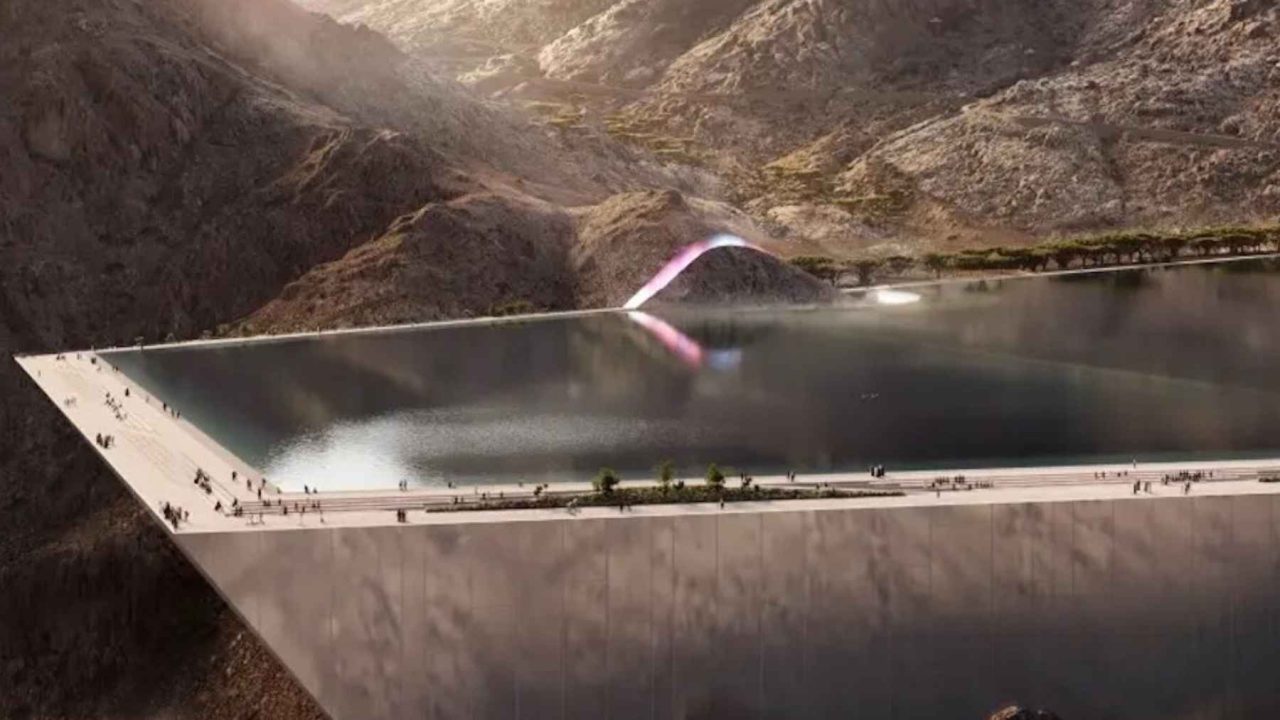
A 1.7-mile-long freshwater lake sitting in the middle of one of the world’s driest landscapes — that is exactly what Saudi Arabia is planning to build, backed by a $4.7 billion investment and a construction contract handed to Italian firm Webuild. The project involves three massive dams, roughly 370 acres of open water, and enough ambition to make even the most seasoned engineers pause.
This is not a rendering on a mood board. It is a live infrastructure project tied to NEOM, Saudi Arabia’s flagship futuristic development in the northwest of the country. And it raises a question that goes far beyond luxury resorts: in a world growing hotter and drier, can a man-made oasis actually be built without devastating the systems around it?
The answer, according to the people building it, is yes. But the details matter — and they are worth understanding.
What Is Actually Being Built at Trojena
Trojena is a mountain destination under development in the Tabuk region of northwest Saudi Arabia, situated near the Gulf of Aqaba, roughly 31 miles from the coast. The terrain rises from about 4,900 feet to as high as 8,500 feet above sea level — steep enough to carve out a natural reservoir basin and cool enough, at altitude, to offer temperatures noticeably lower than the surrounding desert floor.
The plan calls for three large dams to be constructed across this mountain terrain. Together, they would hold back enough water to form an artificial freshwater lake approximately 1.7 miles in length, covering around 370 acres — close to 0.6 square miles of open water. Webuild, the Italian contractor awarded the contract, also describes an island feature within the lake.
The destination is being pitched as a year-round resort. That means skiing in winter, luxury hotels, and water sports on the lake itself — a combination that would be extraordinary anywhere, let alone in a desert nation. Trojena is positioned as one of the centerpiece attractions within the broader NEOM development, which spans a vast stretch of northwestern Saudi Arabia.
The Numbers Behind the Saudi Arabia Artificial Lake Project
The scale of investment and the water figures being cited are what make this project stand out from typical infrastructure announcements. Here is what 7 billion
The weekly water yield figure — 90,000 cubic meters — is the claim that will draw the most scrutiny. Proponents of the project argue this output can be achieved without significantly impacting the surrounding environment, though independent verification of that claim remains an open question as construction progresses.
Why This Is More Than Just a Tourist Attraction
It would be easy to look at Trojena and see only an extravagant vanity project — skiing in the desert, a man-made lake for billionaires. But the engineering challenge sitting underneath all the luxury branding is genuinely significant.
Saudi Arabia has almost no permanent rivers and relies heavily on desalination and groundwater to meet its water needs. Building a freshwater reservoir at altitude using dam infrastructure rather than energy-intensive desalination represents a different approach to the country’s water security problem. Whether it scales or remains a one-off showpiece depends on what the project actually delivers.
The altitude of Trojena is central to the feasibility argument. At elevations between 4,900 and 8,500 feet, the region captures more precipitation than the surrounding desert and experiences cooler temperatures that reduce evaporation losses from an open reservoir. Those two factors — more input, less loss — are what make the site viable for a lake that would be impossible to sustain at lower elevations.
- Higher altitude means cooler air temperatures and reduced surface evaporation
- Mountain terrain creates natural basin geometry suited to dam construction
- Proximity to the Gulf of Aqaba may support moisture-bearing weather patterns
- Three-dam structure distributes water management across multiple control points
Supporters of the project argue that building at altitude with dam infrastructure is fundamentally more sustainable than expanding coastal desalination capacity, which is energy-intensive and produces concentrated brine as a byproduct. Critics, however, point out that any large water body in an arid environment carries environmental costs that are difficult to fully predict.
The Bigger Picture Inside NEOM
Trojena is one piece of a much larger development. NEOM is Saudi Arabia’s attempt to build an entirely new kind of city and tourism economy in the northwest of the country, as part of the Vision 2030 economic diversification plan. Other components of NEOM include The Line, a proposed linear city, and Sindalah, a luxury island development.
Webuild’s involvement signals that international construction firms are actively competing for NEOM contracts despite the scale of the ambition and the engineering unknowns involved. A $4.7 billion contract for dam and reservoir infrastructure alone suggests the project is moving beyond the planning phase into real ground-level work.
Whether Trojena opens on schedule, delivers on its water yield targets, and avoids significant environmental disruption will be watched closely — not just by the tourism industry, but by water engineers and climate researchers studying what is possible in arid-zone infrastructure development.
What Comes Next for the Project
Webuild has confirmed the contract award and the core project parameters. Construction is underway within the broader NEOM development timeline, though specific completion dates for the dam system and lake were not detailed in the available source material.
The resort itself — with its skiing facilities, hotels, and water sports — is tied to Trojena’s overall development schedule. As one of NEOM’s flagship experiences, it faces significant pressure to deliver results that justify the investment and the international attention the project has attracted.
Environmental assessments and water management outcomes will likely define how the project is remembered — either as proof that engineered oases can be built responsibly in desert environments, or as a cautionary example of ambition outpacing ecological reality.
Frequently Asked Questions
How long will the artificial lake at Trojena be?
The planned lake is approximately 1.7 miles long and will cover around 370 acres, according to contractor Webuild.
How much is being invested in the Trojena dam and lake project?
Webuild has confirmed a $4.7 billion contract to build the three dams that will hold the artificial freshwater lake.
How much water will the project produce?
The project is projected to yield 90,000 cubic meters of water per week, according to the available project details.
Who is building the dams at Trojena?
Webuild, an Italian construction contractor, has been awarded the contract to build the three dams that will form the reservoir.
Where exactly is Trojena located?
Trojena is in the Tabuk region of northwest Saudi Arabia, about 31 miles from the Gulf of Aqaba, at elevations ranging from roughly 4,900 to 8,500 feet above sea level.
Will the lake have any environmental impact?
Project proponents claim it will not significantly impact the environment, but independent verification of that claim has not yet been confirmed in the available source material.



Leave a Reply