
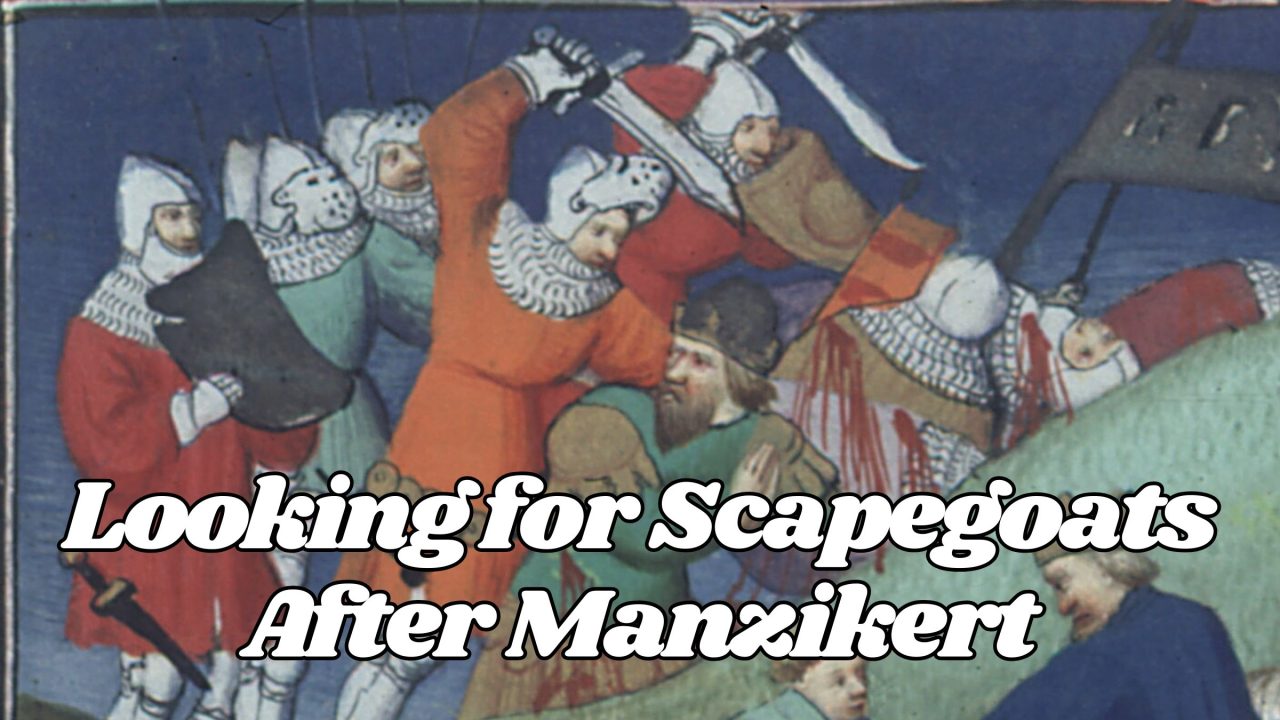
Professor Dimitri Kastakis stared at the ancient manuscript spread across his desk, his weathered fingers tracing the faded Greek text that described one of history’s most controversial military defeats. For forty years, he’d studied Byzantine history, but this 11th-century account of the Battle of Manzikert still made his stomach churn with frustration.
“How could such a powerful empire fall apart so quickly?” he muttered to himself, adjusting his reading glasses. The more he researched, the more he realized that everything most people believed about this pivotal moment in 1071 might be completely wrong.

What happened at Manzikert wasn’t just a military defeat—it was the beginning of the end for Byzantine control over much of what we now call Turkey. But was Emperor Romanos IV really betrayed by his own generals, or did he simply make a catastrophic mistake that changed the course of history forever?
The Day That Changed Everything
On August 26, 1071, two massive armies faced each other on a dusty plain near the town of Manzikert in eastern Turkey. On one side stood the Byzantine Empire, led by Emperor Romanos IV Diogenes—a warrior-emperor determined to push back against Turkish raids that had been devastating his territory for years.
Facing him was Alp Arslan, the brilliant Sultan of the Seljuk Turks, who had actually been planning to campaign elsewhere when he learned of the Byzantine advance. What should have been a manageable border conflict instead became one of the most consequential battles in medieval history.
The traditional narrative paints this as a clear case of treachery, but the reality is far more complex. Romanos IV was dealing with political enemies both on the battlefield and back in Constantinople.
— Dr. Sarah Molloy, Byzantine Studies, Oxford University
The battle itself lasted most of the day, with neither side gaining a clear advantage. Byzantine forces, numbering around 40,000 men, included a mix of professional soldiers, foreign mercenaries, and allied troops. The Seljuk army was smaller but more mobile, relying on mounted archers who could strike quickly and retreat before the heavier Byzantine forces could respond.
Then everything went wrong. As evening approached, a rumor spread through the Byzantine ranks that the emperor had been killed. Some units began to retreat, creating chaos in the formation. In the confusion, Romanos IV was captured—a disaster that would reshape the medieval world.
Breaking Down the Betrayal Theory
For centuries, historians have debated whether the defeat at Manzikert resulted from deliberate sabotage or simply bad luck and poor decisions. The evidence points to a complicated mix of both factors that created the perfect storm for disaster.
Here are the key factors that contributed to the Byzantine defeat:
- Political divisions within the army: Romanos IV faced opposition from powerful noble families who preferred his stepson as emperor
- Communication breakdown: The retreat order may have been misunderstood or deliberately misinterpreted
- Tactical mistakes: The emperor’s decision to personally lead a cavalry charge left his army without clear command
- Mercenary reliability: Foreign troops had little loyalty to the Byzantine cause and fled when the battle turned
- Overconfidence: Byzantine commanders underestimated Seljuk military capabilities
| Factor | Impact on Battle | Evidence Level |
|---|---|---|
| Deliberate sabotage by generals | High | Circumstantial |
| Communication failures | Very High | Multiple sources |
| Poor tactical decisions | High | Well documented |
| Mercenary desertion | Medium | Contemporary accounts |
| Political instability | Very High | Extensive records |
The most damaging aspect wasn’t the military defeat itself, but the political chaos that followed. The empire never recovered from the internal divisions that Manzikert exposed.
— Professor Michael Hendy, Medieval History, Warwick University
Recent scholarship suggests that while some Byzantine generals may have deliberately undermined Romanos IV, the primary cause of defeat was the emperor’s own strategic miscalculations combined with the army’s fragile command structure.
The Ripple Effects That Lasted Centuries
The consequences of Manzikert extended far beyond a single lost battle. Within a decade, most of Anatolia—the heartland of the Byzantine Empire—had fallen under Turkish control. This wasn’t necessarily because of continued military defeats, but because the political chaos following Romanos IV’s capture made effective resistance impossible.
The emperor himself was released after agreeing to pay a massive ransom and cede territory, but when he returned to Constantinople, his political enemies had already moved against him. He was deposed, blinded, and died shortly afterward—a victim of the same court intrigue that may have contributed to his defeat at Manzikert.
What’s fascinating is how quickly the Byzantines could have recovered if they’d maintained political unity. The Seljuks were dealing with their own internal problems and couldn’t consolidate their gains effectively.
— Dr. Alexios Savvides, Institute for Byzantine Research
The loss of Anatolia had profound long-term consequences that are still visible today. Turkish settlement of the region laid the foundation for what would eventually become the Ottoman Empire. The economic impact on Byzantium was devastating, as Anatolia had provided much of the empire’s tax revenue and military recruitment.
Perhaps most significantly, the desperate situation prompted Emperor Alexios I to request military aid from Western Europe—a plea that would eventually lead to the First Crusade. The crusading movement, with all its complex consequences for Christian-Muslim relations, can be traced directly back to the events at Manzikert.
Modern Lessons From Medieval Mistakes
Today’s military historians study Manzikert not just as a turning point in medieval history, but as a case study in how internal political divisions can undermine even the most powerful institutions. The Byzantine Empire’s fundamental problem wasn’t military weakness—it was the inability of its leadership to work together in a crisis.
The battle also demonstrates how quickly geopolitical situations can change when key institutions fail. The Byzantine Empire had survived for over 700 years before Manzikert, weathering everything from Arab invasions to civil wars. Yet a single day’s fighting, complicated by political betrayal and poor decision-making, set in motion changes that would reshape the entire region.
Manzikert shows us that empires don’t usually fall because of external pressure alone. They collapse when internal divisions prevent them from responding effectively to external challenges.
— Dr. Warren Treadgold, Byzantine Studies, Saint Louis University
For modern readers, the story of Manzikert offers sobering insights into how political polarization and institutional distrust can have consequences far beyond what anyone imagines at the time. The Byzantine generals who may have betrayed Romanos IV probably thought they were simply settling a domestic political dispute—they couldn’t have foreseen that their actions would contribute to the loss of half their empire.
FAQs
Was Emperor Romanos IV actually betrayed at Manzikert?
While there’s strong circumstantial evidence that some generals undermined him, the defeat likely resulted from a combination of betrayal, poor decisions, and bad luck.
How did the Seljuk Turks benefit from the battle?
The victory opened Anatolia to Turkish settlement and established the Seljuks as the dominant power in the region, though they couldn’t immediately capitalize on their success due to internal conflicts.
Could the Byzantine Empire have recovered from this defeat?
Yes, if they had maintained political unity. The empire’s resources were still substantial, but internal fighting prevented effective resistance to Turkish expansion.
What role did Manzikert play in starting the Crusades?
The loss of Anatolia eventually forced Emperor Alexios I to request Western military aid, leading to Pope Urban II’s call for the First Crusade in 1095.
Why is this battle still studied today?
Manzikert demonstrates how political divisions can undermine strong institutions and how single events can have massive long-term consequences for entire civilizations.
What happened to Romanos IV after his capture?
He was released by the Seljuks but deposed by his political enemies upon returning to Constantinople, then blinded and exiled, dying shortly afterward.

Leave a Reply