
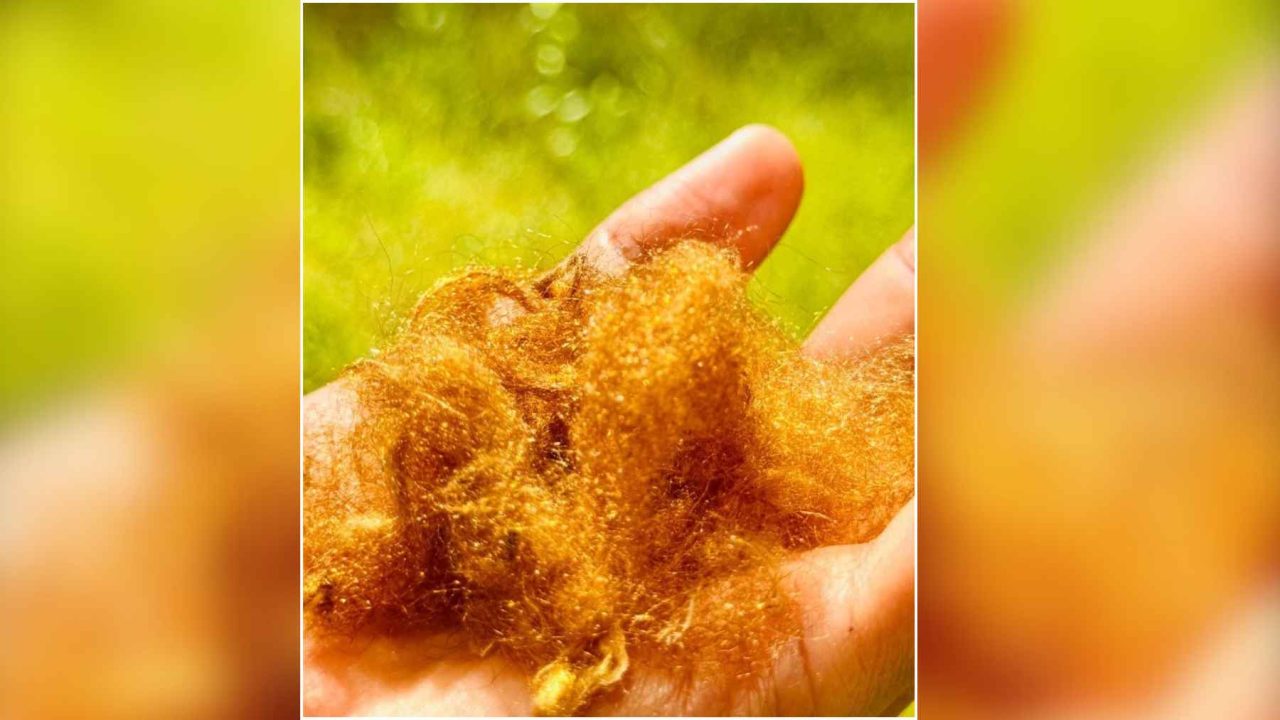
A fabric so rare it was once reserved for emperors and popes has been recreated by researchers in South Korea — and what they discovered about why it never loses its color could quietly reshape how the world thinks about sustainable textiles.
The material is known as sea silk, sometimes called the “golden fiber of the sea.” For centuries it was one of the most coveted substances in the ancient world, prized not just for its extraordinary rarity but for a shimmering, golden sheen that endures without the use of dyes. Now, a research team working with Korea’s coastal waters has brought it back — and explained, for the first time, the structural secret behind its lasting luminosity.
That discovery lands at a particularly pointed moment. The textile industry is under growing pressure over its environmental footprint, and color — specifically how fabric gets it and keeps it — is at the center of that problem.
What Sea Silk Actually Is
Sea silk is not woven from plant or animal fur. It comes from byssus threads — the fine, hair-like fibers that certain mollusks produce to anchor themselves to rocks and surfaces underwater. Historically, the primary source was Pinna nobilis, a large pen shell native to the Mediterranean Sea.
According to POSTECH, the material was associated with emperors, popes, and other figures of high authority during the Roman period. That association wasn’t just symbolic. Sea silk was extraordinarily difficult to harvest and process, which made it genuinely scarce. For most of recorded history, it existed at the intersection of extreme rarity and extreme prestige.
The South Korean team used byssus threads from Atrina pectinata, a pen shell species cultivated in Korean coastal waters, to recreate the fiber. The choice reflects both scientific pragmatism and environmental necessity — Pinna nobilis is now critically endangered in the Mediterranean, making it an impossible source for research or revival at scale.
Why the Color Never Fades — The Science Behind the Sheen
This is the part of the story that goes beyond historical curiosity. Sea silk’s golden color does not come from dye. It comes from the physical structure of the fiber itself — a phenomenon researchers describe as structural coloration, where light interacts with microscopic architecture to produce color without any added pigment.
That distinction matters enormously. Conventional textile dyeing is one of the most chemically intensive processes in manufacturing. The European Parliament has noted that textile production is responsible for approximately 20% of global clean water pollution, with dyeing processes identified as a primary driver. The United Nations Environment Programme describes textile wet processing — which includes dyeing — as an environmental hotspot because of its heavy chemical and energy demands.
A fiber whose color is built into its structure, rather than added through chemical treatment, sidesteps that entire problem. It doesn’t need dye. It doesn’t fade when dye breaks down. And it doesn’t leave behind the chemical runoff that makes conventional textile coloration so damaging.
The South Korean research explains why that color has proven so durable across centuries — the structural properties responsible for the golden sheen are inherent to the fiber, not applied to its surface.
Key Facts at a Glance
| Detail | Information |
|---|---|
| Material name | Sea silk (byssus fiber) |
| Historical source species | Pinna nobilis (Mediterranean pen shell) |
| Species used in Korean research | Atrina pectinata (Korean coastal pen shell) |
| Color source | Structural coloration — no dyes used |
| Historical association | Emperors, popes, Roman-era authority figures |
| Textile dyeing’s share of water pollution | ~20% of global clean water pollution (European Parliament) |
| Research institution cited | POSTECH (South Korea) |
- Sea silk’s golden color requires no chemical dyes and does not fade over time
- The fiber is produced from byssus threads — the anchor filaments mollusks use to attach to surfaces
- The Korean team used a locally cultivated pen shell species rather than the now-endangered Mediterranean original
- UNEP classifies textile wet processing — including dyeing — as an environmental hotspot
- The research both revives a lost material and offers insight into color durability at a structural level
Why This Matters Beyond the History Books
The textile industry’s environmental impact is not abstract. Billions of liters of chemically treated wastewater flow from dyeing facilities into waterways every year. The problem is global, and the solutions proposed so far — cleaner dyes, better filtration, reduced water use — are improvements to a fundamentally chemical-dependent process.
What sea silk represents is a different model entirely. If structural coloration can be understood well enough to replicate or inspire synthetic alternatives, it opens a path toward textiles that carry color without carrying the environmental cost of producing it. Researchers and sustainability advocates have long pointed to nature as a source of design principles for cleaner manufacturing — this is a concrete example of what that can look like in practice.
The fact that the Korean team was able to produce the fiber from a cultivated, locally available species — rather than relying on an endangered one — also suggests a route toward scalability that earlier sea silk research never had.
What Comes Next for Sea Silk Research
What the research establishes is a proof of concept: that sea silk can be recreated using Atrina pectinata, and that the mechanism behind its color durability is now better understood.
Whether that understanding translates into industrial application, bio-inspired synthetic fibers, or simply a deeper scientific foundation for future work remains an open question. But the combination of historical revival and structural discovery gives this research unusual range — it speaks to materials science, environmental chemistry, and the history of luxury all at once.
For an industry under serious pressure to clean up its processes, a centuries-old fiber that solved the color problem without chemistry is, at minimum, worth paying close attention to.
Frequently Asked Questions
What is sea silk made from?
Sea silk is made from byssus threads — fine fibers produced by certain pen shell mollusks to anchor themselves to underwater surfaces.
Why was sea silk so rare and valuable historically?
According to POSTECH, sea silk was associated with emperors, popes, and high-authority figures during the Roman period, reflecting both its extreme scarcity and the difficulty of harvesting and processing the fiber.
Why doesn’t sea silk’s color fade?
The golden sheen comes from structural coloration — a property built into the physical architecture of the fiber itself — rather than from added dyes that can degrade over time.
Which species did South Korean researchers use?
The team used byssus threads from Atrina pectinata, a pen shell species cultivated in Korean coastal waters, rather than the now-endangered Mediterranean species Pinna nobilis.
What does this research have to do with environmental sustainability?
Textile dyeing accounts for approximately 20% of global clean water pollution according to the European Parliament, and UNEP classifies it as an environmental hotspot — making a naturally colored, dye-free fiber scientifically and environmentally significant.
Is sea silk available as a commercial product?




Leave a Reply