
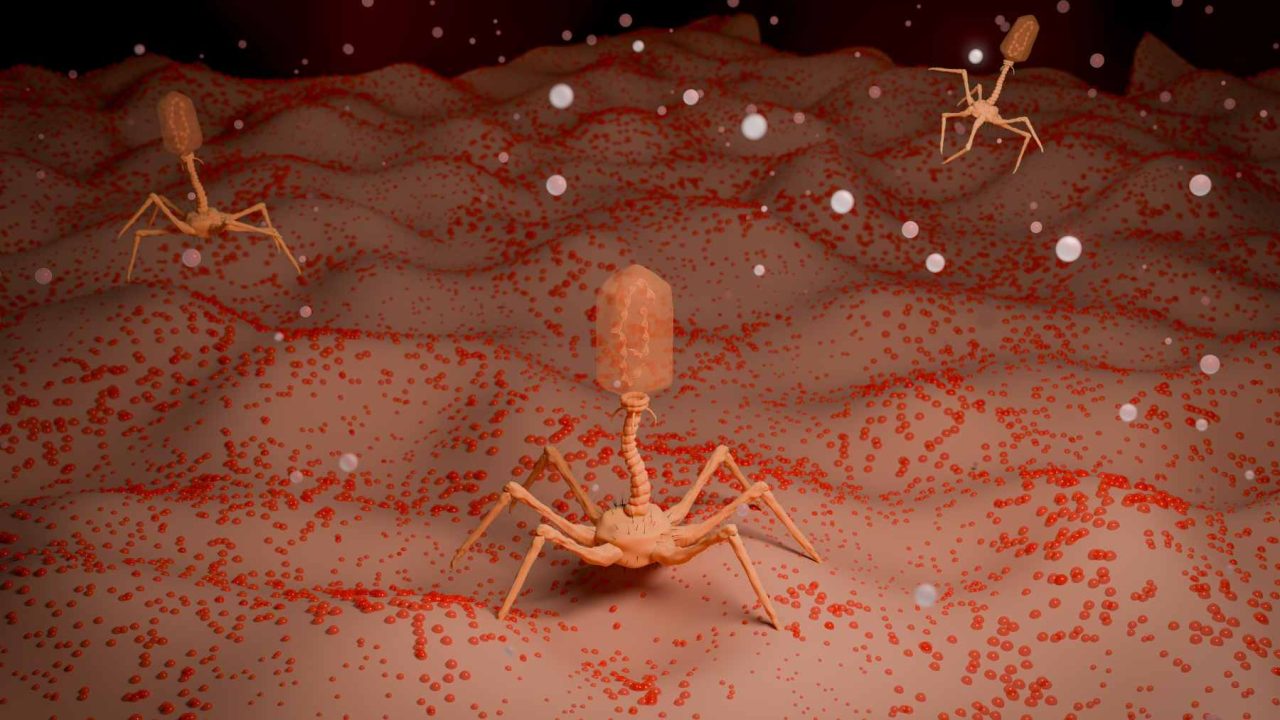
What if the answer to one of medicine’s most urgent crises was floating 250 miles above Earth, evolving in weightlessness? Scientists recently sent viruses into orbit aboard the International Space Station — not to spread disease, but to study how microbes change when gravity nearly disappears. What they found could reshape how we fight drug-resistant infections back on the ground.
Antibiotic resistance is already killing hundreds of thousands of people every year worldwide, and the pipeline for new treatments has slowed to a trickle. Researchers are increasingly turning to bacteriophages — viruses that infect and destroy bacteria — as a potential alternative. The question a team at the University of Wisconsin-Madison decided to ask was bold: does space make those viruses better at their job?
The short answer, based on their microgravity experiment, appears to be yes — and the biology behind it is genuinely surprising.
What Happens When Bacteria and Viruses Evolve in Space
The experiment was elegantly simple in design. Researchers packed test tubes containing Escherichia coli bacteria and a virus called T7 bacteriophage — a well-studied phage that naturally hunts and kills E. coli — and sent them to the International Space Station inside a small hardware box roughly the size of a laptop shelf.
Astronauts incubated the samples for up to 23 days. An identical set of tubes remained on Earth as a control group, running the same timeline under normal gravity conditions. The comparison between the two sets is where things got interesting.
In microgravity, fluids behave differently. Nutrients drift slowly rather than mixing. Microbes float in what researchers describe as a kind of weightless soup. That unusual environment turns out to be a surprisingly powerful pressure cooker for evolution. The bacteria and the phages weren’t just surviving up there — they were changing, and they were changing together.
This process, known as coevolution, is what scientists tracked closely. When a virus and its bacterial host evolve in response to each other over time, the resulting adaptations can be dramatic. In space, with the added pressure of microgravity altering how both organisms move, feed, and interact, that coevolution appeared to accelerate and diverge from what happened on Earth.
Why Microgravity Changes the Rules of Microbial Evolution
On Earth, gravity constantly influences how fluids move, how cells settle, and how microbes interact with their environment. Remove most of that gravitational pull, and the entire physical landscape of microbial life shifts.
Bacteria in microgravity can’t rely on the same fluid dynamics they use on Earth to absorb nutrients or expel waste. The phages hunting them face a different physical challenge too — finding and latching onto bacterial cells when neither party is moving the way evolution on Earth prepared them to move.
That pressure appears to drive rapid, novel adaptation. The T7 phage and E. coli strains that spent 23 days on the ISS coevolved under conditions that have no real parallel in the history of life on this planet. The mutations that emerged weren’t random noise — they were shaped by an entirely new set of environmental rules.
For researchers studying phage therapy as a weapon against antibiotic-resistant bacteria, that’s a significant finding. If space-evolved phages develop new or enhanced abilities to target bacterial hosts, they could potentially offer treatment options that Earth-evolved phages simply don’t have.
The Key Details of the ISS Experiment
| Element | Details |
|---|---|
| Research institution | University of Wisconsin-Madison |
| Location of experiment | International Space Station (ISS) |
| Organisms studied | E. coli bacteria and T7 bacteriophage |
| Duration of incubation | Up to 23 days |
| Equipment used | Small hardware box, approximately laptop-shelf size |
| Control condition | Identical tubes incubated on Earth simultaneously |
| Key variable | Microgravity environment versus standard Earth gravity |
- The ISS is not a sterile environment — microbiology research there already monitors how everyday microbes travel with crews and cargo
- T7 bacteriophage is a well-established research phage, making it an ideal candidate for studying controlled evolutionary changes
- The coevolution of E. coli and T7 in microgravity produced adaptations distinct from those observed in the Earth control group
Why This Matters for the Antibiotic Resistance Crisis
Antibiotic resistance is not a future problem. It is happening now, and it is accelerating. Bacteria that once responded to standard treatments are evolving faster than pharmaceutical companies can develop new drugs. The medical community has been sounding the alarm for years, and options are narrowing.
Phage therapy — using viruses to kill bacteria — has been explored as an alternative for decades, but it has faced significant challenges. Phages are highly specific: a phage that kills one strain of bacteria may do nothing to another. Getting them to work reliably in human patients, and getting regulatory approval for therapies built around living viruses, has proven difficult.
What the ISS experiment suggests is that the evolutionary toolkit available to researchers may be larger than previously understood. Space, with its radically different physical environment, can push phages and bacteria to develop in ways that Earth-based lab conditions simply cannot replicate. If those space-evolved mutations confer new advantages — better targeting, stronger lethality against resistant strains, or novel mechanisms of infection — the implications for phage therapy development could be substantial.
The research also highlights something broader: that extreme environments, whether in orbit or at the bottom of the ocean, may harbor evolutionary possibilities that conventional biology labs have never tapped.
What Comes Next for Space-Based Phage Research
This study represents an early but significant step. The University of Wisconsin-Madison team has demonstrated that microgravity produces measurably different coevolutionary outcomes for bacteria and phages — a finding that opens the door to a range of follow-up questions.
Researchers will likely want to sequence and compare the mutations that emerged in space versus on Earth, identify which specific genetic changes occurred, and then test whether those mutations translate into meaningful differences in how effectively the phages kill bacteria — particularly antibiotic-resistant strains.
The practical path from ISS experiment to clinical phage therapy is long and involves substantial regulatory and scientific hurdles. But the core discovery — that space can serve as a powerful and novel evolutionary pressure on microbes — is now on the table in a way it wasn’t before.
For a world running short on antibiotic options, that’s a direction worth pursuing.
Frequently Asked Questions
What is a bacteriophage?
A bacteriophage is a virus that infects and kills bacteria. They are being studied as a potential alternative to antibiotics for treating drug-resistant bacterial infections.
Which organisms were used in the ISS experiment?
The experiment used Escherichia coli bacteria and a virus called T7 bacteriophage, both of which were incubated aboard the International Space Station for up to 23 days.
Who conducted this research?
The study was led by researchers at the University of Wisconsin-Madison, with samples incubated by astronauts on the International Space Station.
Why does microgravity affect how microbes evolve?
In microgravity, fluids don’t mix the way they do on Earth and nutrients drift slowly, creating a fundamentally different physical environment that appears to accelerate and alter the coevolution of bacteria and the viruses that infect them.
Does this mean space-evolved phages are ready to treat patients?
Not yet. This research is at an early stage, and significant scientific and regulatory steps would be required before any space-evolved phage therapy could be developed for clinical use.
Is the International Space Station a sterile environment for this kind of research?
No — the ISS is not sterile. Microbiology research on board already tracks how everyday microbes travel with crews and cargo, making it an active and complex biological environment.


Leave a Reply