
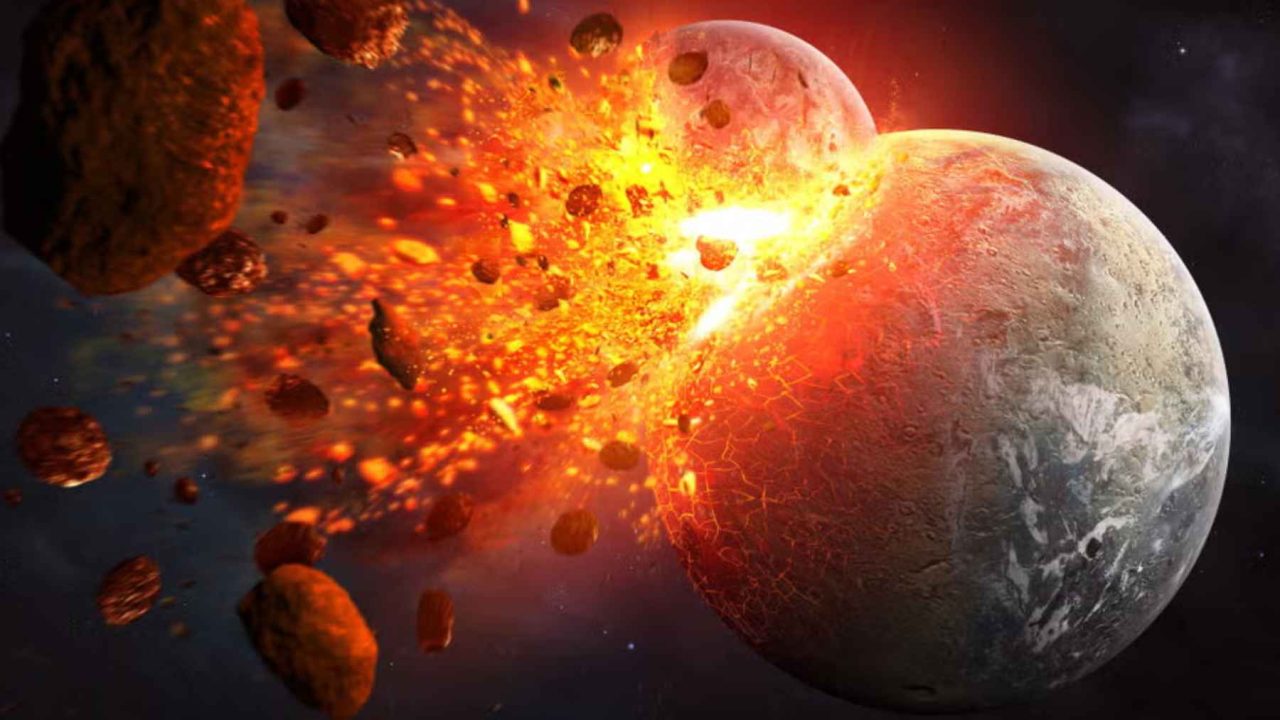
Eleven thousand light-years away — roughly 65 quadrillion miles from Earth — a star quietly went through something astronomers had never caught so close to the moment it happened. It dimmed. Then it dimmed again. Then again. And when researchers dug into the data, the most plausible explanation they could find was that two planets had violently collided, filling the surrounding space with a massive cloud of hot dust and rock.
This isn’t science fiction. It’s the conclusion laid out in a new analysis published on March 11, 2026, by researchers at the University of Washington — and it represents one of the most striking near-real-time observations of planetary destruction ever recorded.
The star at the center of this story is called Gaia20ehk, located in the southern constellation Puppis. For years, it behaved exactly as expected. Then, around 2021, everything changed.
A Star That Suddenly Stopped Making Sense
Gaia20ehk is what astronomers call a main sequence star — the same broad category our own Sun falls into. These stars are supposed to be stable. They burn steadily for billions of years, and their brightness doesn’t fluctuate dramatically without a very good reason.
That’s why the signal in the archived telescope data was so striking. After years of flat, consistent brightness, the star showed three distinct dips in its light output. Something was passing in front of it — or more accurately, a massive cloud of material was blocking its light in a pattern that didn’t match any ordinary stellar behavior.
Anastasios (Andy) Tzanidakis, the lead author of the analysis, put it plainly:
“Right around 2021, it went completely bonkers.”
That kind of irregular dimming, the researchers argue, is consistent with what you’d expect if a catastrophic planetary collision had just occurred — sending enormous quantities of hot dust and debris spreading through the star system and intermittently blocking the star’s light as seen from Earth.
What the Researchers Actually Found — and Why It Matters
Tzanidakis and his colleague James Davenport, both at the University of Washington, studied the archived light data and built a case for the planetary collision hypothesis. Their work was supported by Breakthrough Initiatives, the science and technology program focused on exploring the universe.
The key insight isn’t just that a collision may have happened — it’s the timing. Because the data was already archived, the researchers were able to reconstruct a near-real-time picture of the event’s aftermath. That’s extraordinarily rare in astronomy, where most evidence of planetary collisions comes from debris fields that are already millions of years old.
In this case, the dust cloud appears to be fresh. The star’s behavior shifted dramatically in a short window, and the pattern of dimming fits the profile of newly generated debris rather than an old, settled disk of material.
Key Facts About the Gaia20ehk Discovery
| Detail | Information |
|---|---|
| Star name | Gaia20ehk |
| Distance from Earth | ~11,000 light-years (~65 quadrillion miles) |
| Location in sky | Southern constellation Puppis |
| Star type | Main sequence star |
| Number of brightness dips observed | Three distinct dips |
| Year behavior changed | Around 2021 |
| Analysis published | March 11, 2026 |
| Lead researchers | Anastasios (Andy) Tzanidakis and James Davenport, University of Washington |
| Funding support | Breakthrough Initiatives |
- The dimming pattern did not resemble normal stellar variation
- Researchers believe a planetary collision created a large cloud of hot dust and rock
- The event was reconstructed using archived telescope data
- The observation is considered near-real-time by astronomical standards
Why This Could Change How We Watch the Sky
One of the most consequential parts of this research isn’t the discovery itself — it’s what it suggests about future observations. The University of Washington team believes that next-generation sky surveys could detect around a hundred similar planetary impacts over the next decade.
That would be a dramatic leap. Right now, confirmed near-real-time observations of planetary collisions are extraordinarily rare. If improved survey technology can catch these events as they unfold — or shortly after — it would give astronomers an entirely new window into how planetary systems form, evolve, and sometimes destroy themselves.
For context, our own solar system is thought to have been shaped by massive collisions in its early history, including the impact widely believed to have formed Earth’s Moon. Watching similar events happen around other stars, in something close to real time, would be scientifically transformative.
What Comes Next for This Research
The March 2026 publication is an analysis, not a final verdict. The planetary collision hypothesis is described by the researchers as the best explanation for the observed data — but astronomy rarely delivers certainty on the first pass.
Follow-up observations of Gaia20ehk will likely be needed to track whether the dimming continues, stabilizes, or changes pattern. If the dust cloud is truly the product of a recent collision, its behavior over the coming years should provide additional evidence — or force researchers to reconsider the explanation entirely.
Meanwhile, the broader implication holds regardless of this single case: the tools and archived data already exist to catch these planetary catastrophes. The question now is how systematically astronomers can search for them — and how many are waiting to be found.
Frequently Asked Questions
What is Gaia20ehk?
Gaia20ehk is a main sequence star located approximately 11,000 light-years from Earth in the southern constellation Puppis, which recently displayed unusual and dramatic changes in brightness.
What do researchers think caused the star to dim?
Astronomers at the University of Washington believe the most likely explanation is a catastrophic collision between two planets in the star’s system, which generated a large cloud of hot dust and rock that intermittently blocked the star’s light.
How many times did the star’s brightness dip?
Researchers identified three distinct dips in the star’s brightness, which had previously remained flat and stable for years before the changes began around 2021.
Who conducted this research?
The analysis was led by Anastasios (Andy) Tzanidakis and James Davenport at the University of Washington, with support from Breakthrough Initiatives, and was published on March 11, 2026.
Could we see more events like this in the future?
The researchers suggest that next-generation sky surveys could detect approximately a hundred similar planetary impacts over the next decade, making this type of observation far more common.
Is the planetary collision confirmed?
Not definitively — the researchers describe it as the best available explanation for the observed data, but further follow-up observations would be needed to strengthen or challenge that conclusion.



Leave a Reply