
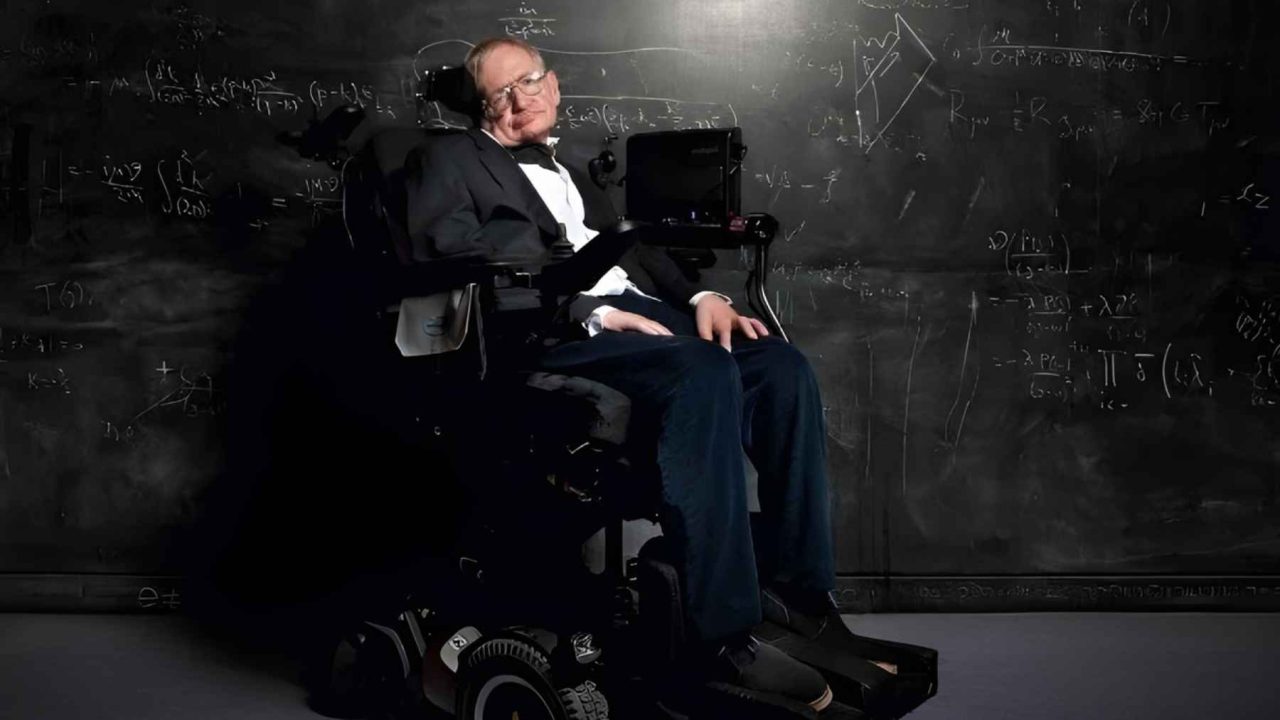
What separates a scientist who truly advances human understanding from one who simply reinforces what everyone already believes? According to Stephen Hawking, the answer has less to do with intelligence and more to do with intellectual honesty — specifically, the willingness to admit what you do not know.
Hawking’s often-cited observation — that the worst enemy of knowledge is not ignorance, but the illusion of knowledge — cuts to the heart of how science can go wrong. False certainty, the feeling that a question is already settled, is far more dangerous than a blank space on the map. At least ignorance leaves room for curiosity. The illusion of knowledge slams the door shut.
That philosophy wasn’t just a quotable line. It defined how Hawking worked, how he communicated, and why his voice carried weight far beyond academic physics.
The Man Behind the Quote: Who Stephen Hawking Was
Hawking was born in Oxford on January 8, 1942. As a child, he was not an obvious standout in the classroom, though classmates apparently saw something in him — they nicknamed him “Einstein.” He went on to study at University College, Oxford, before building a career that would eventually make him one of the most recognized scientists in the world.
Around his 21st birthday, Hawking was diagnosed with ALS — a disease that progressively damages the nerve cells responsible for controlling muscles. Doctors at the time gave him little time to live. That prognosis turned out to be dramatically wrong. He went on to work for decades, marry Jane Wilde, and raise three children.
The illness that was supposed to end his career early became, in a strange way, part of the story of his resilience. As ALS slowly took away his movement and then his natural speech, Hawking continued to research, publish, and communicate. He never stopped pushing.
Why the “Illusion of Knowledge” Warning Still Matters
Hawking spent his career in a field — cosmology — where the temptation to overstate certainty is enormous. The universe is vast, the questions are profound, and the pressure to appear authoritative is real. His consistent pushback against false certainty was not just philosophical posturing. It was a practical stance about how science actually works.
The illusion of knowledge shows up in many forms. It can be a researcher who stops questioning an assumption because the textbooks all agree. It can be a public figure who treats a contested scientific question as fully resolved. It can even be an entire field that mistakes consensus for completeness.
Hawking understood that the history of science is essentially a history of confident beliefs being overturned. What looks like settled ground has a way of shifting. The scientists who helped shift it were almost always the ones willing to say: we might be wrong about this.
Key Facts About Stephen Hawking’s Life and Career
| Detail | Information |
|---|---|
| Date of birth | January 8, 1942 |
| Place of birth | Oxford, England |
| University attended | University College, Oxford |
| Childhood nickname | “Einstein” |
| Age at ALS diagnosis | Around 21 |
| Spouse | Jane Wilde |
| Children | Three |
| Field of work | Cosmology and theoretical physics |
What that table cannot capture is the trajectory — the fact that a young man handed a devastating diagnosis went on to become a global scientific voice precisely because he refused to treat any limitation, personal or intellectual, as final.
What Made Hawking Different From Other Brilliant Scientists
Raw intelligence was never the thing that set Hawking apart. Physics has never been short of brilliant people. What distinguished him was a combination of two qualities that do not always travel together: rigorous skepticism and a genuine desire to bring ordinary people along for the journey.
He worked consistently to make cosmology feel accessible rather than exclusive. The idea that the nature of black holes, the origins of the universe, or the structure of time were topics only specialists could engage with was something he pushed against throughout his career. His ability to communicate complex ideas in plain language was not a side project — it was part of the mission.
That accessibility mattered because it connected directly to the warning about false knowledge. When science stays locked inside institutions and speaks only to insiders, the illusion of knowledge is harder to challenge. Public understanding creates public scrutiny. And public scrutiny is exactly what keeps scientific thinking honest.
The Real-World Relevance of Hawking’s Warning Today
It would be easy to treat Hawking’s observation as a historical curiosity — something wise a famous scientist once said. But the warning is arguably more relevant now than at any point in recent memory.
Across fields ranging from medicine to economics to climate science, debates about what we actually know versus what we think we know are playing out in public in real time. The illusion of certainty — on all sides of contested questions — continues to do exactly the damage Hawking described. It shuts down inquiry. It punishes doubt. It mistakes confidence for competence.
- Genuine knowledge requires ongoing questioning, not just initial discovery
- Certainty that hasn’t been tested is not the same as certainty that has
- The most dangerous scientific errors often come from people who stopped asking questions
- Communicating uncertainty honestly is itself a form of scientific integrity
These are not abstract principles. They describe the difference between science that advances understanding and science that simply defends existing positions.
What Hawking’s Legacy Actually Asks of the Rest of Us
Hawking’s life — from a childhood where he wasn’t obviously exceptional, through a diagnosis that should have ended everything, to decades of work that reshaped how the world thinks about the cosmos — is a case study in refusing to accept false limits.
The quote about ignorance and the illusion of knowledge is often shared as a clever line. But it carries a real obligation. If the illusion of knowledge is the true enemy, then the response isn’t just intellectual humility for its own sake. It’s active, ongoing curiosity — the willingness to keep asking even when the answers seem obvious.
That’s the part of Hawking’s legacy that doesn’t get discussed as often as the black holes or the synthesized voice. He modeled what it looks like to keep questioning, even under conditions that would have given anyone else permission to stop.
Frequently Asked Questions
Where was Stephen Hawking born and when?
Hawking was born in Oxford, England, on January 8, 1942.
What disease did Stephen Hawking have?
He was diagnosed with ALS — a disease that damages the nerve cells controlling muscles — around his 21st birthday.
Did doctors expect Hawking to live a long life after his diagnosis?
No. Doctors initially expected him to have only a short time to live, but he went on to work and live for decades after his diagnosis.
Did Hawking have a family?
Yes. He married Jane Wilde and raised three children.
What was Hawking’s childhood nickname?
His classmates nicknamed him “Einstein,” even though he was not considered a standout student at the time.
What field of science was Hawking known for?
Hawking was known for his work in cosmology and theoretical physics, and for making those subjects accessible to general audiences.




Leave a Reply