
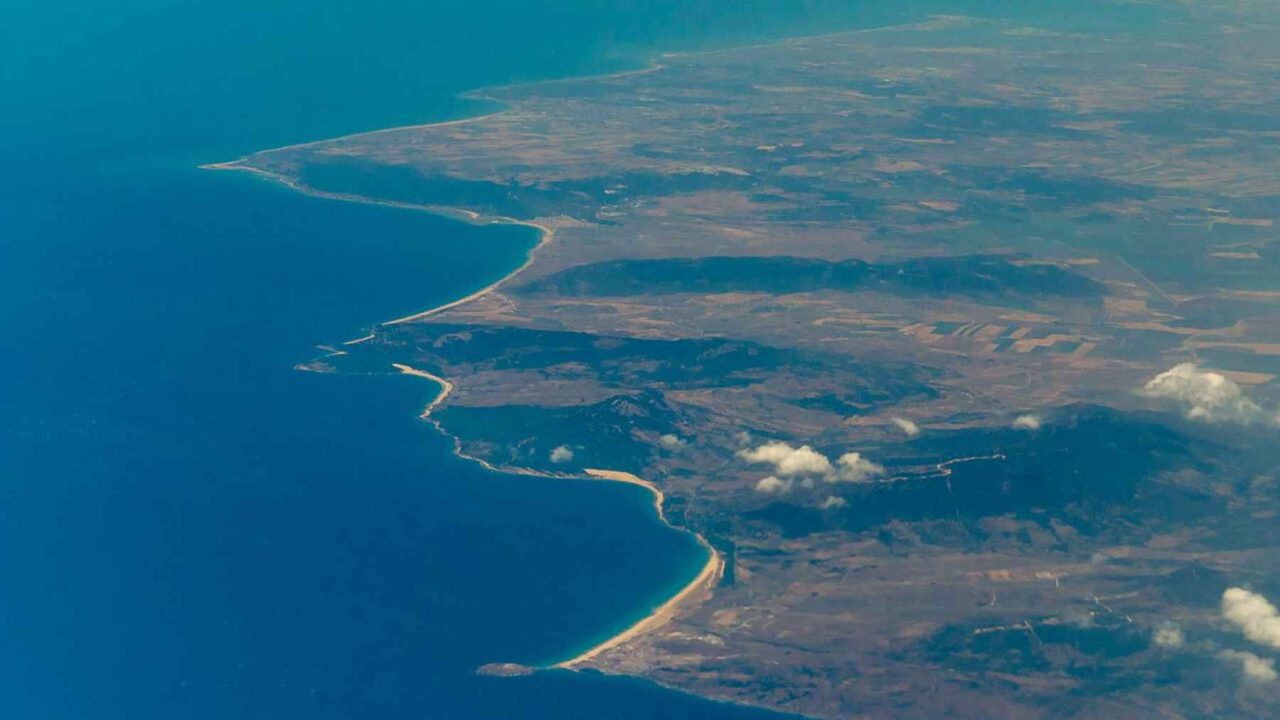
Headlines have been declaring that the Strait of Gibraltar is “about to disappear” — and the claim sounds alarming enough to stop anyone mid-scroll. But here is the part those headlines tend to leave out: the geology behind the story is real, the science is genuinely fascinating, and the actual timeline runs into the millions of years, not anything close to a human lifetime.
A new computer-model study confirms that the rocks beneath this famous waterway are shifting in ways that could eventually reshape the eastern Atlantic Ocean. The word “eventually” is doing a lot of work in that sentence, and understanding why matters more than the clickbait framing suggests.
So what is actually happening beneath one of the world’s most strategically important waterways — and what does it mean for the planet in the very long run?
What the Strait of Gibraltar Actually Is
The Strait of Gibraltar is a narrow, 36-mile-long waterway sitting between Spain and Morocco. It is the only natural connection between the Mediterranean Sea and the Atlantic Ocean, and it is one of the busiest maritime corridors on Earth, used daily by cargo ships, ferries, and naval vessels.
But beneath the surface, the strait sits in a geologically restless neighborhood. It occupies a zone near the boundary where the African and Eurasian tectonic plates push and grind against each other — the same kind of stress that produces earthquakes in the region.
On a geological map, the strait is not just a body of water. It is a marker of enormous forces that have been at work for tens of millions of years and will continue long after any human civilization is around to observe them.
The Science of Subduction — and Why It Matters Here
To understand what the new research is pointing toward, it helps to know what subduction actually means. Earth’s outer shell is not one solid surface. It is broken into massive slabs of rock called tectonic plates, and those plates move — slowly, but constantly.
When two plates collide, one can be forced downward beneath the other. That process is called subduction. The sinking plate bends and descends into Earth’s interior, and as it does, it can trigger earthquakes, feed volcanic systems, and recycle old seafloor material back into the deeper layers of the planet.
Most of the Atlantic Ocean floor today is not being subducted anywhere — it is largely stable and spreading outward. But the research suggests that the geology near Gibraltar may be setting up conditions that could change that picture over an extraordinarily long timeframe.
The computer modeling indicates that the geological stress and plate dynamics in this region are consistent with the early stages of a process that could, millions of years from now, lead to significant changes in how this part of the Atlantic is structured.
Key Facts About the Strait of Gibraltar and the Research
| Feature | Detail |
|---|---|
| Length of the strait | 36 miles |
| What it connects | Mediterranean Sea and Atlantic Ocean |
| Countries separated by the strait | Spain and Morocco |
| Tectonic plates involved | African plate and Eurasian plate |
| Research method used | Computer modeling |
| Projected timeline for geological changes | Millions of years |
A few things worth keeping in mind about the broader geological picture:
- Tectonic plates move slowly but continuously, building and releasing stress over vast timescales
- Subduction zones are associated with earthquakes and volcanic activity, making them significant for regional geology
- The African and Eurasian plates are already known to interact near the Gibraltar region, which is why the area experiences seismic activity
- Computer models are a standard tool in modern geology for projecting long-term planetary processes
- The new study adds to existing scientific understanding rather than representing a sudden or unexpected discovery
Why the Misleading Headlines Still Matter
It would be easy to dismiss the coverage as pure sensationalism and move on. But there is something worth taking seriously underneath the exaggeration.
The Strait of Gibraltar is genuinely one of the most geologically active zones in Europe and North Africa. The same plate boundary that the new research focuses on has produced significant earthquakes historically — the region is not geologically quiet, even on a human timescale.
Understanding how tectonic forces are evolving in this area has real practical value. Subduction processes, even in their early or speculative stages, inform how scientists model earthquake risk, volcanic potential, and long-term changes to sea-level dynamics in connected bodies of water like the Mediterranean.
The research is a reminder that the planet is not a static backdrop to human activity. It is an active, changing system — and the forces that shaped the Mediterranean world over millions of years are still operating today, just too slowly for any individual to perceive directly.
What Happens Over Millions of Years
The honest answer is that the Strait of Gibraltar is not closing, not disappearing, and not posing any threat to the ships crossing it today, tomorrow, or for any foreseeable future measured in human terms.
What the computer modeling suggests is that the geological setup beneath the strait may be part of a longer-term process involving subduction that could eventually alter the eastern Atlantic. “Eventually” here means timescales that dwarf all of recorded human history many times over.
For context, the Mediterranean Sea itself has gone through extraordinary transformations over geological time — including a period millions of years ago when it largely dried up before being refilled. The forces driving those kinds of changes are the same forces that the new research is examining. They are real, they are ongoing, and they are measured in millions of years.
That is not a reason to dismiss the science. If anything, it is a reason to find it more interesting — because it places the familiar geography of southern Europe and North Africa inside a much longer story that is still being written.
Frequently Asked Questions
Is the Strait of Gibraltar actually closing or disappearing?
No. The strait is not closing on any human timescale. Research suggests geological processes are underway that could reshape the region over millions of years, not decades or centuries.
How long is the Strait of Gibraltar?
The strait is 36 miles long and connects the Mediterranean Sea to the Atlantic Ocean, separating Spain from Morocco.
What tectonic plates are involved near the Strait of Gibraltar?
The African plate and the Eurasian plate meet near the strait, creating geological stress that can produce earthquakes in the region.
What is subduction, and is it happening at Gibraltar?
Subduction is the process where one tectonic plate is forced beneath another and sinks into Earth’s interior. The research suggests the geology near Gibraltar may be setting up conditions related to this process, but over an extremely long timeframe.
What method did researchers use to study the geology of the strait?
The study used computer modeling to analyze the shifting geology beneath and around the Strait of Gibraltar.
Does this research change anything for people living near the strait today?
The research does not indicate any new immediate risk. However, understanding the plate dynamics in this seismically active region has long-term value for earthquake and geological hazard modeling.



Leave a Reply