
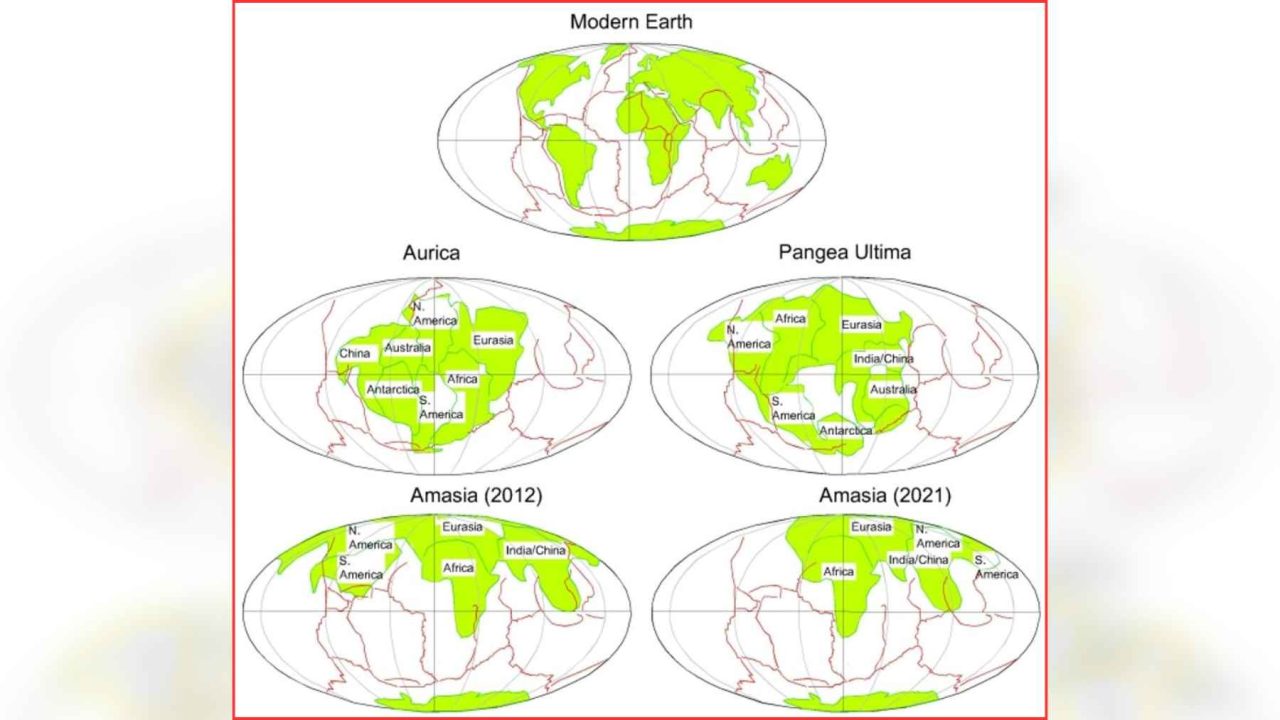
In roughly 200 to 250 million years, Earth’s scattered continents are expected to merge again into a single giant landmass — and new research suggests the consequences for complex land life, including any descendants of humanity, could be catastrophic. This isn’t science fiction. It is the natural continuation of a geological process that has already happened multiple times in our planet’s history.
Scientists have now combined plate tectonic models with powerful climate simulations to map out what that future supercontinent might look like — and what it would mean for the living world. The results are sobering. Depending on how the continents come together, Earth could tip into either a deep freeze or an extreme greenhouse, leaving only narrow coastal strips or polar refuges where complex life could survive.
The planet has done this before. It will do it again. The question researchers are now asking is: what will the world look like when it does?
The Supercontinent Cycle Earth Never Stopped Running
Most people think of ancient Pangea as a one-time geological oddity — a curiosity from the distant past. In reality, Earth moves through a long, repeating supercontinent cycle. Continents drift apart, then slowly come back together. The breakup of Pangea, which began around 200 million years ago, was not an ending. It was simply the latest chapter in an ongoing process.
Researchers led by Hannah Sophia Davies have outlined four main scenarios for how the next supercontinent could form, using plate tectonic rules and long-range reconstructions that project hundreds of millions of years into the future. Each scenario produces a radically different world — different geography, different climate, and very different odds for the survival of land animals.
The first option, often called Novopangea, keeps the Atlantic Ocean open while the Pacific closes. In this scenario, the Americas would eventually collide with a landmass formed from Africa, Europe, and other fragments, creating a supercontinent centered in the eastern hemisphere.
The other scenarios involve different combinations of ocean closures and continental collisions, each producing its own distinct geography and climate signature. Some configurations concentrate landmass near the equator, generating brutal heat. Others push land toward the poles, triggering ice ages. None of them look particularly comfortable for the kind of biodiversity Earth currently supports.
Four Futures, All of Them Extreme
The core finding of the research is that supercontinent formation does not just reshape coastlines — it fundamentally rewires the planet’s climate system. A single giant landmass creates vast interior regions completely cut off from ocean moisture. Temperatures in those interiors can swing wildly between seasons, and the overall heat balance of the planet shifts dramatically.
| Supercontinent Scenario | Key Mechanism | Likely Climate Outcome |
|---|---|---|
| Novopangea | Pacific closes; Atlantic remains open | Concentrated landmass; extreme interior conditions |
| Scenario 2 (equatorial formation) | Continents merge near equator | Intense greenhouse heat across interior |
| Scenario 3 (polar formation) | Landmass concentrates near poles | Deep freeze conditions; ice age potential |
| Scenario 4 (mixed formation) | Partial closures of multiple ocean basins | Narrow habitable coastal and polar refuges |
The research suggests that across most of these configurations, only narrow coastal strips or high-latitude refuges would remain hospitable for complex land life. The vast interior of any supercontinent would likely be either too hot, too dry, or too cold for most species to survive.
Why This Matters for Life on Earth — Including Us
The implications stretch well beyond geology. The research frames supercontinent formation as a potential mass extinction trigger — not through a sudden catastrophe like an asteroid strike, but through a slow, relentless transformation of the planet’s habitability.
Complex land animals, the category that includes mammals, reptiles, birds, and humans, are particularly vulnerable. They depend on stable temperatures, reliable rainfall, and functioning ecosystems. A world where the interior of a single giant continent bakes at lethal temperatures for months at a time, or freezes solid through extended polar winters, offers very little of that stability.
The research does not claim that life itself would end. Oceans would likely remain productive. Coastal zones and polar edges might support some species. But the rich diversity of land life that currently covers every continent? That could be dramatically reduced — or in many cases, eliminated entirely.
For any intelligent species existing at that time, the challenge would be unlike anything in recorded human history. Climate change driven by continental drift operates on timescales so vast that no single civilization could adapt its way out. The geography of the planet itself would become hostile.
What Happens Between Now and Then
It is worth keeping the timeline in perspective. We are talking about 200 to 250 million years from now — a span of time roughly equal to the entire period since the dinosaurs first appeared. In geological terms, that is not immediate. In human terms, it is essentially incomprehensible.
But the research matters now precisely because it illustrates how geology and climate are inseparable. The shape of the continents drives ocean circulation, which drives weather patterns, which determines where life can and cannot thrive. Understanding the deep past and the deep future of that system helps scientists build better models of how the Earth actually works — models that have direct relevance to understanding climate change today.
The plate tectonic reconstructions used in this research represent some of the most sophisticated long-range modeling ever attempted. They project not just where the continents will be, but what the resulting climate would look like — a combination that gives researchers an unprecedented window into Earth’s long-term future.
The planet has always been moving. It has always been changing. The next supercontinent is not a question of if. It is only a question of which version arrives — and what survives to see it.
Frequently Asked Questions
When will the next supercontinent form?
Scientists estimate the next supercontinent will form in roughly 200 to 250 million years, based on current plate tectonic models and the known speed of continental drift.
Who led the research into future supercontinent scenarios?
The research outlining the four main supercontinent formation scenarios was led by Hannah Sophia Davies and her colleagues, using plate tectonic models combined with climate simulations.
What is Novopangea?
Novopangea is one of four proposed names for the next supercontinent. In this scenario, the Pacific Ocean closes while the Atlantic remains open, eventually bringing the Americas into collision with Africa and Europe.
Could the next supercontinent cause a mass extinction?
The research suggests it could, by triggering extreme climate conditions — either intense greenhouse heat or deep freeze — across vast interior regions, leaving only narrow coastal or polar zones habitable for complex land life.
Would any life survive the formation of the next supercontinent?
The research does not suggest all life would end. Ocean ecosystems and narrow coastal or high-latitude refuges might remain habitable, but the diversity of complex land life could be dramatically reduced.
Is this related to current climate change?
While the timescales are vastly different, understanding how continental configuration drives climate helps scientists build better models of how the Earth’s climate system works — knowledge that has relevance to studying climate change today.

Leave a Reply